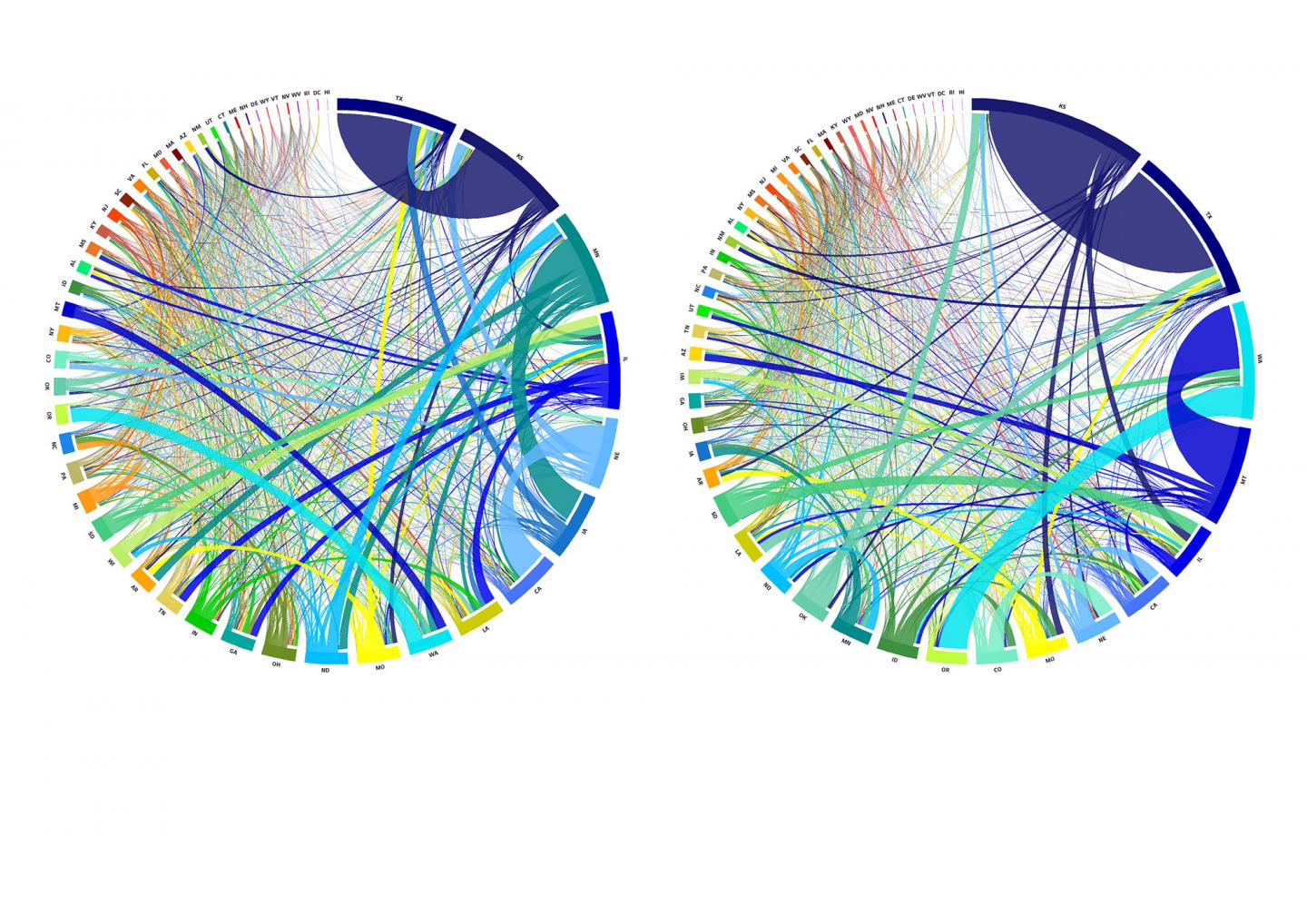
Credit: Swanson School of Engineering/Nemi Vora
PITTSBURGH (July 2, 2018) … Does producing one ton of rice consume more water in Arkansas or California? Is it more sustainable for Texas to import oranges from Florida or grow its own? Will switching to water efficient irrigation pumps reduce both water and energy footprint of food production?
To better integrate sustainability across multiple production systems, the National Science Foundation (NSF) awarded two professors from the University of Pittsburgh Swanson School of Engineering a $305,764 grant for their research into the interconnectivity of U.S. food, energy, and water resources. The research will focus on modeling the complex network of resources in the United States and strategies for optimizing sustainability in resource production and consumption with a focus on food, energy, and water systems.
"People tend to see food, energy, and water as individual diodes on a larger network, when they are more like a mesh of connections. This research is asking how you can model the nexus of these complex systems," says Vikas Khanna, associate professor of civil and environmental engineering at Pitt and principal investigator of the study.
The study titled "Modeling and Optimization of Sustainable and ResilienT FEW (MOST FEW) Networks" will use publicly available data from the U.S. Bureau of Transportation Statistics, the Department of Agriculture, and related organizations to examine the environmental sustainability of U.S. national food system with an emphasis on interstate trade. The researchers in particular will focus on identifying networks of "virtual resources."
"Virtual resources are those consumed in a process but not intended to be directly used in the exchange itself," Dr. Khanna explains. "For example, a large amount of water is consumed across the entire supply chain of corn. A singular focus on optimizing corn production could come at the expense of high water consumption or increased fertilizer use, or result in some other negative consequence if relationships within the system aren't better understood."
Joining Dr. Khanna on the study as co-principal investigator is Oleg Prokopyev, professor of industrial engineering. Dr. Prokopyev specializes in Operations Research and develops tools and algorithms for describing complex, mathematical relationships in networks. Their collaboration began after Dr. Khanna used similar techniques and principles to model the London public transit system. Dr. Prokopyev recognized their common research interests, and the two decided to collaborate on the current project.
Dr. Prokopyev says, "When looking at multiple objectives, most often efficiency with one thing will come at the expense of another. These are problems that don't really have easy solutions, but there are mathematical ways to describe the processes and help people visualize how their decisions impact the network."
During the grant period, the researchers hope to identify "hot spots" for improvement opportunities and provide a range of solutions that minimize environmental impact and maximize the efficiency of resource production and consumption.
"When your focus is sustainability, you always have a research application in mind," says Dr. Khanna. "We face real life problems every day that require tradeoffs like quality for price or personal preference for availability. In the same way consumers can make better decision by being more informed, modeling the food, energy, and water networks will help to inform better decision making about our national resource policies by government, industry, utilities, and more."
###
Media Contact
Paul Kovach, Director of Marketing and Communications
[email protected]
412-624-0265
http://www.pitt.edu
Original Source
https://www.engineering.pitt.edu/News/2018/Khanna-MOST-FEW-Grant/