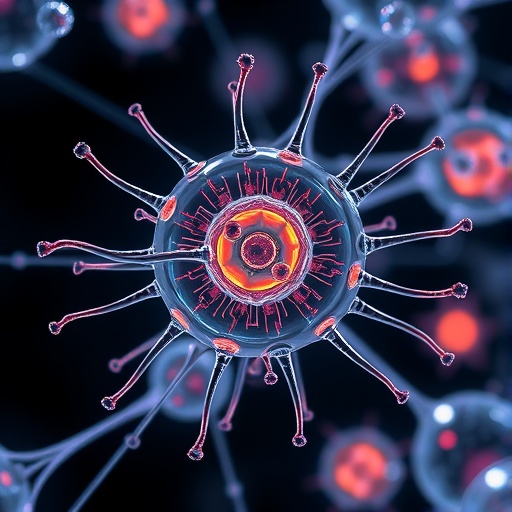
Researchers in Japan have reconstructed a key aspect of cellular behavior inside artificial cells, showing that a network of actin and myosin proteins can produce large-scale changes in cell shape—and even establish a front and rear—without the biochemical signaling systems normally associated with living cells. The study, led by Makito Miyazaki at the RIKEN Center for Integrative Medical Sciences in Japan in collaboration with researchers at Purdue University, demonstrates how relatively simple physical interactions can generate some of the defining features of cellular life.
The findings, published in Science Advances, address a central question in cell biology: how do molecular structures operating at microscopic scales produce coordinated changes across an entire cell? Living cells contain thousands of interacting molecules, making it difficult to determine which processes are essential and which are secondary. To isolate the underlying mechanics, the researchers created cell-sized liposomes, spherical membrane compartments that resemble primitive cells but lack the complex internal machinery of biological organisms.
Inside these liposomes, the team introduced purified components of the actomyosin cytoskeleton. Actin is a protein that polymerizes into filaments, while myosin motor proteins use chemical energy to slide along those filaments and generate contractile forces. In living cells, actomyosin networks help control movement, division, adhesion, and mechanical organization. By reconstructing the network from selected components, the researchers could observe how molecular-scale forces deform a membrane without interference from signaling pathways, organelles, or other cellular systems.
The experiments focused on membrane blebbing, a process in which the cell membrane briefly detaches from the underlying cortex and expands outward as a rounded, bubble-like protrusion. Blebs are involved in several forms of cell movement and can appear at the front or rear of migrating cells. They are also associated with cell division, programmed cell death, and changes in tissue architecture. Although blebs are familiar features of living cells, their formation is governed by a complicated combination of membrane tension, cortical contractility, adhesion, and fluid movement.
When the artificial cells were subjected to a specific physical manipulation, the actomyosin network generated a bleb that expanded in a consistent direction. The liposomes consequently developed a distinct asymmetry, with one region behaving differently from the opposite side. This result indicates that front-rear polarity does not necessarily require a pre-existing biochemical signal or an internal molecular compass. Instead, mechanical stresses within the cytoskeletal network can be sufficient to break the symmetry of an initially uniform cell-like system.
The researchers combined microscopy with large-scale computer simulations and theoretical analysis to connect the behavior of individual actin filaments and myosin motors to changes occurring across the entire liposome. The simulations showed how local contractions can redistribute mechanical stress, alter membrane attachment, and create conditions favorable for bleb formation. Once a protrusion appeared, changes in membrane tension and cytoskeletal organization helped stabilize and enlarge it, allowing a local event to become a cell-scale transformation.
This distinction between local and global mechanisms is important because membrane blebs can arise through more than one physical route. In some cases, contraction of the actomyosin cortex increases internal pressure and forces the membrane outward. In others, a local weakening of the connection between the membrane and cortex allows the membrane to balloon into the surrounding space. By reconstructing the system with controlled ingredients, the researchers were able to distinguish these mechanisms and examine how they interact during bleb formation and symmetry breaking.
“By reconstructing membrane morphogenesis from purified proteins, we showed that local interactions within the actin cytoskeleton are sufficient to generate large-scale changes in cell shape,” Miyazaki said. The result does not mean that biochemical signaling is unimportant in living organisms. Rather, it reveals that signaling may act by regulating a physical system whose basic capacity for shape change is already embedded in the properties of the cytoskeleton, membrane, and surrounding fluid.
The artificial-cell platform could become a useful tool for investigating how cells move, divide, and organize themselves during development. Because the system is quantitatively controllable, researchers can vary protein concentrations, membrane composition, network architecture, and mechanical constraints one factor at a time. The same approach could help identify the minimal ingredients required for other cellular behaviors, including force sensing, directed movement, and dynamic remodeling of internal structures.
The work also contributes to the long-term goal of building autonomous artificial cells. Future versions could incorporate molecular sensors, energy-generating reactions, or programmable biochemical circuits, allowing them to respond to their surroundings or perform specific tasks. Potential applications include drug delivery, regenerative medicine, synthetic biology, and the manufacture of biological compounds. For now, the study provides a fundamental lesson: some of the complexity associated with living cells can emerge from the physics of interacting molecules, even before sophisticated biological signaling networks are added.
Subject of Research: Not applicable
Article Title: Reconstitution of actomyosin networks in cell-sized liposomes dissects distinct mechanisms of membrane blebbing and symmetry breaking
Web References: https://doi.org/10.1126/sciadv.aed8818
References: Science Advances, DOI: 10.1126/sciadv.aed8818
Image Credits: RIKEN
Keywords: artificial cells, actomyosin networks, actin cytoskeleton, myosin, membrane blebbing, cell morphogenesis, symmetry breaking, cell polarity, liposomes, synthetic biology, cellular mechanics, RIKEN
Tags: actin and myosin cytoskeletonArtificial cellsbiophysical cell modelscell mechanicscell morphologycell motilitycellular front-rear polarizationcellular shape changescellular shape formationcytoskeletal dynamicsliposome modelsprimitive cell behavior