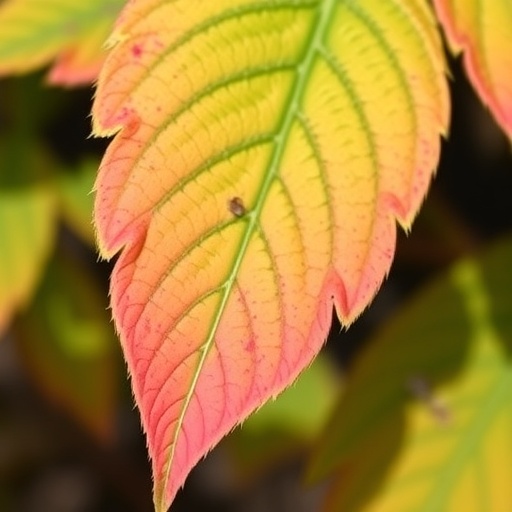
Fungal diseases that attack grain crops are beginning their assault long before the first visible lesion appears. The encounter starts on the leaf surface, where airborne spores land, sense chemical and physical cues, germinate, and attempt to establish an infection. A new study in Biointerphases argues that this microscopic contact zone should become a central target in the search for safer agricultural protection. Instead of relying primarily on broad-spectrum fungicides, researchers propose studying—and ultimately disrupting—the biointerface where plants and fungal pathogens first recognize one another.
The work, led by River J. Pachulicz and Bryan R. Coad of Adelaide University, applies concepts from biomaterials science to plant pathology. Biomaterials researchers routinely engineer uniform coatings and analyze how cells, proteins, and microbes respond when they encounter a surface. By transferring those techniques to plant-fungal interactions, the researchers created controlled experimental surfaces that reproduce one important feature of a leaf without involving living plant tissue. This approach allowed them to isolate the chemical contribution of the leaf surface from the complex geometry and biology of an intact leaf.
A leaf is covered by a thin protective layer known as the cuticle. Made largely of waxes and related compounds, the cuticle helps limit water loss and shields internal tissues from environmental stress. It is not simply an inert barrier, however. Increasing evidence suggests that the waxy layer can provide information to organisms that land on the plant, including fungal pathogens. The molecular composition of the cuticle, together with the arrangement of its surface compounds, may act as a chemical landscape that tells a spore whether it has reached a suitable host.
For a fungal spore, landing on a leaf is only the beginning of a sequence of decisions. It must attach to the surface, respond to humidity and other environmental conditions, produce a germ tube, and locate an appropriate site for penetration. Powdery mildew fungi are especially adapted to living on plant surfaces, where they form networks of hyphae and draw nutrients from host cells. Their ability to germinate depends on a combination of chemical signals, surface texture, water availability, and other physical properties. Understanding which cues matter most could reveal ways to interfere with infection before the fungus becomes established.
To investigate the cuticle’s role, the researchers deposited leaf wax onto non-biological substrates. The resulting biomimetic surfaces reproduced the chemical presence of the wax while removing much of the structural complexity found on a real leaf. Two types of powdery mildew were then tested on these coated surfaces. Both fungal species were able to germinate, demonstrating that cuticular wax itself can support or stimulate an early stage of fungal development, even in the absence of the underlying leaf structure.
That finding does not mean the wax is solely responsible for disease. On a living leaf, fungal behavior is influenced by many interacting variables. Surface roughness can affect how spores attach and where water collects. Wettability—the tendency of a surface to attract or repel water—can alter hydration and germination. Temperature, humidity, light, nutrient availability, and the physiological state of the plant also shape the outcome. The importance of the new experiment is that it separates one component of this complicated system, making it possible to study the chemical signals without the confounding effects of the whole plant.
The researchers’ longer-term goal is to identify the precise surface molecules that trigger host recognition. If particular wax components serve as fungal signals, future crop-protection technologies might be designed to mask, remove, imitate, or chemically alter those cues. A surface treatment could potentially make a leaf less recognizable to a pathogen, preventing germination or delaying infection. Such strategies remain speculative and would need to be tested for durability, environmental safety, compatibility with plant growth, and effects on beneficial organisms. Nevertheless, targeting recognition could offer a more selective alternative to repeatedly applying chemicals that affect a broad range of fungi.
This biointerface perspective could also change how scientists evaluate disease-resistant crops. Plant breeding programs often focus on genes involved in immunity or internal defense responses, but the first interaction takes place at the outermost surface. Differences in cuticle chemistry, microscopic structure, and water behavior may help explain why some plant varieties are more vulnerable than others. Combining surface analysis with fungal biology could allow researchers to identify protective traits that are difficult to see using conventional genetic or physiological measurements alone.
The study is an early step rather than a ready-made replacement for fungicides. The authors emphasize that foliar fungal disease emerges from synergistic and antagonistic interactions among chemistry, geometry, climate, and biology. Building a predictive picture will require collaboration among chemists, materials scientists, plant biologists, and fungal pathologists. By treating the leaf as an active biointerface rather than a passive barrier, the researchers hope to move crop protection upstream—to the moment when a spore first decides whether a plant is a viable host. Blocking that decision could eventually help protect grain production while reducing dependence on increasingly challenged fungicide treatments.
Subject of Research: Leaf cuticle–fungus interactions and biomimetic surfaces for preventing foliar fungal disease
Article Title: Addressing agricultural challenges through biomimetic surfaces: Reframing foliar fungal disease as a biointerface problem
News Publication Date: 4-Aug-2026
Web References: https://doi.org/10.1116/6.0005533; https://pubs.aip.org/avs/bip
References: Pachulicz, R. J., and Coad, B. R. “Addressing agricultural challenges through biomimetic surfaces: Reframing foliar fungal disease as a biointerface problem.” Biointerphases. DOI: 10.1116/6.0005533.
Image Credits: River J. Pachulicz and Bryan R. Coad
Keywords: fungal diseases, powdery mildew, leaf cuticle, plant pathology, biomimetic surfaces, biointerfaces, crop protection, fungicide resistance, agricultural science, plant-fungi interactions
Tags: airborne spores germinationbiointerface disruption for disease controlbiomaterials science in agriculturecrop disease early detectionCrop disease preventionfungal infection mechanismsinnovative agricultural protection strategiesleaf surface biointerfaceleaf surface modelingplant pathology and surface chemistryplant surface microenvironmentplant-fungal pathogen interactions