• HOME
  • NEWS
  • EXPLORE
    • CAREER
      • Companies
      • Jobs
    • EVENTS
    • iGEM
      • News
      • Team
    • PHOTOS
    • VIDEO
    • WIKI
  • BLOG
  • COMMUNITY
    • FACEBOOK
    • INSTAGRAM
    • TWITTER
Sunday, May 24, 2026
BIOENGINEER.ORG
No Result
View All Result
  • Login
  • HOME
  • NEWS
  • EXPLORE
    • CAREER
      • Companies
      • Jobs
        • Lecturer
        • PhD Studentship
        • Postdoc
        • Research Assistant
    • EVENTS
    • iGEM
      • News
      • Team
    • PHOTOS
    • VIDEO
    • WIKI
  • BLOG
  • COMMUNITY
    • FACEBOOK
    • INSTAGRAM
    • TWITTER
  • HOME
  • NEWS
  • EXPLORE
    • CAREER
      • Companies
      • Jobs
        • Lecturer
        • PhD Studentship
        • Postdoc
        • Research Assistant
    • EVENTS
    • iGEM
      • News
      • Team
    • PHOTOS
    • VIDEO
    • WIKI
  • BLOG
  • COMMUNITY
    • FACEBOOK
    • INSTAGRAM
    • TWITTER
No Result
View All Result
Bioengineer.org
No Result
View All Result
Home NEWS Science News Health

A Fox code for the face

Bioengineer by Bioengineer
June 26, 2018
in Health
Reading Time: 2 mins read
0
Share on FacebookShare on TwitterShare on LinkedinShare on RedditShare on Telegram
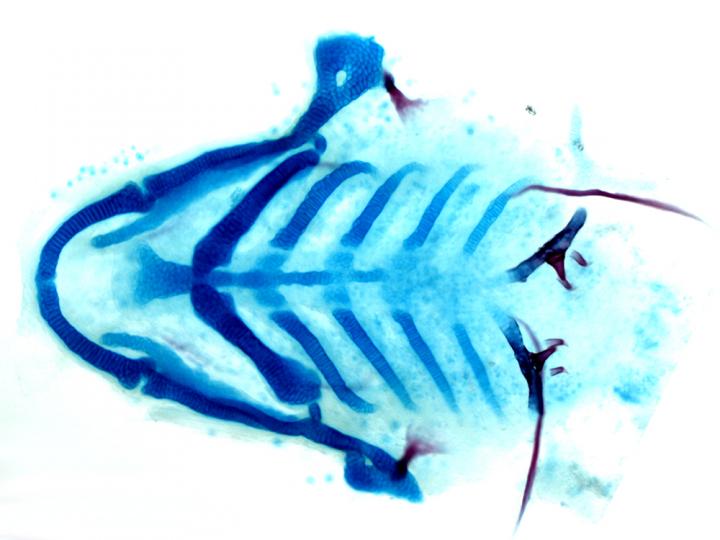
IMAGE

Credit: Image by Pengfei Xu/Crump Lab/USC Stem Cell

In the developing face, how do stem cells know whether to become cartilage, bones or teeth? To begin to answer this question, scientists from the USC Stem Cell laboratory of Gage Crump tested the role of a key family of genes, called "Forkhead-domain transcription factors," or Fox. Their findings appear in the journal Development.

While mutations in the Fox genes can cause diseases ranging from cancer to language disorders, postdoc Pengfei Xu and her collaborators focused on how these genes affect facial development.

"While examination of Fox genes in the mammalian face reveals they are required for bone and palate formation, whether Fox genes broadly control regional facial skeletal fates, as well as their mechanisms of action, remains unclear," said Xu.

To observe this, the team created mutant zebrafish that lacked different types of Fox–specifically, Fox-C genes or Fox-F genes. They found that fish lacking Fox-C failed to form cartilage in the upper face. Fish lacking Fox-F genes had problems developing their jaws, cartilage in the middle of their faces and teeth.

Further experiments revealed that Fox-C and Fox-F have a role in helping another important gene, Sox9, activate a slew of additional genes that promote cartilage development in the embryo.

Other laboratories have noted similar effects in mice lacking Fox genes. These findings suggest that the Fox genes play a role in the facial development of not only zebrafish and mice, but also many other vertebrate species, including humans.

"Transcription factors like Sox9 play roles in many different organs in the body," said Crump, who is a professor of stem cell biology and regenerative medicine at USC. "This tour-de-force genetic study shows how a family of Fox factors direct cells to form only cartilage and teeth and not other cell types. This may help in strategies toward directing stem cells to form cartilage and teeth for future regenerative medicine applications."

###

Additional co-authors include Bartosz Balczerski, Amanda Ciozda and Kristin Louie from USC, and Veronika Oralova and Ann Huysseune from Ghent University in Belgium.

The research was funded by the National Institutes of Health (R01-DE018405 and R35-DE027550).

Media Contact

Cristy Lytal
[email protected]
@keckmedusc

Keck Medicine of USC

Original Source

https://stemcell.keck.usc.edu/a-fox-code-for-the-face/

Share12Tweet8Share2ShareShareShare2

Related Posts

RBM20 Isoform Control Shapes Splicing in Health

May 24, 2026

ZNF274 Blocks Lineage Switch, Fuels CDK7 Drug Resistance

May 24, 2026

Evaluating School Policies During COVID-19 Pandemic

May 24, 2026

Deep Phenotyping Reveals Skin Remodeling in Sclerosis Treatment

May 24, 2026
Please login to join discussion

POPULAR NEWS

  • ESMO 2025: mRNA COVID Vaccines Enhance Efficacy of Cancer Immunotherapy

    313 shares
    Share 125 Tweet 78
  • New Study Reveals Plants Can Detect the Sound of Rain

    734 shares
    Share 293 Tweet 183
  • Research Indicates Potential Connection Between Prenatal Medication Exposure and Elevated Autism Risk

    847 shares
    Share 339 Tweet 212
  • Common Food Preservatives Associated with Elevated Blood Pressure and Increased Heart Disease Risk

    55 shares
    Share 22 Tweet 14

About

We bring you the latest biotechnology news from best research centers and universities around the world. Check our website.

Follow us

Recent News

Sepsis from C. difficile Infection Has Comparable Mortality

Mortality Trends in Dallas Very Preterm Neonates, 1977–2024

Nanofiber Self-Adhesive Electrode with PEDOT, Polyurethane

Subscribe to Blog via Email

Success! An email was just sent to confirm your subscription. Please find the email now and click 'Confirm' to start subscribing.

Join 83 other subscribers
  • Contact Us

Bioengineer.org © Copyright 2023 All Rights Reserved.

Welcome Back!

Login to your account below

Forgotten Password?

Retrieve your password

Please enter your username or email address to reset your password.

Log In
No Result
View All Result
  • Homepages
    • Home Page 1
    • Home Page 2
  • News
  • National
  • Business
  • Health
  • Lifestyle
  • Science

Bioengineer.org © Copyright 2023 All Rights Reserved.