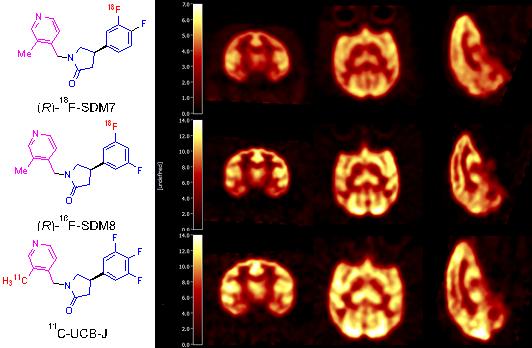
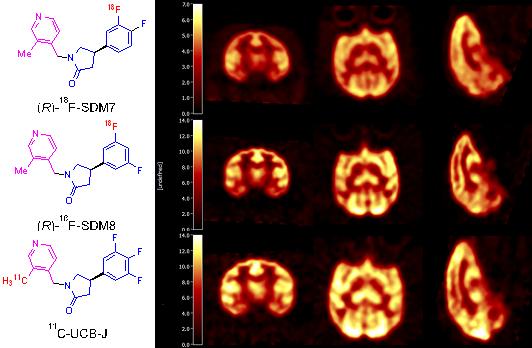
Credit: Z Cai and S Li et al., Yale University, New Haven, Conn.
PHILADELPHIA – New nuclear medicine tracers could help medical researchers find a cure for Alzheimer's and other neurodegenerative diseases. The research was presented today at the SNMMI 2018 Annual Meeting, June 23-26 in Philadelphia.
The development of therapies for neurodegenerative diseases has been hampered by the lack of a reliable and sensitive method to detect disease early and to effectively monitor the performance of experimental drugs. Synapse loss is one of the earliest and most robust biomarkers for Alzheimer's disease, and quantification of synaptic density in the central nervous system could be used to detect a variety of neurodegenerative diseases at their earliest stage, track disease progression and monitor the effect of therapy.
Positron emission tomography (PET) imaging can obtain crucial information about synaptic density that cannot be acquired through other approaches. Previous research identified a radiotracer (11C-UCB-J) for the synaptic vesicle protein 2 (SV2A) that was successfully used to image synaptic density in vivo; however, its characteristics were not conducive to clinical use.
"We set out to develop 18F-labeled SV2A tracers with imaging characteristics comparable to those of 11C-UCB-J," said Zhengxin Cai, PhD, of the Department of Radiology and Biomedical Imaging at Yale University. Cai, together with Songye Li, PhD, and colleagues from the Yale PET Center, were able to successfully synthesize and evaluate a number of novel SV2A tracers with attractive imaging properties: high brain uptake, fast tissue kinetics, and high specific binding signals in the brain. "With a longer half-life," Cai said, "our new tracers are suitable for multicenter clinical trials, routine clinical use and potential commercialization."
As new generations of drugs are undergoing clinical trials for neurodegenerative diseases, the new radiotracers will be able to facilitate the development of therapies, providing a novel tool for identifying which patients may benefit from a particular treatment and then for assessing its therapeutic effect.
"The successful development of our new SV2A PET tracers for synaptic density imaging and their use in the study of a variety of neurologic and psychiatric disorders will play a crucial role in CNS drug discovery and development," said Yiyun Henry Huang, professor of Radiology and Biomedical Imaging, Director of Chemistry at the Yale PET Center, and senior author of the research presented at the meeting.
Abstract 69: "In vivo imaging evaluation of a novel 18F-labeled SV2A PET tracer in nonhuman primates," Zhengxin Cai, Songye Li, Daniel Holden, Shu-fei Lin, Anupama Shirali, Paul Emery, Michael Kapinos, Jim Ropchan, Nabeel Nabulsi, Richard E. Carson and Yiyun Huang, Yale University, New Haven, CT; and Wenjie Zhang, West China Hospital, New Haven, CT. SNMMI 2018 Annual Meeting, June 23-26, 2018, Philadelphia.
Link to Abstract 69
###
RELATED ABSTRACT
Abstract 68: "18F-SDM-8: A novel radiotracer for PET imaging of synaptic density," Songye Li, Zhengxin Cai, Daniel Holden, Nabeel Nabulsi, David Labaree, Anupama Shirali, Jo-ku Teng, Richard E. Carson, Yiyun Huang, PET Center, Yale University, New Haven, CT. SNMMI 2018 Annual Meeting, June 23-26, 2018, Philadelphia.
Link to Abstract 68
Please visit the SNMMI Media Center for more information about molecular imaging and personalized medicine. To schedule an interview with the researchers, please contact Laurie Callahan at 703-652-6773 or [email protected]. 2018 SNMMI Annual Meeting abstracts can be found online at http://jnm.snmjournals.org/content/59/supplement_1. Current and past issues of The Journal of Nuclear Medicine are online at http://jnm.snmjournals.org.
ABOUT THE SOCIETY OF NUCLEAR MEDICINE AND MOLECULAR IMAGING
The Society of Nuclear Medicine and Molecular Imaging (SNMMI) is an international scientific and medical organization dedicated to advancing nuclear medicine and molecular imaging, vital elements of precision medicine that allow diagnosis and treatment to be tailored to individual patients in order to achieve the best possible outcomes.
SNMMI's more than 16,000 members set the standard for molecular imaging and nuclear medicine practice by creating guidelines, sharing information through journals and meetings and leading advocacy on key issues that affect molecular imaging and therapy research and practice. For more information, visit http://www.snmmi.org.
Media Contact
Laurie F Callahan
[email protected]
@SNM_MI
http://www.snm.org
Original Source
http://www.snmmi.org/NewsPublications/NewsDetail.aspx?ItemNumber=29462