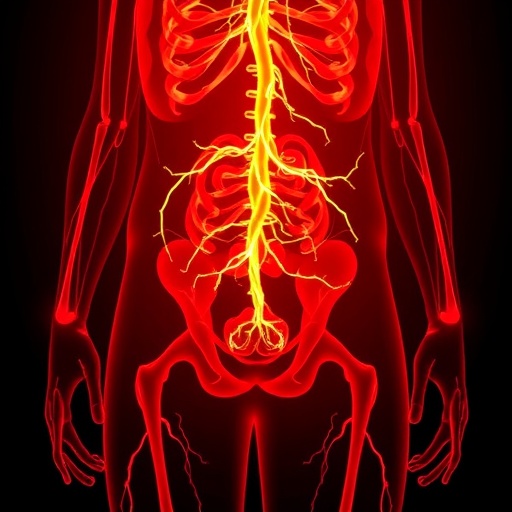
Credit: Digestive Disease Week(R)
Washington, DC (June 5, 2018) — Utilizing newly adapted artificial intelligence, researchers have developed an acoustic belt that offers a new way to diagnose irritable bowel syndrome (IBS) by listening to the noises in a patient's gut, according to research presented at Digestive Disease Week® (DDW) 2018 (http://www.ddw.org).
Study implications
"IBS is an extremely common disorder that is notoriously difficult to diagnose. We wanted to find a way to listen to the rumblings and grumblings of the gut to identify patterns that characterize chronic gut conditions, like IBS," said Barry Marshall, AC, FRACP, FAA, FRS, MBBS, Nobel Laureate, director of the Marshall Centre at the University of Western Australia and a lead researcher on the study. "We used acoustic sensing technology that was originally created to track the munching sounds of termites to see if we could detect problems in the human gut."
Marshall received the 2005 Nobel Prize in Physiology or Medicine with collaborator J. Robin Warren for the unexpected discovery of the bacterium Helicobacter pylori and its role in gastritis and peptic ulcer disease.
IBS is a common and often painful condition that causes bloating, diarrhea and constipation. It is estimated to affect more than 10 percent of the world's population. However, IBS can be difficult to diagnose and often requires patients to undergo a colonoscopy. Many patients with IBS go undiagnosed and, therefore, untreated.
Study design
In this preliminary study, researchers developed a basic prototype belt that uses machine learning techniques to identify complex features and patterns of the sounds collected from within the abdomen. They recruited study participants with an existing clinical diagnosis of IBS or with healthy digestive systems. Participants wore the belt and their bowel sounds were recorded for two hours post-fasting, and then for 40 minutes after a standardized meal.
Study results
The preliminary results showed that the acoustic index output of the belt predicts IBS with high accuracy, allowing researchers to effectively differentiate between the two groups. Recordings from the first 31 IBS and 37 healthy participants were used to build the IBS acoustic index model. A statistical method called "leave one out cross-validation" was used with this data set and yielded 90 percent sensitivity and 92 percent specificity for IBS diagnosis. Independent testing using the next 15 IBS and 15 healthy subjects revealed 87 percent sensitivity and 87 percent specificity for IBS diagnosis.
"This study allowed us to achieve proof of concept. Once we further develop the belt and test it on more patients, this tool will be intended for use in primary care settings for the diagnosis of IBS," said Josephine Muir, PhD, associate director of the Marshall Centre at the University of Western Australia, another researcher on the study. "The hope is that this new technology can offer a less- invasive way to diagnose this painful, and sometimes debilitating, condition."
###
DDW Presentation Details
Barry Marshall will present data from the study, "Non-invasive diagnosis of irritable bowel syndrome via novel bowel sound features: proof of principle," abstract Tu2017, on Tuesday, June 5, at 9:30 a.m. EDT. For more information about featured studies, as well as a schedule of availability for featured researchers, please visit http://www.ddw.org/press. The McCusker Charitable Foundation funded the research.
Digestive Disease Week® (DDW) is the largest international gathering of physicians, researchers and academics in the fields of gastroenterology, hepatology, endoscopy and gastrointestinal surgery. Jointly sponsored by the American Association for the Study of Liver Diseases (AASLD), the American Gastroenterological Association (AGA) Institute, the American Society for Gastrointestinal Endoscopy (ASGE) and the Society for Surgery of the Alimentary Tract (SSAT), DDW takes place June 2-5 at the Walter E. Washington Convention Center in Washington, DC. The meeting showcases more than 5,000 abstracts and hundreds of lectures on the latest advances in GI research, medicine and technology. More information can be found at http://www.ddw.org.
Media Contact
Aimee Frank
[email protected]
301-941-2620