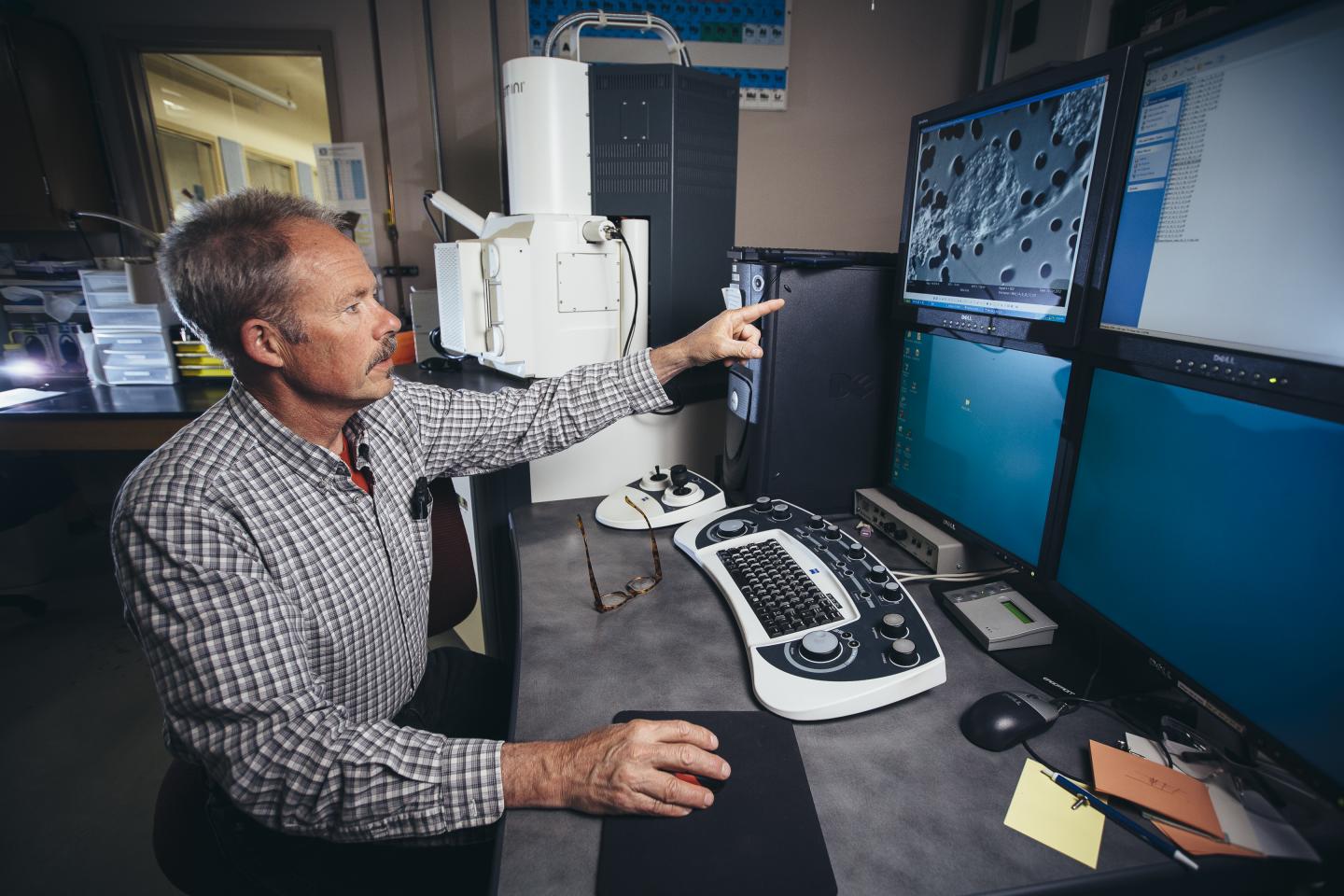

Credit: MSU Photo by Adrian Sanchez-Gonzalez
BOZEMAN — Montana State University scientists have found a new lineage of microbes living in Yellowstone National Park's thermal features that sheds light on the origin of life, the evolution of archaeal life and the importance of iron in early life.
Professor William Inskeep and his team of researchers published their findings May 14 in the scientific journal Nature Microbiology.
"The discovery of archaeal lineages is critical to our understanding of the universal tree of life and evolutionary history of the Earth," the group wrote. "Geochemically diverse thermal environments in Yellowstone National Park provide unprecedented opportunities for studying archaea in habitats that may represent analogues of early Earth."
Archaea is one of the three domains of life, the others being bacteria and eukaryotes. Like bacteria, archaea are single-cell organisms. The eukaryote domain contains more cellularly complex organisms, such as humans, other animals, plants and fungi.
The scientists called the new archaeal lineage Marsarchaeota after Mars, the red planet, because these organisms thrive in habitats containing iron oxides. Within Marsarchaeota, they discovered two main subgroups that live throughout Yellowstone and thrive in hot, acidic water where iron oxide is the main mineral. One subgroup lives in water above 122 degrees Fahrenheit, and the other lives in water above 140 to 176 degrees. The water is about as acidic as grapefruit juice. Their microbial mats are red because of the iron oxide.
"It's interesting that the habitat of these organisms contains (iron) minerals similar to those found on the surface of Mars," Inskeep said.
He added that microbes produce iron oxide, but the Marsarchaeota do not. They might be involved in reducing iron into a simpler form, "which is important from an early Earth standpoint. Iron cycling has been implicated as being extremely important in early Earth conditions."
The Marsarchaeota live fairly deep in microbial mats, but they still require low levels of oxygen, Inskeep said. The subgroups are so abundant that, together, they can account for as much as half of the organisms living within a single microbial mat.
The scientists studied microbial mats throughout Yellowstone. Microorganisms in these "microbial beaver dams" produce iron oxide that creates terraces, which, in turn, block streams. As water (only a couple of millimeters deep) runs over the terraces, oxygen is captured from the atmosphere and supplied to the Marsarchaeota.
"Physics comes together with chemistry and microbiology," Inskeep said. "It's like a sweet spot of conditions that this group of organisms likes."
In addition to learning more about life on early Earth and the potential for life on Mars, Inskeep said the research can help scientists understand more about high-temperature biology.
"Knowing about this new group of archaea provides additional pieces of the puzzle for understanding high-temperature biology," he said. "That could be important in industry and molecular biology."
The work that resulted in the Nature Microbiology paper was the culmination of research that took place over the past decade, said Inskeep, who has studied the geochemistry and microbiology of Yellowstone's high-temperature environments for the last 20 years. Inskeep is a professor of geomicrobiology in MSU's Department of Land Resources and Environmental Sciences in the College of Agriculture and co-founder of MSU's Thermal Biology Institute.
The lead authors of the Nature Microbiology paper earned their doctorates at MSU and were part of NSF's Integrative Graduate Education and Research Traineeship (IGERT) program while at MSU. Zackary Jay is now a postdoctoral researcher in the Department of Chemical and Biological Engineering in the Norm Asbjornson College of Engineering and the Center for Biofilm Engineering at MSU. Jacob Beam is now a postdoctoral researcher at Bigelow Laboratory for Ocean Sciences at East Boothbay, Maine.
"In the end, after many years of work, it's exciting, and a relief, to have our team's work recognized and published, particularly in a high impact journal," Jay said.
###
Other co-authors were Mensur Dlakic from MSU's Department of Microbiology and Immunology in the College of Letters and Science and College of Agriculture; Douglas Rusch from the Center for Bioinformatics at Indiana University; and Mark Kozubal from the Thermal Biology Institute, MSU's Department of Land Resources and Environmental Sciences, and Sustainable Bioproducts in Bozeman.
The Yellowstone research was a collaboration involving the Thermal Biology Institute, the Montana Agriculture Experiment Station (MAES) and the Yellowstone Center for Resources (National Park Service). Funding came from IGERT, the Pacific Northwest National Laboratory and MAES. The U.S. Department of Energy Joint Genome Institute in Walnut Creek, California, sponsored the genetic sequencing.
Media Contact
William Inskeep
[email protected]
406-570-0916
@montanastate?lang=en
http://www.montana.edu
Original Source
http://www.montana.edu/news/17737/msu-scientists-discovery-in-yellowstone-extremely-relevant-to-origin-of-life http://dx.doi.org/10.1038/s41564-018-0163-1