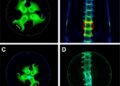
Credit: Brendan Colvert, Mohamad Alsalman, Eva Kanso
The shape of water. Can it tell us about what drives romance? Among fish, it might. Eva Kanso, a professor of Aerospace and Mechanical Engineering at the USC Viterbi School of Engineering studies fluid flows and almost like a forensic expert, Kanso, along with her team, is studying how aquatic signals are transported through the water.
When it comes to mating, tiny crustaceans called copepods are one of the most abundant multi-cellular organisms, says Kanso, the Zohrab Kaprielian Fellow in Engineering.
To locate their mate, male copepods search for and follow the hydrodynamic and chemical trail of the female. Scientists like Kanso believe aquatic organisms transmit and read information through the movements they make and the wakes they leave behind in the water. Harbor seals, for example, have been shown to track the wake of a moving object, even when the seal is blindfolded and initially acoustically-masked. Researchers believe the flow of water encodes a pattern of information–a type of language by which an organism can call another to mate, use to avoid predators or even in the case of salmon, begin upstream migration.
Just as a seagull's footprint in the sand is different than a human's, every moving body in the water generates a different pattern or wake based on certain factors such as the size of the body that created it or the speed at which it is moving (a fast-swimming and scared animal might generate a distinct wake by the more frequent and faster beat of its tail). Kanso would like to understand how these water flow patterns are perceived at a local level, by an organism or a bio-inspired vehicle, and decode them to ascertain what's happening in the water at a larger scale.
Using a computational physics model, Kanso, and PhD students Brendan Colvert and Mohamad Alsalman, generated various fluid flow patterns, then using machine learning, trained an algorithm to correctly identify these fluid patterns, achieving 99 percent accuracy. By doing this, the researchers developed an algorithm to, in a sense, mimic an aquatic sensory intelligence with regards to the patterns created in water. It is one of the first instances in which machine learning was applied to characterizing patterns in fluid flows.
Why does it matter? Consider how technologies have evolved based on the way a bat generates awareness of an environment. Just as sonar waves are used by submarines to actively probe their environment, there could be navigational uses for knowledge of water patterns under the sea. Without GPS, underwater vehicles equipped with sensors that are trained with such algorithms could, in principle, detect vehicles of a particular size and speed, known to generate certain flow patterns. By the same token, understanding the patterns that make a given wake detectable could help design underwater vehicles that leave behind inconspicuous wakes.
Kanso and her team are now testing these algorithms on real-life data and extending their scope to spatially-distributed networks of sensors that have the potential to create more robust and accurate maps of the flow patterns.
###
Kanso's research conducted with Brendan Colvert and Mohamad Alsalman, is supported by the Department of Defense (Office of Naval Research, Army Research Office, and NDSEG program) and documented in "Classifying vortex wakes using neural networks." The article was recently published in Bioinspiration & Biomimetics.
Media Contact
Amy Blumenthal
[email protected]
917-710-1897
@USC