Credit: Pixabay.com / PollyDot
Defying gravity: A special mixture of proteins in the larval food of bees ensures that future queen larvae survive. Surprisingly this has less to do with nourishment than with gravity. The special properties of the proteins prevent the large and heavy larvae from falling out of their cells. Researchers at Martin Luther University Halle-Wittenberg (MLU) have discovered how this is accomplished at a molecular level. Their study will appear in the internationally renowned journal Current Biology.
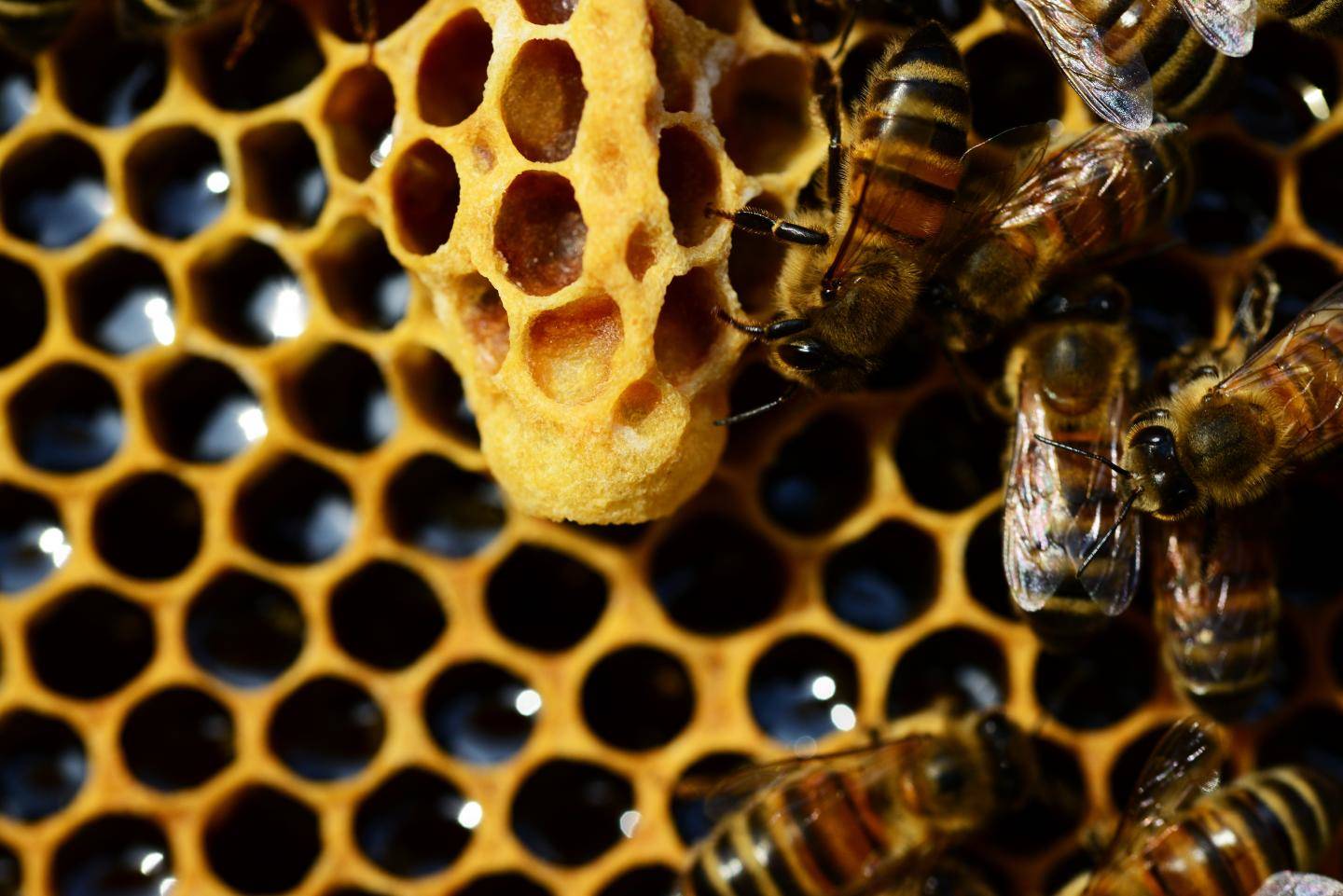
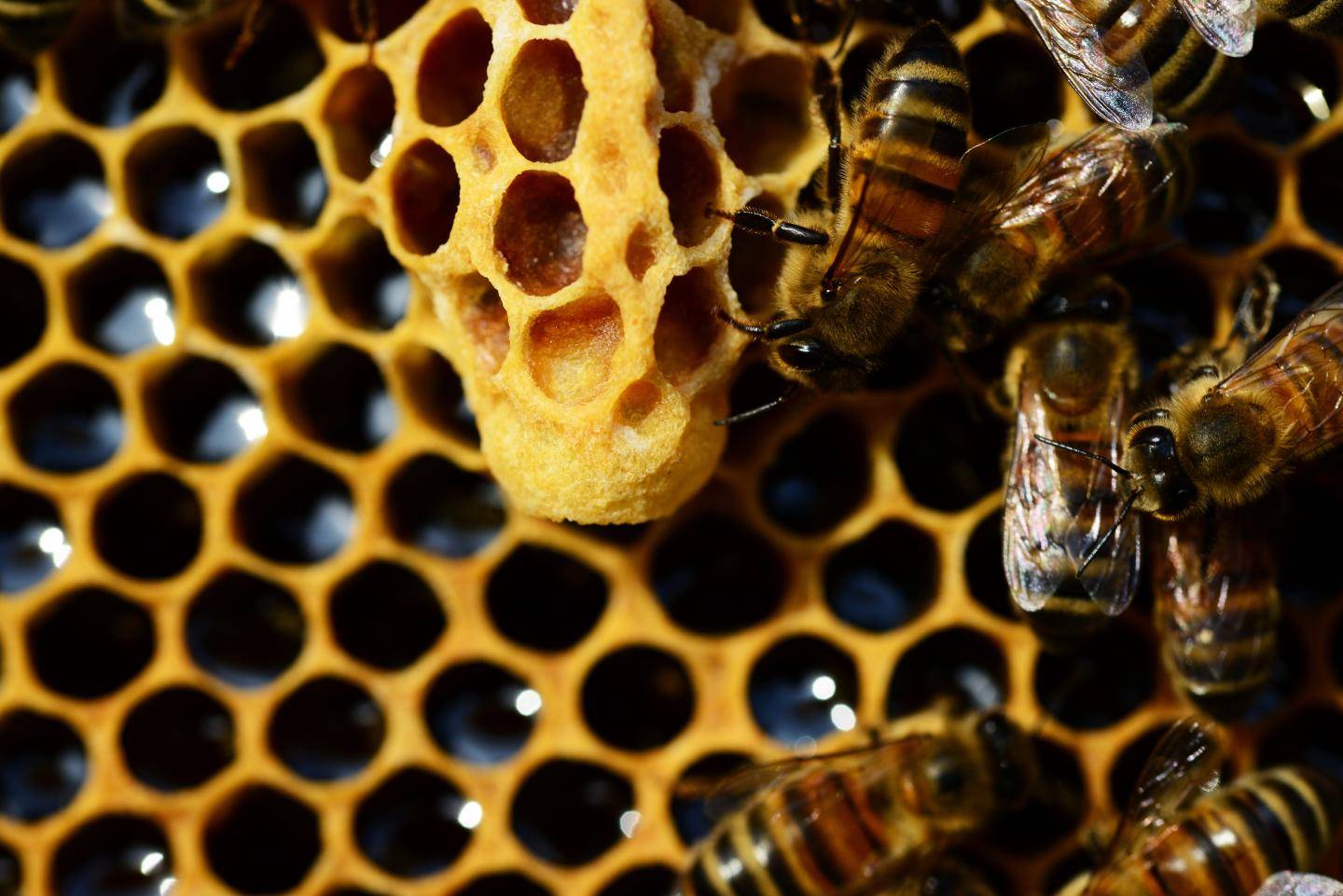
Because queen larvae are large, they cannot be raised in the normal worker bee cells of a honeycomb. "The bees build special queen cells for the royal offspring which are attached to the lower edge of a honeycomb. The larvae developing in these cells, are essentially hanging from the ceiling, and somehow have to avoid falling out of the cell," explains Dr Anja Buttstedt, a biologist who carried out the study at MLU's Institute of Biology under the supervision of Professor Robin Moritz. Currently she is conducting research at the Center for Molecular Bioengineering at TU Dresden.
Honeybees feed queen larvae exclusively with royal jelly secreted from their hypopharyngeal glands. This contains all of the nutrition the larvae need to develop into queens. "For decades, researchers have searched for a specific substance in the royal jelly that causes larvae to develop into queen bees rather than worker bees. In recent decades the focus has shifted to the proteins contained within it," says biologist Robin Moritz. In 2011, the Japanese scientist Masaki Kamakura caused a stir when he claimed to have discovered a protein that enables all larvae to develop into queens when consumed: the protein MRJP1, also referred to as royalactin. However, the research team from Halle was able to refute this claim in 2016. "But because MRJP1 is quantitatively the main protein in royal jelly, we felt that the protein must have a special function," continues Moritz.
In earlier studies the scientists noticed, somewhat coincidently, that royal jelly becomes much more fluid in the absence of this protein. This led the group from Halle to examine the structure of MRJP1. They discovered that when it is in a slightly acidic solution of pH value of 4.0 and is combined with the protein apisimin, a fibre-like structure forms that resembles a string of pearls. Since royal jelly usually has the same slightly acidic pH value, the researchers sought to discover what the function of this fibre-like structure might be. In collaboration with biotechnologists and pharmacists at MLU and the Fraunhofer Institute for Microstructure of Materials and Systems IMWS, the biologists identified that only a pH value of 4.0 ensures that the royal jelly develops fibre-like structures that make it viscous enough to keep the queen larvae from falling out of their cells. "When we artificially increased the pH, not only did the larval food become much more fluid, the larvae fell out of their cells and were unable to fully develop," says Buttstedt. If this happened the entire bee colony would be at risk since it would not be able to rear young queens to replace the old queen. The continued existence of the colony is dependent on queen larvae remaining in their cells with the glue provided by the royal jelly proteins.
The team of researchers was also able to prove that the proteins MRJP1 and apisimin are solely responsible for the functional viscosity of the royal jelly. Even a purified mixture that only consisted of the two proteins changed its viscosity in relation to the pH value. "This shows that the role of MRJP1 in royal jelly is in no way unspectacular. The protein plain and simply ensures the survival of the bee colony – though in a way entirely different than initially thought," says Buttstedt in conclusion.
###
Media Contact
Tom Leonhardt
[email protected]
49-345-552-1438
http://www.uni-halle.de
Original Source
http://pressemitteilungen.pr.uni-halle.de/index.php?modus=pmanzeige&pm_id=2849 http://dx.doi.org/10.1016/j.cub.2018.02.022