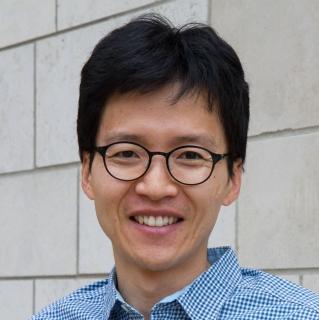
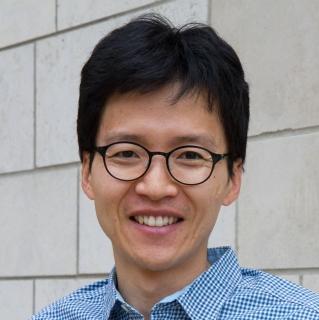
Credit: UMass Amherst
AMHERST, Mass. – Cognitive neuroscience researcher Joonkoo Park at the University of Massachusetts Amherst, who recently received a five-year, $751,000 faculty early career development (CAREER) grant from the National Science Foundation (NSF) to address basic research questions about how our brains process number and magnitude and how such processes give rise to more complex mathematical thinking, has co-authored a paper that reports this week where in the brain numerical quantity evaluation is processed.
In a series of experiments, Park and colleagues at Carnegie Mellon University used a psychophysical method that allowed them to "explore the extent to which the adult human subcortex contributes to number processing," in particular to distinguish between cortical and subcortical involvement. Details appear in the current online edition of Proceedings of the National Academy of Sciences.
As Park explains, people can tell at a quick glance the difference between 8 and 10 apples without counting them. "It's called number sense, and it's evolutionarily ancient," he notes. "That is, we share this ability with other primates, mammals, birds and fish. Even babies can discriminate between 10 and 20 dots well before they learn to count."
In the recent study led by Marlene Behrmann at Carnegie Mellon, Park and colleagues measured college students' performance in making numerical judgments on two dot array images presented very briefly one after another. Sometimes these two images were presented to a single eye (monocular presentation), and other times these two images were presented to different eyes (dichoptic presentation).
Under the monocular, but not the dichoptic, presentation, the visual information reaches the same subcortical structure. So, if participants do better in the monocular condition compared to the binocular condition, one can conclude that the subcortex is involved in numerical judgment. Indeed, the researchers found that participants performed better under monocular presentation when making the numerical judgment, especially when they discriminated two dot arrays with large ratios (4:1 or 3:1).
While it has been well established that humans share such a primitive numerical ability with other animals and even invertebrates, the brain basis of such an ability has been largely unknown, Park explains. This is because many other animals known to possess such a numerical ability have very limited computational power provided by the cortex. This new finding suggests that the coarse, primitive numerical ability shared across many species stems from the subcortex, an evolutionarily older brain structure.
With his CAREER grant, Park plans to study further questions that remain about the nature of this skill. Understanding mathematical ability is not only of interest to basic neuroscience but to educators who want to improve math education, he says. Similar to language development, the creation and use of mathematics is uniquely human, yet little is understood about the cognitive and neural processes that support it.
The neuroscientist points out that some research suggests that the sense of magnitude, which allow us to judge which is more and which is less without counting or using numerical symbols, provides a rudimentary foundation for mathematical thinking. But the picture is far from complete.
He says, "My research interest revolves around the neural basis of numerical cognition, its development, and individual differences, such as who is good at learning numbers and math, who is not, and why."
One controversy Park is particularly interested to investigate is whether "number sense" involves judgment about numbers or is derived from judgment about mass/size. "It's a technical distinction," he says, "but actually quite important from a theoretical point of view. It goes back at least to Kant, who argued that we have an innate sense of number, space and time. We and other creatures may have been born with this ability but how the sense of number emerges is still an open question."
Using a series of electroencephalography (EEG) and functional magnetic resonance imaging (fMRI) studies, Park plans to go beyond naming the brain region where magnitude processing takes place to identify the anatomy and function of neural pathways involved in magnitude processing and reveal neural mechanisms that support mathematical thinking. He says the EEG and fMRI techniques "counter each other's weaknesses" in pathway analysis.
In addition, Park plans to pursue practical applications. By relating results to individual differences in more complex mathematical ability, he hopes to provide new insights into the factors that underlie successful math education. "This is meaningful because a lot of recent studies have shown that young children's number sense is a reasonable predictor of their math skills. We'll study to what extent the brain's representation of magnitude is directly related to different aspects of more complex math ability such as geometry or arithmetic."
Park also plans to create a new course in cognitive neuroscience methods for undergraduates at UMass Amherst and will engage pre-college high school students in his research over summer. He hopes to engage underrepresented minority students, children and families from diverse backgrounds in the scientific research.
###
Media Contact
Janet Lathrop
[email protected]
413-545-0444
@umassscience
http://www.umass.edu