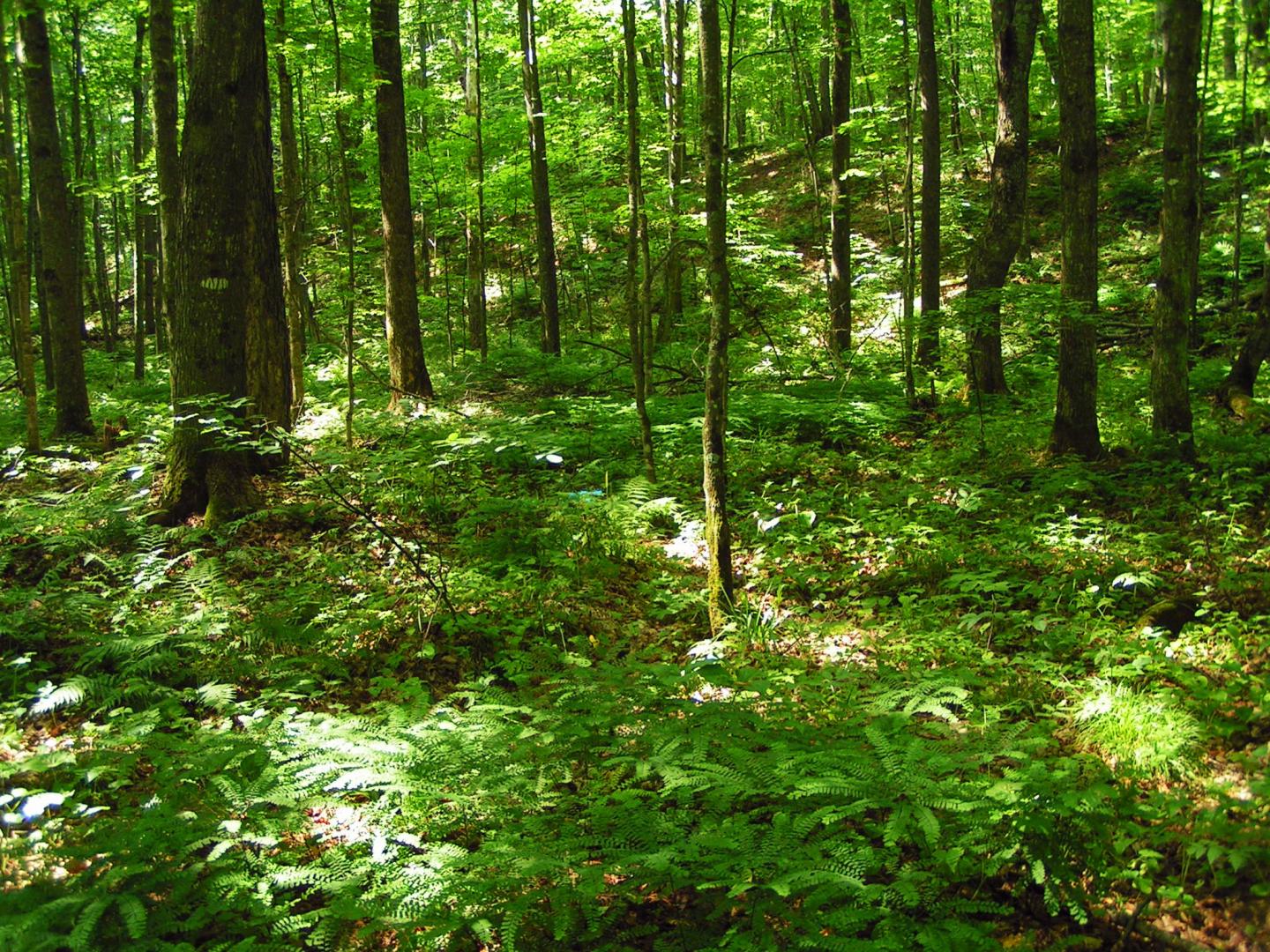
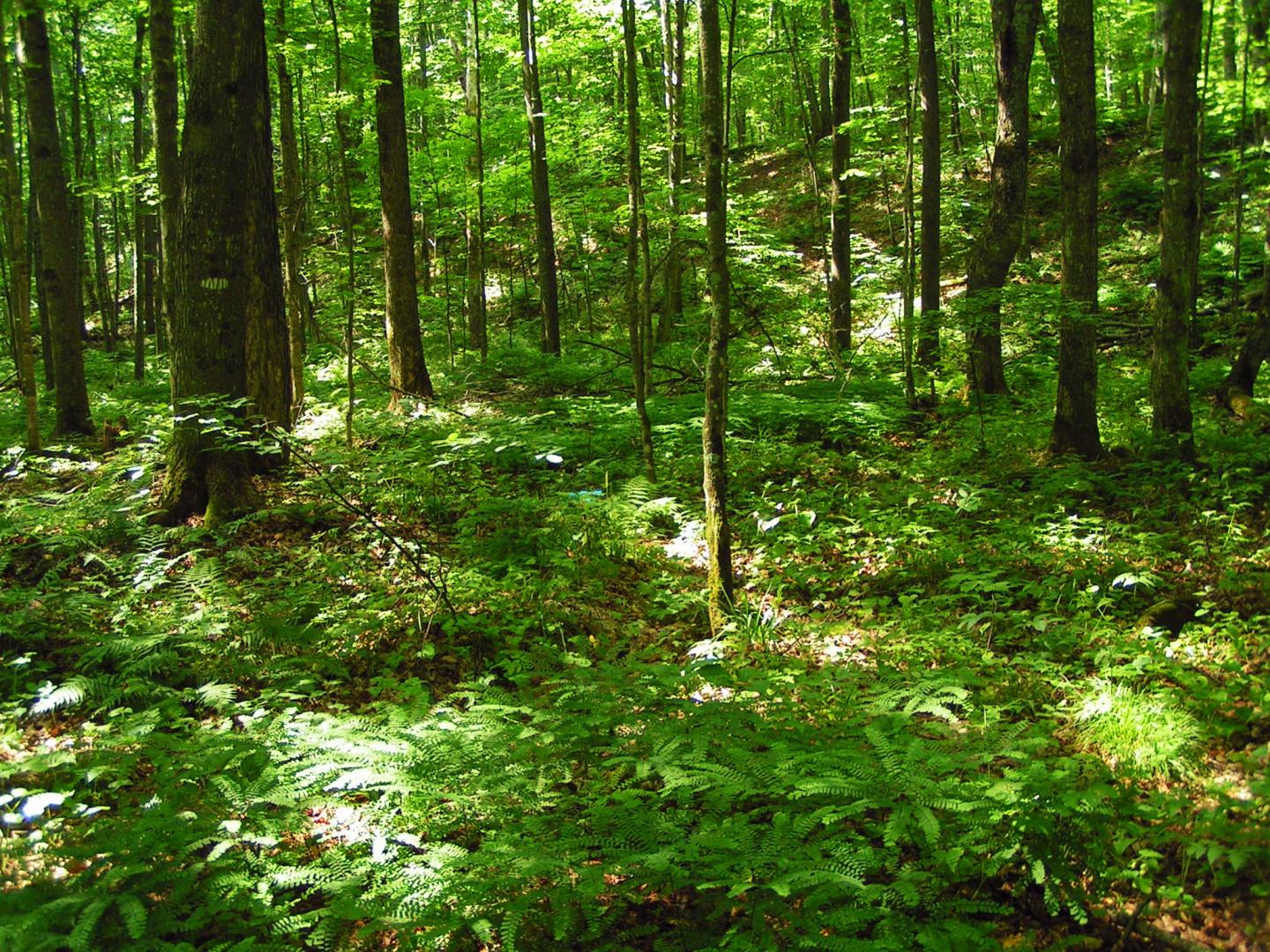
Credit: Paul Ojanen (University of Minnesota)
Leipzig. In Europe, they are classified as beneficial organisms, but many North American ecosystems are not adapted to these subterranean burrowers. This is because almost all earthworms became extinct there during the last ice age, which ended about 12,000 years ago. When the ice retreated, new ecosystems that are adapted to soils without earthworms emerged. But by now, several earthworm species live again in North America. They were introduced by European settlers and spread by anglers. An earthworm invasion is making its way through the forests at approximately five metres per year and is altering the physical and chemical properties of soils. Earthworms mix soils and build extensive burrows, which interrupts the symbiotic relationship between plants and fungi (mycorrhiza). The mixing also affects soil pH: the best-known earthworm in central Europe, the Lumbricus terrestris, carries alkaline soil upwards from deeper layers. On the forest floor, the leaf litter vanishes as it is eaten up by the worms and turned into humus. As a result, the nutrients stored in the leaves become quickly available to the plants. Furthermore, the soils dry out easily as water drains away readily.
Many native plants cannot thrive under these unusual circumstances, which is why the species diversity of the forest understory is decreasing. Wherever the worm creeps, the goblin fern (Botrychium mormo), for example, has become rare. Other plants are also threatened by the earthworm invasion, such as the largeflower bellwort (Uvularia grandiflora), the Japanese angelica tree (Aralia elata), the forest lily (Trillium spp.), the Solomon's seal (Polygonatum spp.) or the tormentil (Potentilla erecta). Conversely, the worms literally prepare the soil for non-native (exotic) plants, which are used to living with earthworms. Grasses also grow well in invaded forests because their fine roots can quickly absorb soil nutrients, particularly nitrogen, and can tolerate summer droughts. Moreover, earthworms eat small seeds of certain plant species and thus directly influence the composition of the forest understory. Because earthworms live in different soil layers and their effects are cumulative, the more types of earthworms that live together in one location, the more plant species vanish.
The researchers have brought together and evaluated data from 14 studies and published their findings in the journal Global Change Biology. Their results demonstrate, for the first time, a general pattern between the decline in species diversity in North American forests and the spread of European earthworms. 'The earthworm invasion has altered the biodiversity and possibly functioning of the forest ecosystems, because it affects the entire food web as well as water and nutrient cycles', says Dylan Craven, lead author of the study. 'The long-term impact could be massive and be exacerbated further still by climate change', adds director of studies, Professor Nico Eisenhauer. Both are scientists at the German Centre for Integrative Biodiversity Research (iDiv) and at the Leipzig University and have conducted their study together with colleagues from the United States and Canada. Eisenhauer had recently raised 1.5 million euros in funding from the EU to investigate the consequences of the earthworm invasion.
###
Link to pictures: https://portal.idiv.de/owncloud/index.php/s/c2wfArZ82Y86DsU
Publication:
Dylan Craven, Madhav P. Thakur, Erin K. Cameron, Lee E. Frelich, Robin Beausejour, Robert B. Blair, Bernd Blossey, James Burtis, Amy Choi, Timothy J. Fahey, Nicholas A. Fisichelli, Kevin Gibson, I. Tanya Handa, Kristine Hopfenspberger, Scott R.Loss,Victoria Nuzzo, John C. Maerz, Tara Sackett, Bryant C. Scharenboch, Sandy M. Smith, Mark Vellend, Lauren G. Umek, Nico Eisenhauer (2016): The unseen invaders: introduced earthworms as drivers of change in plant communities in North American forests (a meta-analysis). Global Change Biology. DOI: 10.1111/gcb.13446. Published online on 3. September 2016. http://onlinelibrary.wiley.com/doi/10.1111/gcb.13446/full
Useful links:
iDiv press release: European Research Council awards Leipzig biologist a EUR 1.5 million grant
https://www.idiv.de/en/press/press-releases/press_release_single_view/news_article/european-res.html
General info on earth worms in North America:
http://ecosystems.serc.si.edu/earthworm-invaders/
and
http://www.nrri.umn.edu/worms/
iDiv is a central facility of the University of Leipzig within the meaning of Section 92 (1) of the Act on Academic Freedom in Higher Education in Saxony (Saechsisches Hochschulfreiheitsgesetz, SaechsHSFG). It is run together with the Martin Luther University Halle-Wittenberg and the Friedrich Schiller University Jena, as well as in cooperation with the Helmholtz Centre for Environmental Research (UFZ). The following non-university research institutions are involved as cooperation partners: the Helmholtz Centre for Environmental Research (UFZ), the Max Planck Institute for Biogeochemistry (MPI BGC), the Max Planck Institute for Chemical Ecology (MPI CE), the Max Planck Institute for Evolutionary Anthropology (MPI EVA), the Leibniz Institute DSMZ / German Collection of Microorganisms and Cell Cultures, the Leibniz Institute of Plant Biochemistry (IPB), the Leibniz Institute of Plant Genetics and Crop Plant Research (IPK) and the Leibniz Institute Senckenberg Museum of Natural History Goerlitz (SMNG).
Media Contact
Tabea Turrini
[email protected]
49-341-973-3106
http://www.idiv.de