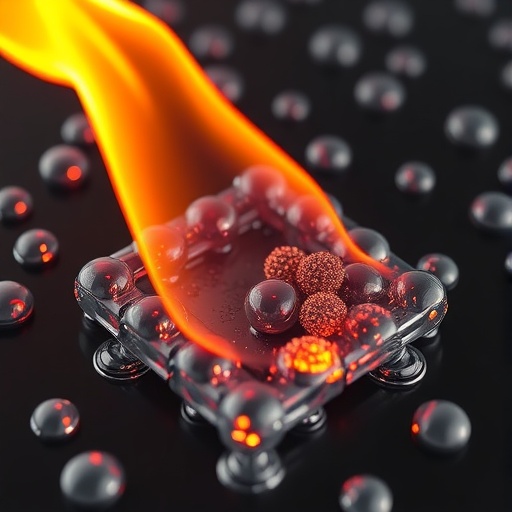
A new type of fire-safe coating is turning to nature for inspiration, using a skin-like design to overcome a major weakness of many flame-retardant materials: poor durability in humid environments. According to researchers led by Wendong Liu at Dalian University of Technology in China, conventional flame-retardant coatings often become hydrophilic, making them prone to dissolving or degrading when exposed to moisture. Their solution decouples waterproofing and fire protection into distinct layers that work together under real-world conditions.
Published in Nano Research on April 15, 2026, the approach mimics the epidermis and dermis bilayer architecture of human skin. The outer “epidermal” layer is engineered for extreme water repellence, while the inner “dermal” layer is optimized for thermal insulation and flame suppression. The result is a spray-applied biomimetic coating that is both scalable and designed for long-term performance.
At the molecular and microstructural level, the superhydrophobic surface is built from silicone nanofilaments combined with PVDF-HFP and PFDTS. This layer is reported to achieve a static water contact angle of 165°, enabling the coating to resist a range of everyday liquids. The same outer layer also maintains performance across a broad pH range from 1 to 13, suggesting chemical stability relevant to diverse environments.
Beneath the water-repellent skin is an intumescent flame-retardant system dominated by APP and UPTMS. When exposed to heat, the formulation expands and forms a protective char. This char layer acts as a physical barrier to slow heat and oxygen transport, while released flame-retardant gases further contribute to self-extinguishing behavior.
The fire results are striking: the limiting oxygen index (LOI) rises from 21.44% for the uncoated substrate to 85.30% with the biomimetic coating. Key combustion metrics also improve dramatically, with the peak heat release rate (PHRR) reduced by 59.4% and the fire growth index (FGI) lowered by 73.5%. The team highlights that the synergy between the two layers is central to these gains.
Durability tests suggest the coating is mechanically robust rather than merely cosmetic. After 1000 bending cycles between 90° and 180°, the coating shows no significant change in surface microstructure, and the contact angle remains above 160° on SFR-PET. That combination of flexibility and moisture resistance points to potential use in safer, flexible devices.
Because the coating can be sprayed onto multiple flammable substrates—including cardboard, fabrics, and foam—it may support practical manufacturing routes rather than lab-only demonstrations. The researchers emphasize multifunctionality, processability, and thermal stability as the core advantages of this skin-mimicking strategy.
Overall, this biomimetic, spray-applied intumescent superhydrophobic coating offers a compelling pathway toward safer materials that stay effective under moisture exposure—an issue that has limited many previous flame-retardant solutions in real-world safety-critical applications.
Other contributors include Mingxuan Zhang, Yuechang Lian, Haonan Liu, Siyuan Xiang, Yutao Wang, Bo Yang, Shengyang Tao, and Michael Kappl. The work was supported by funding from China’s National Natural Science Foundation and related provincial and institutional programs, reflecting strong national investment in next-generation materials for fire safety.
Keywords
Biomimetic coating, superhydrophobicity, intumescent flame retardant, skin-inspired bilayer design, durability, self-extinguishing, limiting oxygen index, fire safety
Subject of Research: Biomimetic intumescent flame-retardant and superhydrophobic coating
Article Title: Robust, Biomimetic, Superhydrophobic Coating with Flame-Retardant Properties and Excellent Self-Extinguishing Performance
News Publication Date: 15-Apr-2026
Web References: http://dx.doi.org/10.26599/NR.2026.94908394
References: Nano Research (15-Apr-2026); DOI: 10.26599/NR.2026.94908394
Image Credits: Nano Research, Tsinghua University Press
Tags: biomimetic superhydrophobic flame-retardant coatingbiomimicry in advanced materialdurable waterproof fire-resistant coatingenhanced fire safety in humid conditionsenvironmentally stable flame-retardant materialslong-term performance of fire-retardant coatingsmicrostructural design for flame retardancymultilayer skin-inspired fire protectionnanostructured superhydrophobic surfacescalable spray-applied fire protectionself-extinguishing fire-safe coatingssilicone nanofilaments for water repellence