

• HOME
  • NEWS
  • EXPLORE
    • CAREER
      • Companies
      • Jobs
    • EVENTS
    • iGEM
      • News
      • Team
    • PHOTOS
    • VIDEO
    • WIKI
  • BLOG
  • COMMUNITY
    • FACEBOOK
    • INSTAGRAM
    • TWITTER
Thursday, April 2, 2026
BIOENGINEER.ORG
No Result
View All Result
  • Login
  • HOME
  • NEWS
  • EXPLORE
    • CAREER
      • Companies
      • Jobs
        • Lecturer
        • PhD Studentship
        • Postdoc
        • Research Assistant
    • EVENTS
    • iGEM
      • News
      • Team
    • PHOTOS
    • VIDEO
    • WIKI
  • BLOG
  • COMMUNITY
    • FACEBOOK
    • INSTAGRAM
    • TWITTER
  • HOME
  • NEWS
  • EXPLORE
    • CAREER
      • Companies
      • Jobs
        • Lecturer
        • PhD Studentship
        • Postdoc
        • Research Assistant
    • EVENTS
    • iGEM
      • News
      • Team
    • PHOTOS
    • VIDEO
    • WIKI
  • BLOG
  • COMMUNITY
    • FACEBOOK
    • INSTAGRAM
    • TWITTER
No Result
View All Result
Bioengineer.org
No Result
View All Result
Home NEWS Science News Biology

Bright and stable: New acid-tolerant green fluorescent protein for bioimaging

Bioengineer by Bioengineer
February 12, 2018
in Biology
Reading Time: 2 mins read
0
Share on FacebookShare on TwitterShare on LinkedinShare on RedditShare on Telegram
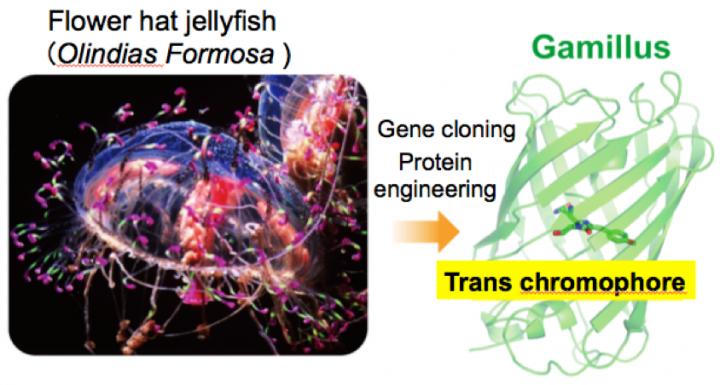
IMAGE

Credit: Kamo Aquarium and Osaka University

Osaka – Visualizing cellular components and processes at the molecular level is important for understanding the basis of any biological activity. Fluorescent proteins (FPs) are one of the most useful tools for investigating intracellular molecular dynamics.

However, FPs have usage limitations for imaging in low pH environments, such as in acidic organelles, including endosomes, lysosomes, and plant vacuoles. In environments of pH less than 6, most FPs lose their brightness and stability due to their neutral pKa. pKa is the measure of acid strength; the smaller the pKa is, the more acidic the substance is.

"Although there are reports of several acid-tolerant green FPs (GFPs), most have serious drawbacks. Furthermore, there is a lack of acid-tolerant GFPs that are practically applicable to bioimaging," says Hajime Shinoda, lead author of an Osaka University study that aimed to design acid-tolerant monomeric GFP that is practically applicable to live-cell imaging in acidic organelles. "In the current study, we developed an acid-tolerant GFP. We called it Gamillus."

Gamillus is a GFP cloned from Olindias formosa (flower hat jellyfish) and exhibits superior acid tolerance (pKa=3.4) and nearly twice as much brightness compared with the reported GFPs. The fluorescence spectrum is constant between pH4.5 and 9.0, which falls between the intracellular range in most cell types. X-ray crystallography (a technique used for determining the atomic and molecular structure of a crystal, in this case, a Gamillus crystal) and point mutagenesis suggest the acid tolerance of Gamillus is attributed to stabilization of deprotonation in its chemical structure. The findings were published in Cell Chemical Biology.

"The applicability of Gamillus as a molecular tag was shown by the correct localization pattern of Gamillus fusions in a variety of cellular structures, including ones that are difficult to target," corresponding author Takeharu Nagai says. "We believe Gamillus can be a powerful molecular tool for investigating unknown biological phenomena involving acidic organelles, such as autophagy."

###

Media Contact

Saori Obayashi
[email protected]
81-661-055-886
@osaka_univ_e

http://www.osaka-u.ac.jp/en

Original Source

http://resou.osaka-u.ac.jp/en/research/2017/20171229_1 http://dx.doi.org/10.1016/j.chembiol.2017.12.005

Share13Tweet8Share2ShareShareShare2

Related Posts

Newly Discovered Chronic Pain Circuit Unveils Potential Avenues for Innovative Treatments

Newly Discovered Chronic Pain Circuit Unveils Potential Avenues for Innovative Treatments

April 2, 2026
DNA Transforms from Blueprint to Active Field Agent

DNA Transforms from Blueprint to Active Field Agent

April 2, 2026

UBC Okanagan Study Reveals How Trees Visually Signal Their Spring Rehydration

April 1, 2026

Rising Temperatures from Climate Change Associated with Reduced Newborn Size

April 1, 2026
Please login to join discussion

POPULAR NEWS

  • blank

    Revolutionary AI Model Enhances Precision in Detecting Food Contamination

    96 shares
    Share 38 Tweet 24
  • Imagine a Social Media Feed That Challenges Your Views Instead of Reinforcing Them

    1007 shares
    Share 398 Tweet 249
  • Promising Outcomes from First Clinical Trials of Gene Regulation in Epilepsy

    51 shares
    Share 20 Tweet 13
  • Popular Anti-Aging Compound Linked to Damage in Corpus Callosum, Study Finds

    44 shares
    Share 18 Tweet 11

About

We bring you the latest biotechnology news from best research centers and universities around the world. Check our website.

Follow us

Recent News

Study Finds Older Men More Prone to Using Saltshakers, While Women Display More Complex Salt-Adding Habits

Bioinspired Asymmetric Design Powers Soft Robotics Actuators

Examining Replicability in Social and Behavioral Sciences

Subscribe to Blog via Email

Enter your email address to subscribe to this blog and receive notifications of new posts by email.

Join 78 other subscribers
  • Contact Us

Bioengineer.org © Copyright 2023 All Rights Reserved.

Welcome Back!

Login to your account below

Forgotten Password?

Retrieve your password

Please enter your username or email address to reset your password.

Log In
No Result
View All Result
  • Homepages
    • Home Page 1
    • Home Page 2
  • News
  • National
  • Business
  • Health
  • Lifestyle
  • Science

Bioengineer.org © Copyright 2023 All Rights Reserved.