• HOME
  • NEWS
  • EXPLORE
    • CAREER
      • Companies
      • Jobs
    • EVENTS
    • iGEM
      • News
      • Team
    • PHOTOS
    • VIDEO
    • WIKI
  • BLOG
  • COMMUNITY
    • FACEBOOK
    • INSTAGRAM
    • TWITTER
Wednesday, April 1, 2026
BIOENGINEER.ORG
No Result
View All Result
  • Login
  • HOME
  • NEWS
  • EXPLORE
    • CAREER
      • Companies
      • Jobs
        • Lecturer
        • PhD Studentship
        • Postdoc
        • Research Assistant
    • EVENTS
    • iGEM
      • News
      • Team
    • PHOTOS
    • VIDEO
    • WIKI
  • BLOG
  • COMMUNITY
    • FACEBOOK
    • INSTAGRAM
    • TWITTER
  • HOME
  • NEWS
  • EXPLORE
    • CAREER
      • Companies
      • Jobs
        • Lecturer
        • PhD Studentship
        • Postdoc
        • Research Assistant
    • EVENTS
    • iGEM
      • News
      • Team
    • PHOTOS
    • VIDEO
    • WIKI
  • BLOG
  • COMMUNITY
    • FACEBOOK
    • INSTAGRAM
    • TWITTER
No Result
View All Result
Bioengineer.org
No Result
View All Result
Home NEWS Science News Health

Pain neuron may protect fungal inflammation and bone destruction

Bioengineer by Bioengineer
February 11, 2018
in Health
Reading Time: 2 mins read
0
Share on FacebookShare on TwitterShare on LinkedinShare on RedditShare on Telegram
IMAGE

Credit: Kenta Maruyama

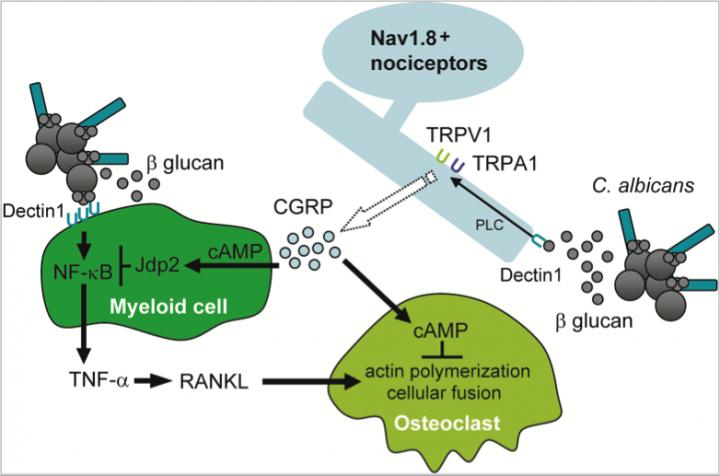
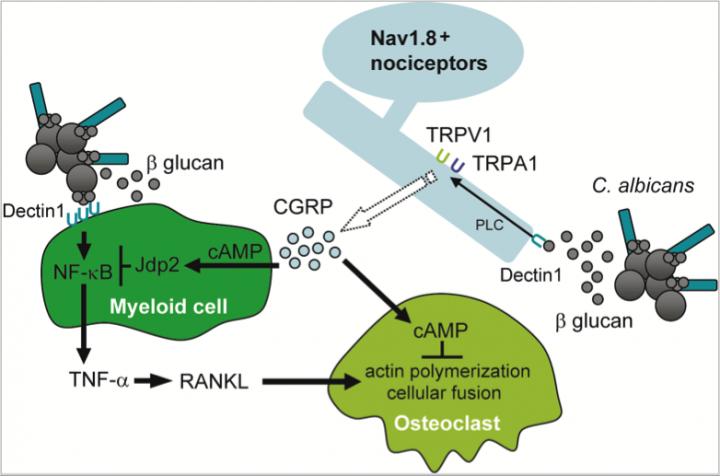
Pain neuron exaggerates inflammation of contact dermatitis and psoriasis. Despite its importance in allergic and autoimmune inflammation, it is not known so far whether pain neuron modulates pathogen-induced inflammation. Scientist at Immunology Frontier Research Center (IFReC) discovered that Nav1.8 ion channel expressing pain neuron inhibits fungal inflammation and bone destruction.

"We generated the Nav1.8 ion channel expressing neuron null mice. After C. albicans or C. albicans derived β-glucan injection into the hind paw, these mice showed significantly increased footpad swelling and bone destruction" said Kenta Maruyama, M.D., Ph.D. (Assistant Professor, IFReC). Intriguingly, Nav1.8 ion channel positive neuron expresses Dectin-1, a β-glucan receptor, and Dectin-1 mediated inflammation is potently suppressed by pain neurons, rather than bacterial component-induced inflammation. Detailed experiments of pain neurons revealed that Dectin-1-stumulated pain neuron produces robust amount of CGRP, a neuropeptide that inhibits osteoclast and cytokine production via TRPV1 and TPRA1 ion channel activation. "To our surprise, TRPV1/TRPA1 double deficient mice exhibited exaggerated inflammation and bone destruction in response to β-glucan due to impaired CGRP production, and myeloid cell transcription factor Jdp2 is necessary for the immunosuppression triggered by this neuropeptide" said Kenta.

A significant discovery in this study is that transcription factor Jdp2 is induced by CGRP and directly inhibits β-glucan-indeuced NF-κB activation in macrophages. Such findings are consistent with the results showing that Jdp2 deficiency hyper inflammatory phenotype induced by β-glucan was only observed in vivo.

Additional study revealed that β-glucan-induced CGRP production from pain neuron is more potent than that induced by LPS, a gram negative bacterial component.

"Previous reports suggested that pain neurons are deleterious for inflammation, but our findings suggest that pain neurons may function primarily in suppressing fungal inflammation, rather than bacterial inflammation" said Kenta. "Congenital insensitivity to pain with anhidrosis is an extremely rare hereditary disease characterized by impairment of nociceptor development. Manifestations of this disease are recurrent episodes of skin injury, osteomyelitis, bony fractures, and oral osteolysis. Our discovery may improve the therapeutic strategies of this disease and precise microbiological observation of this patient may clarify the bona-fide role of human pain neurons in fungal infection."

###

Media Contact

Kenta Maruyama
[email protected]
81-668-794-266
@osaka_univ_e

http://www.osaka-u.ac.jp/en

Related Journal Article

http://dx.doi.org/10.1016/j.celrep.2017.06.002
Share13Tweet8Share2ShareShareShare2

Related Posts

Entorhinal Cortex Maps Remote Tasks Without CA1

April 1, 2026

Recombinant Protein Restores Platelet Function in Mice

April 1, 2026

ERAST Enables Scalable Homology Detection Breakthrough

April 1, 2026

Survey Reveals Strong American Support for Autism Research, Yet Brain Donation Remains Overlooked as Essential for Progress

April 1, 2026
Please login to join discussion

POPULAR NEWS

  • blank

    Revolutionary AI Model Enhances Precision in Detecting Food Contamination

    96 shares
    Share 38 Tweet 24
  • Imagine a Social Media Feed That Challenges Your Views Instead of Reinforcing Them

    1006 shares
    Share 398 Tweet 249
  • Promising Outcomes from First Clinical Trials of Gene Regulation in Epilepsy

    51 shares
    Share 20 Tweet 13
  • Popular Anti-Aging Compound Linked to Damage in Corpus Callosum, Study Finds

    43 shares
    Share 17 Tweet 11

About

We bring you the latest biotechnology news from best research centers and universities around the world. Check our website.

Follow us

Recent News

Entorhinal Cortex Maps Remote Tasks Without CA1

Chikungunya Virus Lingers in Joint Macrophages, Causes Chronic Disease

Recombinant Protein Restores Platelet Function in Mice

Subscribe to Blog via Email

Enter your email address to subscribe to this blog and receive notifications of new posts by email.

Join 78 other subscribers
  • Contact Us

Bioengineer.org © Copyright 2023 All Rights Reserved.

Welcome Back!

Login to your account below

Forgotten Password?

Retrieve your password

Please enter your username or email address to reset your password.

Log In
No Result
View All Result
  • Homepages
    • Home Page 1
    • Home Page 2
  • News
  • National
  • Business
  • Health
  • Lifestyle
  • Science

Bioengineer.org © Copyright 2023 All Rights Reserved.