

• HOME
  • NEWS
  • EXPLORE
    • CAREER
      • Companies
      • Jobs
    • EVENTS
    • iGEM
      • News
      • Team
    • PHOTOS
    • VIDEO
    • WIKI
  • BLOG
  • COMMUNITY
    • FACEBOOK
    • INSTAGRAM
    • TWITTER
Saturday, May 16, 2026
BIOENGINEER.ORG
No Result
View All Result
  • Login
  • HOME
  • NEWS
  • EXPLORE
    • CAREER
      • Companies
      • Jobs
        • Lecturer
        • PhD Studentship
        • Postdoc
        • Research Assistant
    • EVENTS
    • iGEM
      • News
      • Team
    • PHOTOS
    • VIDEO
    • WIKI
  • BLOG
  • COMMUNITY
    • FACEBOOK
    • INSTAGRAM
    • TWITTER
  • HOME
  • NEWS
  • EXPLORE
    • CAREER
      • Companies
      • Jobs
        • Lecturer
        • PhD Studentship
        • Postdoc
        • Research Assistant
    • EVENTS
    • iGEM
      • News
      • Team
    • PHOTOS
    • VIDEO
    • WIKI
  • BLOG
  • COMMUNITY
    • FACEBOOK
    • INSTAGRAM
    • TWITTER
No Result
View All Result
Bioengineer.org
No Result
View All Result
Home NEWS Science News Health

Horses masticate similarly to ruminants

Bioengineer by Bioengineer
February 11, 2018
in Health
Reading Time: 2 mins read
0
Share on FacebookShare on TwitterShare on LinkedinShare on RedditShare on Telegram
IMAGE

Credit: UZH

Herbivores digest their food much better if it has been strongly fragmented by intensive mastication. For ruminants such as cows, sheep, goats, deer, llamas or camels, eating and ruminating are two different processes: Some time after feeding, they regurgitate part of their food and chew it again with particularly even, rhythmic movements. In this way, they achieve the maximum degree of fragmenta-tion of their food.

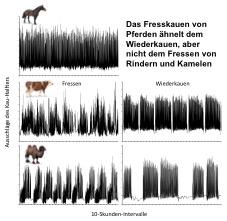
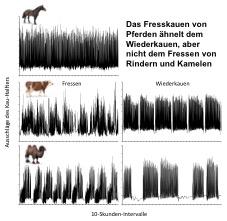
Researchers of the University of Zurich and the Swiss Federal Institute of Technology Zurich (ETH Zurich) are now investigating whether the chewing movements of the ruminants are similar to those of other ruminants and other herbivores. In their study with horses, cows and camels, they use special mastication halters, which can record the movements of the mouth and automatically differentiate between eating and ruminating.

Similar rhythmic chewing movements

In the case of cows and camels, the mastication rhythms differ clearly in a predictable manner. The movements during eating were much more irregular than those during rumination, and camels gener-ally have a lower chewing rate during ruminate than cows. The situation is different for horses: "Much to our surprise, the evaluation software determined that horses do not eat, but rather ruminate," says Marie Dittmann, doctoral student at the University of Zurich and ETH Zurich. "Although horses are not ruminants, they fragment their food with the same rhythmic chewing movements as cows do during rumination."

For Marcus Clauss, professor at the Clinic for Zoo Animals, Exotic Pets and Wildlife of the University of Zurich, the similarity in the chewing rhythm of such different animal groups is understandable: "Horses do not have a second chance to re-chew something that is hard to digest. For that reason, they have to masticate very thoroughly when eating. That obviously works best with rhythmic and even movements."

Irregular chewing protects the teeth

That begs another question: Why do cows chew differently when eating? The researchers have an interesting theory: When grazing in the wild, herbivores also take in dust, dirt or earth, which addition-ally abrades the teeth while eating. Horses have to put up with this problem. Ruminants, on the other hand, can postpone thorough mastication after the initial eating process until later after the food has been cleaned of such contamination in the rumen. Less tooth abrasion therefore results during eating due to less intensive chewing. "The irregular ingestive mastication of cows could therefore have de-veloped in order to protect the teeth while eating," Clauss says. Further studies are necessary to con-firm this assumption.

###

Media Contact

Marcus Clauss
[email protected]
41-446-358-376
@uzh_news

http://www.uzh.ch

Original Source

http://www.media.uzh.ch/en/Press-Releases/2017/Horses-Ruminants.html http://dx.doi.org/10.1002/jez.2075


Share13Tweet7Share2ShareShareShare1

Related Posts

Metabolic Stress Worsens Parkinson’s via Mitochondrial Ferroptosis

May 16, 2026

Four New Hydroxyl Fatty Acids from Bacillus sp.

May 16, 2026

Validating B-IPQ Short Form for Older Colombians

May 16, 2026

New Actinomycin Derivatives Target Malaria More Selectively

May 16, 2026
Please login to join discussion

POPULAR NEWS

  • Research Indicates Potential Connection Between Prenatal Medication Exposure and Elevated Autism Risk

    844 shares
    Share 338 Tweet 211
  • New Study Reveals Plants Can Detect the Sound of Rain

    730 shares
    Share 291 Tweet 182
  • Salmonella Haem Blocks Macrophages, Boosts Infection

    62 shares
    Share 25 Tweet 16
  • Breastmilk Balances E. coli and Beneficial Bacteria in Infant Gut Microbiomes

    58 shares
    Share 23 Tweet 15

About

We bring you the latest biotechnology news from best research centers and universities around the world. Check our website.

Follow us

Recent News

Uncovering C. elegans Immunity via Genetic Screens

Congenital Heart Disease’s Lasting Impact on Brain Health

Metabolic Stress Worsens Parkinson’s via Mitochondrial Ferroptosis

Subscribe to Blog via Email

Enter your email address to subscribe to this blog and receive notifications of new posts by email.

Join 82 other subscribers
  • Contact Us

Bioengineer.org © Copyright 2023 All Rights Reserved.

Welcome Back!

Login to your account below

Forgotten Password?

Retrieve your password

Please enter your username or email address to reset your password.

Log In
No Result
View All Result
  • Homepages
    • Home Page 1
    • Home Page 2
  • News
  • National
  • Business
  • Health
  • Lifestyle
  • Science

Bioengineer.org © Copyright 2023 All Rights Reserved.
