• HOME
  • NEWS
  • EXPLORE
    • CAREER
      • Companies
      • Jobs
    • EVENTS
    • iGEM
      • News
      • Team
    • PHOTOS
    • VIDEO
    • WIKI
  • BLOG
  • COMMUNITY
    • FACEBOOK
    • INSTAGRAM
    • TWITTER
Thursday, November 26, 2026
BIOENGINEER.ORG
No Result
View All Result
  • Login
  • HOME
  • NEWS
  • EXPLORE
    • CAREER
      • Companies
      • Jobs
        • Lecturer
        • PhD Studentship
        • Postdoc
        • Research Assistant
    • EVENTS
    • iGEM
      • News
      • Team
    • PHOTOS
    • VIDEO
    • WIKI
  • BLOG
  • COMMUNITY
    • FACEBOOK
    • INSTAGRAM
    • TWITTER
No Result
View All Result
Bioengineer.org
No Result
View All Result
Home NEWS Science News Technology

Parallel Deep Learning Framework Detects Parkinson’s Disease Using MRI Images

by
November 26, 2026
in Technology
Reading Time: 2 mins read
0
Parallel Deep Learning Framework Detects Parkinson's Disease Using MRI Images

Parallel Deep Learning Framework Detects Parkinson's Disease Using MRI Images

Share on FacebookShare on TwitterShare on LinkedinShare on RedditShare on Telegram

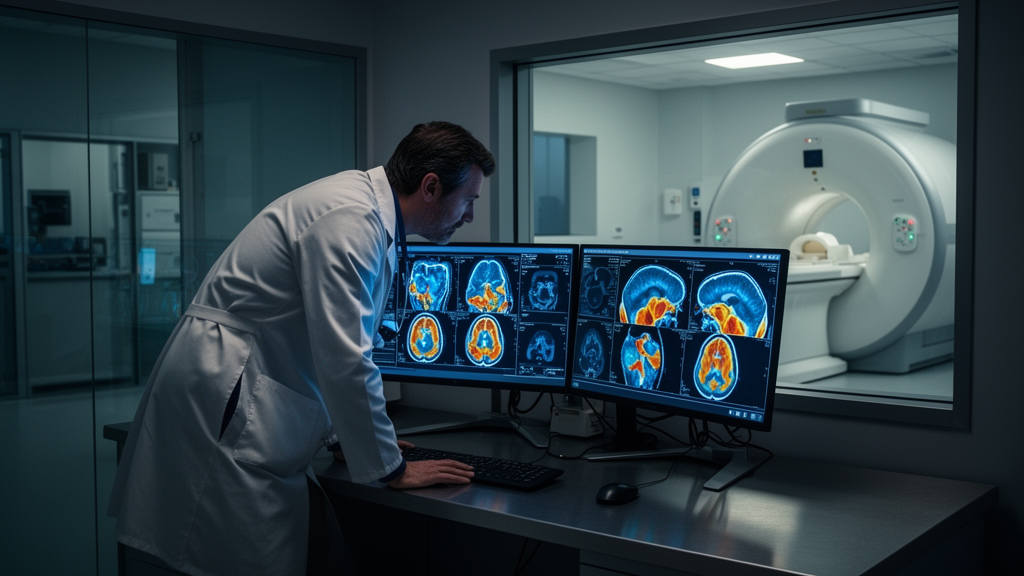
A novel deep learning framework combining advanced image processing and parallel neural networks has been developed to detect Parkinson’s disease from magnetic resonance imaging scans, according to a study published in Frontiers in Artificial Intelligence. The proposed Transfer Learning-enabled Advanced Parallel CNN-based Parkinson’s disease Detection framework, designed by researchers at VIT University in Vellore, India, is engineered to distinguish between scans of diseased patients and healthy individuals.

The research addresses diagnostic challenges associated with Parkinson’s disease, a progressive neurodegenerative condition where timely and precise detection is critical for enhancing patient care and treatment effectiveness. Clinical identification during the early stages of the disease remains difficult because its manifestations frequently overlap with symptoms caused by other neurological disorders.

To improve input data quality prior to feature analysis, the computational pipeline begins with an image preprocessing phase applied directly to the magnetic resonance scans. The framework implements Gaussian filtering across the magnetic resonance imaging data, a step specifically designed to suppress background noise and improve overall visual quality for downstream evaluation.

Following preprocessing, the architecture extracts two complementary categories of characteristics to capture a broad range of image properties. Deep features are learned through transfer learning using pre-trained convolutional neural network models, specifically Residual Network and Visual Geometry Group 16 architectures, while texture-based features are generated using Local Ternary Tree Pattern and Log-Gabor Filter with Adaptive Threshold-based Median Ternary Pattern techniques.

Classification of the extracted deep and textural features is performed using two distinct predictive models: a Top-k max average pooling-based parallel convolutional neural network, designated TkMAP-PCNN, and a ShuffleNet model. To optimize diagnostic reliability and overall robustness, the framework integrates the predictions of both classifiers through an Adaptive Normalization-based Score Level Fusion strategy.

Experimental evaluations demonstrated that the integrated system effectively separated magnetic resonance scans of Parkinson’s disease patients from those of healthy subjects. Within the tested framework, the TkMAP-PCNN classification architectures exhibited maximal diagnostic accuracies reported at 98.5% and 90% in distinguishing healthy individuals from diseased classes.

Subject of Research: Deep learning framework for Parkinson's disease detection using MRI scans

Article Title: TL-PCNN: Transfer Learning-enabled Advanced Parallel CNN with score-level fusion for Parkinson's disease detection using MRI images

Article References: Pradeep, P., & Kamalakannan, J. (2026). TL-PCNN: Transfer Learning-enabled Advanced Parallel CNN with score-level fusion for Parkinson's disease detection using MRI images. Frontiers in Artificial Intelligence, 9, Article 1963105. https://doi.org/10.3389/frai.2026.1963105

Image Credits: AI Generated

DOI: 10.3389/frai.2026.1963105

Keywords: Parkinson's disease, magnetic resonance imaging, deep learning, transfer learning, convolutional neural network, TL-APC-PD, TL-PCNN, Gaussian filtering, ResNet, VGG16, Local Ternary Tree Pattern, Log-Gabor filter, LFAT-MTP, TkMAP-PCNN, ShuffleNet, score level fusion, AN-SLF, neurodegenerative disorders

News Source: Cassandra Pierce. (November 26, 2026). Parallel Deep Learning Framework Detects Parkinson’s Disease Using MRI Images. Scienmag.

Tags: AN-SLFconvolutional neural networkdeep learningGaussian filteringLFAT-MTPLocal Ternary Tree PatternLog-Gabor filtermagnetic resonance imagingneurodegenerative disordersParkinson’s diseaseResNetscore level fusionShuffleNetTkMAP-PCNNTL-APC-PDTL-PCNNTransfer LearningVGG16
Share12Tweet7Share2ShareShareShare1

Related Posts

Pruned Deep Learning Framework Accurately Diagnoses Diseases Across Medical Image Modalities

Pruned Deep Learning Framework Accurately Diagnoses Diseases Across Medical Image Modalities

November 26, 2026
Seaport Virtual Power Plants Cut Grid Deviation Using Two-Stage Scenario Coordination

Seaport Virtual Power Plants Cut Grid Deviation Using Two-Stage Scenario Coordination

November 26, 2026

How Cathodic Degradation Destabilizes Metal Electrodes Under Strongly Reducing Interfacial Conditions

November 26, 2026

Random Forest Predicts Construction Cost Deviations With High Accuracy in Digital Twin Framework

November 26, 2026

POPULAR NEWS

  • Cucumber Extract Alters Zinc Oxide Optical Properties Without Ensuring Colloidal Uniformity

    Cucumber Extract Alters Zinc Oxide Optical Properties Without Ensuring Colloidal Uniformity

    29 shares
    Share 12 Tweet 7
  • Adjuvant mFOLFOXIRI Improves Recurrence-Free Survival in Resected Metastatic Colorectal Cancer

    29 shares
    Share 12 Tweet 7
  • Multimodal Deep Learning Model Assesses English Teaching Effectiveness With High Accuracy

    29 shares
    Share 12 Tweet 7
  • Edible Mushroom Scaffolds Guide Muscle Cell Alignment Through Physical Processing Alone

    29 shares
    Share 12 Tweet 7

About

We bring you the latest biotechnology news from best research centers and universities around the world. Check our website.

Follow us

Recent News

Feline Intestinal Organoids Reveal Cell-Specific Tropism and Host Responses to FIPV

Multivariable Model Predicts Left Ventricular Ejection Fraction After Cardiac Arrest Resuscitation

Review Outlines How Mesenchymal and Pluripotent Stem Cells Restore Damaged Myocardium

Subscribe to Blog via Email

Enter your email address to subscribe to this blog and receive notifications of new posts by email.

Join 89 other subscribers
  • Contact Us

Bioengineer.org © Copyright 2023 All Rights Reserved.

Welcome Back!

Login to your account below

Forgotten Password?

Retrieve your password

Please enter your username or email address to reset your password.

Log In
No Result
View All Result
  • Homepages
    • Home Page 1
    • Home Page 2
  • News
  • National
  • Business
  • Health
  • Lifestyle
  • Science

Bioengineer.org © Copyright 2023 All Rights Reserved.