• HOME
  • NEWS
  • EXPLORE
    • CAREER
      • Companies
      • Jobs
    • EVENTS
    • iGEM
      • News
      • Team
    • PHOTOS
    • VIDEO
    • WIKI
  • BLOG
  • COMMUNITY
    • FACEBOOK
    • INSTAGRAM
    • TWITTER
Tuesday, December 23, 2025
BIOENGINEER.ORG
No Result
View All Result
  • Login
  • HOME
  • NEWS
  • EXPLORE
    • CAREER
      • Companies
      • Jobs
        • Lecturer
        • PhD Studentship
        • Postdoc
        • Research Assistant
    • EVENTS
    • iGEM
      • News
      • Team
    • PHOTOS
    • VIDEO
    • WIKI
  • BLOG
  • COMMUNITY
    • FACEBOOK
    • INSTAGRAM
    • TWITTER
  • HOME
  • NEWS
  • EXPLORE
    • CAREER
      • Companies
      • Jobs
        • Lecturer
        • PhD Studentship
        • Postdoc
        • Research Assistant
    • EVENTS
    • iGEM
      • News
      • Team
    • PHOTOS
    • VIDEO
    • WIKI
  • BLOG
  • COMMUNITY
    • FACEBOOK
    • INSTAGRAM
    • TWITTER
No Result
View All Result
Bioengineer.org
No Result
View All Result
Home BIOENGINEERING

Mechanism of aging recovery for progeria patients revealed

Bioengineer by Bioengineer
February 9, 2018
in BIOENGINEERING
Reading Time: 2 mins read
0
Share on FacebookShare on TwitterShare on LinkedinShare on RedditShare on Telegram
IMAGE

Credit: DGIST

DGIST's research team has identified a mechanism that can recover the aging of patients with Hutchinson-Gilford Progeria Syndrome (HGPS). DGIST announced that the Chair Professor Park SangChul of New Biology (Head of Well-Aging Research Center) and the research team led by Professor Lee YoungSam has discovered a drug that can improve the aging of HGPS patients and identified the mechanism of aging recovery by using the drug.

HGPS represents one of premature aging syndromes. The patients with HGPS experience growth retardation as well as age-associated symptoms such as skin wrinkles, hair loss, visual impairment, and cardiovascular diseases. Their average life expectancy is 13 years as they age 10 times faster than others. When it comes to aging control, improvement of biological function and solutions for aging of HGPS patients have been big challenges in academia.

This study needs to be highlighted as the research team has identified the molecular causal relationship between ROCK protein activation and mitochondrial dysfunction in the progression of cell senescence for the first time in the world.

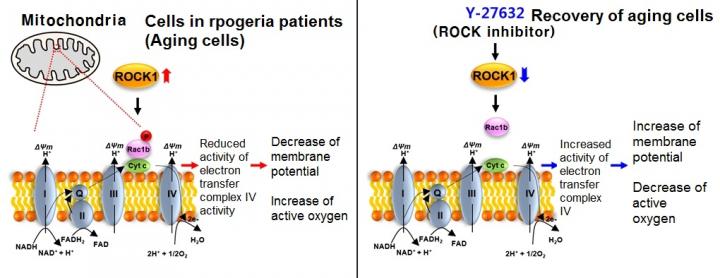
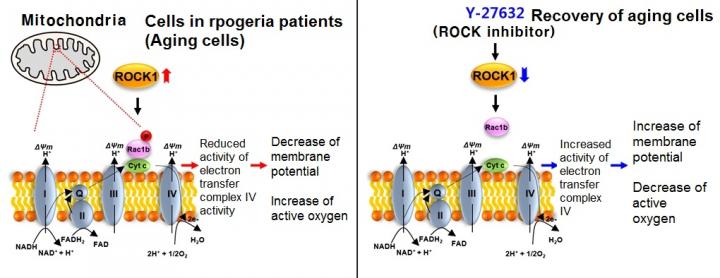
DGIST's research team noted that the level of reactive oxygen species increases when mitochondrial function diminishes during the progression fibroblasts of the HGPS patients. By performing high-throughput screening system, the team found 'Y-27632' as an effective agent to control reactive oxygen species and discovered that this drug is effective in improving mitochondrial function.

Mitochondria are intracellular organelles that play a key role in energy and metabolism in cells. It is known that mitochondrial dysfunction causes aging of cells as it increases level of active oxygen and decreases energy production efficiency.

The research team found that 'Y-27632' drug inhibits the phosphorylation level of ROCK and increases the oxidative phosphorylation efficiency of mitochondria. The study also confirms that the drug recovers mitochondrial function and induces the recovery of aging cells by reducing nuclear membrane degeneration and genetic damage that are characteristics of HGPS patient cells.

The Chair Professor Park SangChul stated "This study is significant as we have newly discovered the means to control aging. We have also identified the mechanism to recover the function of aging cell through inhibition and recovery of mitochondrial dysfunction due to aging." He added "We will continue to carry out studies that will extend the healthy lifespan of humans through the verification of the mechanism in aging animal models as well as progeny animal models."

###

Media Contact

Dahye Kim
[email protected]
82-537-851-163

http://www.dgist.ac.kr
Share12Tweet7Share2ShareShareShare1

Related Posts

IMAGE

Ferrets, cats and civets most susceptible to coronavirus infection after humans

December 10, 2020
IMAGE

Deep Longevity publishes an epigenetic aging clock of unprecedented accuracy

December 8, 2020

How poor oral hygiene may result in metabolic syndrome

December 8, 2020

New findings shed light on the repair of UV-induced DNA damage

December 8, 2020
Please login to join discussion

POPULAR NEWS

  • Nurses’ Views on Online Learning: Effects on Performance

    Nurses’ Views on Online Learning: Effects on Performance

    70 shares
    Share 28 Tweet 18
  • NSF funds machine-learning research at UNO and UNL to study energy requirements of walking in older adults

    71 shares
    Share 28 Tweet 18
  • Unraveling Levofloxacin’s Impact on Brain Function

    54 shares
    Share 22 Tweet 14
  • Exploring Audiology Accessibility in Johannesburg, South Africa

    51 shares
    Share 20 Tweet 13

About

We bring you the latest biotechnology news from best research centers and universities around the world. Check our website.

Follow us

Recent News

Innovative Peptide Vaccine Targets Ovarian Cancer Epitopes

Advancing Neonatal Care: Surfactant Use in Vietnam

Trained Immunity Reduces Lung Injury via Metabolic Shift

Subscribe to Blog via Email

Enter your email address to subscribe to this blog and receive notifications of new posts by email.

Join 70 other subscribers
  • Contact Us

Bioengineer.org © Copyright 2023 All Rights Reserved.

Welcome Back!

Login to your account below

Forgotten Password?

Retrieve your password

Please enter your username or email address to reset your password.

Log In
No Result
View All Result
  • Homepages
    • Home Page 1
    • Home Page 2
  • News
  • National
  • Business
  • Health
  • Lifestyle
  • Science

Bioengineer.org © Copyright 2023 All Rights Reserved.