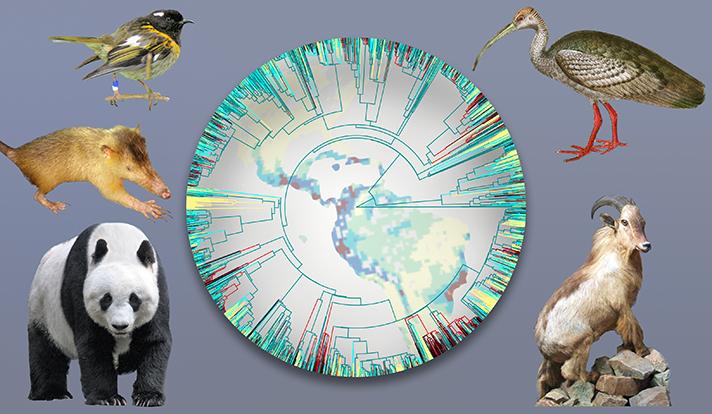
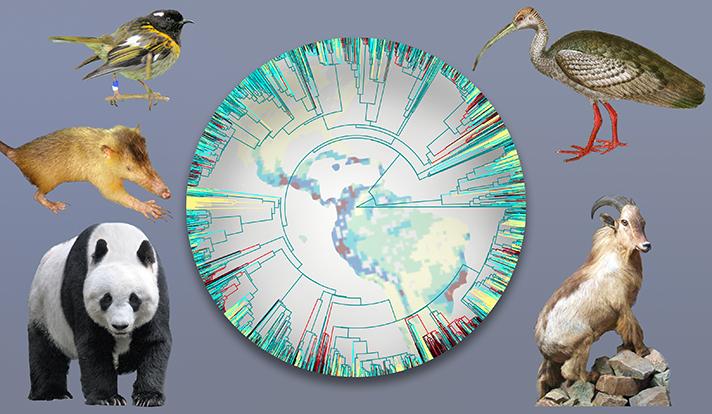
Credit: Yale University/University of Grenoble
New Haven, Conn. – A new study finds that major gains in global biodiversity can be achieved if an additional 5% of land is set aside to protect key species.
Scientists from Yale University and the University of Grenoble said such an effort could triple the protected range of those species and safeguard their functional diversity. The findings underscore the need to look beyond species numbers when developing conservation strategies, the researchers said.
"Biodiversity conservation has mostly focused on species, but some species may offer much more critical or unique functions or evolutionary heritage than others — something current conservation planning does not readily address," said Walter Jetz, a Yale associate professor of ecology and evolutionary biology, and director of the Yale Center for Biodiversity and Global Change.
"We show that a direct consideration of these other biodiversity facets identifies different regions as high-priority for conservation than a focus on species does, and more effectively safeguards functions or evolutionary heritage," Jetz said. "We find that through the smart placement of conservation areas, strong gains in the conservation of the multiple facets of biodiversity facets are possible."
The study appears online May 24 in the journal Nature. Laura Pollock of the University of Grenoble is the study's first author, Jetz is senior author, and Wilfried Thuiller of the University of Grenoble is co-author.
The researchers noted that 26% of the world's bird and mammal species are not reliably included in protected areas. The outlook for filling gaps in bird and mammal diversity could improve dramatically by smartly expanding the areas currently managed for conservation, they said.
The researchers advocate a conservation strategy that emphasizes global representation, i.e., the planetary safeguarding of species function or evolutionary heritage planet-wide, rather than local representation. They estimate that a carefully prepared 5% increase in conservation area would allow a dramatically improved capture of bird and mammal biodiversity facets; an approach focused on species numbers alone would be much less optimal, the researchers said.
Jetz and his colleagues also said their approach enables a more comprehensive guidance and capture of progress as mandated by the Convention on Biological Diversity and under evaluation by the Intergovernmental Science-Policy Platform on Biodiversity and Ecosystem Services.
"Given the current biodiversity crisis, these results are encouraging because they show big conservation gains are possible for aspects of biodiversity that might otherwise be overlooked in conservation plans," Pollock said. "This biodiversity is key to retaining the tree of life or functioning ecosystems, which nicely fits declared international policy goals. This approach can be updated and refined as the world's biodiversity becomes better understood, catalogued, and documented."
###
The researchers have created interactive web maps in the Map of Life project to accompany the study. They can be found at: https://mol.org/patterns/facets
The National Science Foundation, the Yale Center for Biodiversity and Global Change, the People's Programme of the European Union's Seventh Framework Programme, and the European Research Council supported the research.
Media Contact
Jim Shelton
[email protected]
203-432-3881
@yale
http://www.yale.edu