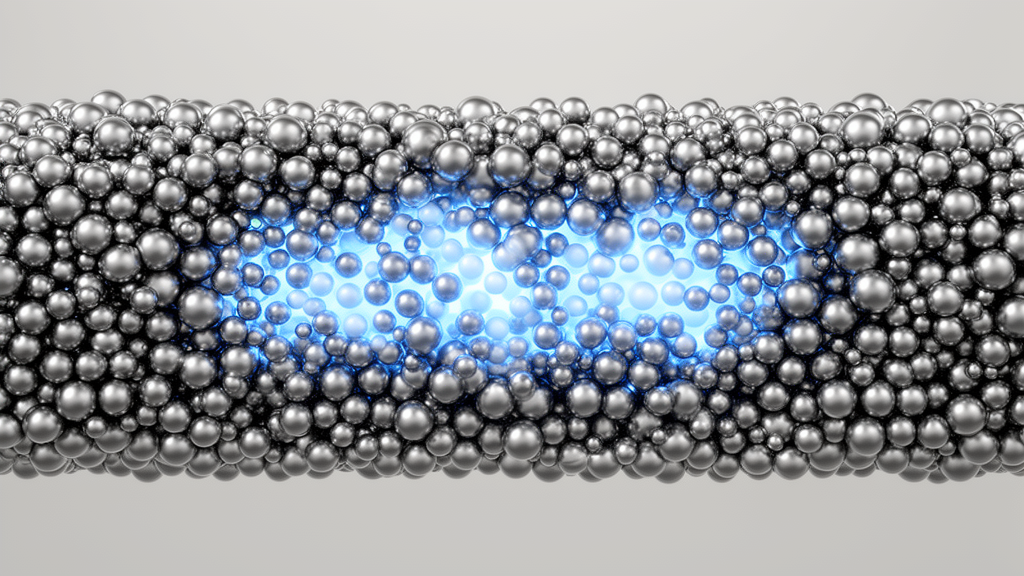
A theoretical study published in the Journal of Materials Science: Materials Theory demonstrates that the mathematical equations governing porosity evolution, density change, and effective cross-sectional area during metallic powder compaction are directly analogous to the Johnson–Mehl–Avrami–Kolmogorov phase transformation framework. Author Aarne Pohjonen established this formal correspondence by demonstrating that inelastic strain during powder pressing behaves mathematically like the extended volume fraction used to track nucleating and growing phase domains in solid-state materials. The mathematical equivalence provides a mean-field interpretation in which the compacting solid particles can be interpreted as one phase growing into and impinging upon a second phase representing the pore network. Alongside this unified formulation, the investigation introduces a geometrically motivated refinement to electrical resistivity equations that incorporates a critical separation threshold, achieving improved correlation when benchmarked against previously published experimental compaction data.
Understanding porosity evolution in powder metallurgy and sintering operations is fundamental for predicting the resulting mechanical, thermal, and electrical performance of fabricated components. Prior investigations have long sought to model effective physical properties, such as electrical conductivity and normalized density, as functions of relative porosity across various stages of mechanical consolidation. Foundational work by early researchers established baseline relationships for normalized conductivities, while later microstructural models introduced critical porosity thresholds and tap porosity parameters to capture the behavior of sintered powder aggregates. Subsequent models proposed by Montes and colleagues connected electrical resistivity to effective cross-sectional conduction areas and electrical path lengths, establishing expressions that align with classical percolation theory where initial tap porosity acts as an effective percolation threshold across metallic powders such as iron, nickel, bronze, and aluminum.
The current investigation systematically addresses how densification progresses across overlapping mechanical regimes, beginning with the initial pouring of particulate media into a compaction chamber, proceeding through elastic deformation, and culminating in substantial inelastic deformation. During the early loading stages before significant mechanical deformation takes place, powder compacts densify primarily through the spatial arrangement and rearrangement of individual particles. The theoretical upper limit for densification achievable strictly through frictionless rearrangement of uniform spheres is governed by close packing, corresponding to the Kepler conjecture limit of approximately 0.7404 of the theoretical solid density. However, when spherical particulates are introduced randomly into a container, physical packing typically reaches an upper limit of approximately 0.63, a baseline that closely matches the initial experimental tap packing densities observed in empirical metallic compaction datasets.
Following initial particle arrangement, the onset of mechanical loading induces an elastic response before permanent deformation occurs. Compressive elastic strain in the axial loading direction generates corresponding lateral strains across perpendicular dimensions governed by Poisson’s ratio. This relationship dictates how the effective cross-sectional area and relative density evolve under purely elastic conditions. Because real powder aggregates feature small, irregular interparticle contact asperities where local contact stresses rapidly exceed the yield criterion, the purely elastic stage remains exceedingly narrow during actual powder processing. As compressive force increases, particle plasticity quickly dominates the mechanical response, accompanied by secondary particle rearrangements that permanently alter the internal pore geometry.
To formalize the analogy with phase transformation kinetics, the study analyzes the governing differential equations of inelastic deformation, where the rate of porosity change with respect to effective inelastic true strain is directly proportional to the instantaneous porosity fraction. Integrating this relationship reveals an exponential decay of porosity as inelastic strain accumulates from the initial tap state. By comparing this exponential densification relationship with the classic Johnson–Mehl–Avrami–Kolmogorov formulation, the author demonstrated that relative density and relative effective cross-sectional area precisely satisfy the Avrami relation. In this formulation, the transformed fraction corresponds directly to the relative density or normalized contact area, while the extended volume fraction is defined mathematically by the effective inelastic strain minus the natural logarithm of the initial tap porosity.
In classical physical metallurgy, the extended volume fraction describes the hypothetical total volume of nucleating and growing crystal regions calculated as if domains grew unimpeded without mutual impingement or spatial overlap. The Johnson–Mehl–Avrami–Kolmogorov formulation bridges this hypothetical extended volume to the actual transformed fraction by accounting for domain collisions and mutual impingement over time. In the context of powder compaction, the author geometrically interprets this mechanism through planar cross-sections perpendicular to the axial pressing direction. As mechanical compaction proceeds, solid particulate cross-sections expand into the void space, impinging on adjacent particles and generating new interparticle contact interfaces. The difference between the hypothetical extended volume fraction and the real volume fraction provides a quantitative metric for measuring the accumulation of newly formed interparticle contact boundaries during plastic densification.
Beyond cold static compaction, the theoretical derivation extends directly to rate-dependent deformation regimes such as high-temperature hot compression. In elevated-temperature processing, the accumulation rate of effective inelastic strain is traditionally governed by power-law relationships such as the Norton–Hoff constitutive formulation, which incorporates temperature dependencies through an Arrhenius activation energy term. By differentiating the unified Avrami densification expression with respect to time, the rate of change of relative density and cross-sectional area maps directly onto the differential Avrami equation. Under this unified framework, the time derivative of the extended volume fraction corresponds exactly to the inelastic strain rate dictated by the thermal and stress conditions of the hot pressing process.
In addition to establishing the phase transformation equivalence, the study introduces an analytical refinement to the equations governing electrical resistivity evolution in compacted powders. Conventional formulations expressed resistivity as a power-law function normalized by initial tap porosity, implying that electrical resistivity approaches divergence precisely when porosity matches the initial poured tap state. The author notes that particles in an undisturbed tap configuration remain in delicate physical contact, exhibiting very low but measurable electrical conductivity rather than true infinite resistance. To capture this physical reality, the refined equation introduces an adjusted critical porosity threshold representing an infinitesimally expanded state where neighboring particles are fully separated by minute clearances, causing electrical conductivity to vanish completely.
The author developed a linear fitting procedure to determine the critical separation porosity threshold and powder morphology exponents directly from experimental data. By applying a natural logarithm transformation to the modified resistivity relation, the physical parameters can be extracted through linear regression by plotting logarithmic resistivity against logarithmic normalized porosity. Optimizing the coefficient of determination across digitized experimental data from electrical resistance sintering trials yielded an optimal critical separation porosity of 0.644, located marginally above the measured initial tap porosity of 0.6426. This optimization achieved an exceptionally high coefficient of determination, confirming that incorporating the discrete particle separation threshold provides a superior physical and mathematical description compared to unadjusted tap porosity models.
The study clarifies that the analytical framework is inherently grounded in the governing continuum assumptions of metallic plastic flow and cannot be directly applied to brittle powders that undergo extensive fragmentation and comminution without dedicated experimental validation. Furthermore, while the mathematical forms describing mean-field phase transformations and pore closure are identical, the underlying microscopic physical mechanisms remain distinct, contrasting atomic interface rearrangement with macroscopic dislocation-mediated plastic deformation and contact impingement. The author proposes that future experimental verification utilizing interrupted compaction tests could offer deeper insights into the real-time geometric migration of free particle surfaces into void spaces, while suggesting generalized differential formulations to accommodate variable densification kinetics across diverse alloy systems.
The theoretical framework also establishes a direct bridge to percolation phenomena involving overlapping geometric domains. By evaluating domain area and volume fractions occupied by randomly positioned overlapping regions, the author connects the spatial contact process to Poisson-distributed spherical models where number density and particle radius govern boundary interactions. In this formulation, the quantity describing the difference between the extended fraction and the actual transformed fraction—adjusted for the initial loaded state—provides an explicit measure of the accumulation of new contact boundaries. This mathematical connection highlights how the relative change in the moving surface contour along intersecting planes perpendicular to the pressing axis scales directly with the ratio of instantaneous porosity to initial tap porosity.
Furthermore, the mathematical equivalence between phase transformation kinetics and compaction mechanics allows both electrical and thermal resistivity relations to be reformulated directly in terms of the transformed solid fraction. Rather than relying exclusively on empirical curve fitting, the expressions translate porous aggregate densification into the progressive evolution of a solid phase, where thermal resistivity follows an analogous power-law dependence with fully densified baseline properties. This transformation-based representation reinforces the thermodynamic continuity between phase changes and inelastic deformation, as both processes ultimately operate under overarching thermodynamic driving principles despite their distinct microscopic manifestation in atomic rearrangement versus macroscopic dislocation glide.
To expand the flexibility of the densification model, Pohjonen proposes a generalized differential equation incorporating a dedicated proportionality constant to regulate the rate at which compacts approach full density under effective inelastic true strain. In cold compaction environments, where Hollomon’s constitutive law links applied compressive stress to effective inelastic deformation through power-law hardening exponents, the extended volume fraction can be expressed directly as a function of external stress. This analytical relationship provides engineering flexibility for tailoring compaction predictions to specific powder feedstocks while maintaining exact compatibility with limiting boundary conditions at both loose tap loading and full densification.
Subject of Research: Mathematical modeling of porosity evolution and electrical resistivity in metallic powder compaction using phase transformation theory
Article Title: Application of Johnson–Mehl–Avrami-Kolmogorov theory in modelling porosity evolution and resistivity in metallic powder compaction
Article References: Pohjonen, A. (2026). Application of Johnson–Mehl–Avrami-Kolmogorov theory in modelling porosity evolution and resistivity in metallic powder compaction. Journal of Materials Science: Materials Theory, 10(1), Article 12. https://doi.org/10.1186/s41313-026-00080-w
Image Credits: AI Generated
DOI: 10.1186/s41313-026-00080-w
Keywords: powder metallurgy, metallic powder compaction, porosity evolution, Johnson-Mehl-Avrami-Kolmogorov theory, electrical resistivity, densification modeling, phase transformations, percolation theory, inelastic deformation, contact area, particle rearrangement, Norton-Hoff law, Hollomon law, tap porosity, materials theory
News Source: Gavin Prescott. (November 20, 2026). Phase Transformation Theory Accurately Models Porosity Evolution in Metal Powder Compaction. Scienmag.