Horticultural scientists have established an optimized in vitro adventitious shoot regeneration protocol and an Agrobacterium-mediated genetic transformation system in the highbush blueberry cultivar ‘Legacy’ (Vaccinium corymbosum), achieving a stable transformation efficiency of 6.5 percent using a heterogeneous anthocyanin regulatory gene. Reporting in the journal Horticulture Advances, researchers Mingfei Zhang, Ruiming Du, Xun Wang, and colleagues addressed the longstanding technical bottlenecks that have historically constrained transgenic applications and precision biotechnology in commercially cultivated tetraploid blueberries. Commercial blueberry production has traditionally relied on conventional crossbreeding, an approach frequently hindered by complex heterozygosity, polyploidy, and protracted multi-year evaluation cycles that slow cultivar development and narrow genetic diversity. While Agrobacterium-mediated foreign gene delivery represents a direct method for accelerating trait improvement and functional genomics, establishing stable, reproducible transgenic lines from highbush blueberry explants has proven persistently difficult across plant tissue culture laboratories.
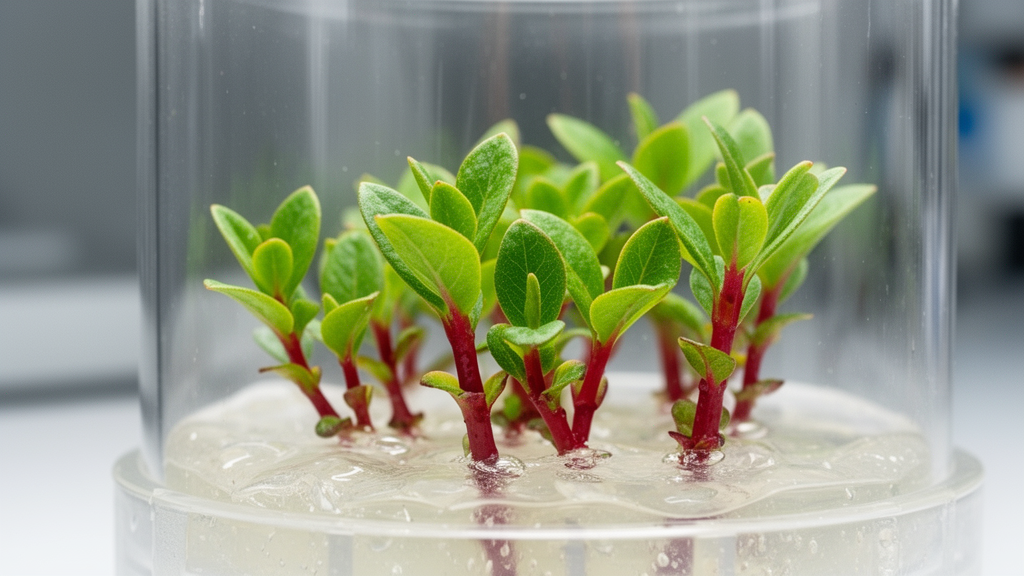
To overcome these developmental constraints, the research team first focused on engineering an efficient, two-stage adventitious shoot regeneration platform using vegetative tissues harvested from two-year-old orchard trees in Chongzhou City, Chengdu, Sichuan Province, China. In vitro plantlets were established by sterilizing 5- to 7-centimeter moderately lignified spring shoots with ethanol and sodium hypochlorite, after which 1-centimeter single-bud stem segments were inoculated onto Woody Plant Medium supplemented with 4 milligrams per liter of zeatin at pH 5.2. Leaf explants derived from 8- to 10-week-old subcultured plantlets maintained on Woody Plant Medium with 1 milligram per liter of zeatin were subsequently used to systematically evaluate hormone formulations. The investigators tested multiple cytokinin and auxin combinations, comparing zeatin concentrations of 2, 3, and 4 milligrams per liter and 6-benzylaminopurine concentrations of 1, 2, and 3 milligrams per liter combined with 0.5 milligrams per liter of naphthaleneacetic acid against thidiazuron treatments at 1, 2, and 3 milligrams per liter combined with 0.5 milligrams per liter of naphthaleneacetic acid.
The hormonal evaluations demonstrated that cytokinin type and concentration strictly govern adventitious bud initiation and subsequent shoot development. While initial induction media containing 1 or 2 milligrams per liter of thidiazuron combined with 0.5 milligrams per liter of naphthaleneacetic acid produced significantly higher regeneration rates of 58.9 percent and 72.1 percent, respectively, the resulting adventitious shoots remained arrested as small buds and completely failed to elongate during continued culture. Conversely, explants cultured directly on media containing zeatin exhibited lower overall regeneration rates, such as 22.2 percent on medium supplemented with 3 milligrams per liter of zeatin, but produced markedly healthier, better-developed vegetative shoots. To resolve this developmental antagonism between proliferation and elongation, the authors implemented a sequential two-stage protocol: leaf explants were first placed on thidiazuron-naphthaleneacetic acid induction medium for 20 days to trigger bud initiation, and the developing buds were subsequently transferred to medium containing 3 milligrams per liter of zeatin, which successfully induced robust shoot elongation across all treated explants.
Alongside phytohormone optimization, the team methodically refined explant physical conditions and environmental variables to maximize shoot organogenesis. Evaluating leaf positions along in vitro-grown plantlets revealed that younger top leaves collected from shoot tips achieved an adventitious shoot regeneration rate of 25.3 percent, significantly outperforming middle leaves at 13.2 percent and basal leaves at 10.6 percent. Leaf wounding techniques also proved pivotal: moderate wounding, designated Method 2, differentiated regenerated shoots at a rate of 34.2 percent, whereas slight wounding yielded 17.1 percent and excessive mechanical trauma reduced regeneration to just 7.0 percent. Furthermore, explant orientation on the culture plate exerted complete control over organogenic competence; placing leaf explants with their abaxial, or back, surface in direct contact with the medium while the adaxial surface faced upward yielded a 33.3 percent regeneration rate, whereas placing the adaxial surface downward completely prevented adventitious shoot formation. Finally, subjecting the explants to an initial 12-day dark incubation period produced a 27.7 percent shoot regeneration rate, significantly surpassing shorter 8-day and 10-day dark incubation treatments before transfer to a 16-hour photoperiod at 25 degrees Celsius.
Prior to introducing foreign DNA, the investigators calibrated the baseline antibiotic sensitivity of non-infected blueberry leaf explants to establish an airtight chemical selection threshold. Culturing explants across gradient concentrations of kanamycin indicated that while explants maintained an 83.4 percent regeneration rate on antibiotic-free medium and 39.4 percent at 7.5 milligrams per liter, shoot regeneration dropped to exactly zero at 10 milligrams per liter. At this 10 milligram per liter threshold, explant tissues produced only unorganized white calli and stunted, purplish-red shoots that failed to undergo normal vegetative morphogenesis, identifying 10 milligrams per liter of kanamycin as the optimal selective concentration for suppressing untransformed escapes on adventitious regeneration medium. Because developing blueberry root systems are inherently fragile, the researchers determined that kanamycin selection pressure had to be omitted entirely during the subsequent rooting stage on half-strength Woody Plant Medium supplemented with 1 milligram per liter of indole-3-butyric acid.
Building upon the optimized regeneration protocol, the team systematically mapped the physical and biological parameters governing Agrobacterium tumefaciens infection efficiency. The binary vector construct, pK2GW7, harbored four independently driven expression cassettes: an enhanced green fluorescent protein reporter gene, a spectinomycin resistance marker, a plant kanamycin resistance gene, and CgRuby1, an R2R3 MYB transcription factor isolated from wild purple pummelo (Citrus grandis) that regulates anthocyanin biosynthesis. Five transformation variables were evaluated using resistant shoot regeneration rates quantified after 40 days on selection medium. Liquid-cultured Agrobacterium significantly outperformed solid-plate cultures, yielding resistant shoot regeneration rates of 8.5 percent compared to 2.6 percent. Assessing suspension densities demonstrated that an optical density at 600 nanometers of 0.8 achieved the highest regeneration rate of 7.4 percent, whereas higher bacterial concentrations led to sharp declines, dropping to 1.7 percent at an optical density of 1.1. Inoculation duration testing showed that a 1-hour infection yielded a peak resistant shoot rate of 6.3 percent, whereas a 3-hour infection completely suppressed shoot regeneration.
Physical infiltration and co-cultivation duration constituted additional critical determinants of transformation success. Applying a negative pressure vacuum infiltration of minus 80 kilopascals during Agrobacterium infection enhanced the resistant shoot regeneration rate to 7.2 percent, outperforming ambient treatments by facilitating bacterial entry into stomatal cavities and internal intercellular air spaces without compromising tissue viability. Co-cultivation testing revealed that maintaining leaf explants on co-culture medium for 6 days produced the optimal resistant shoot regeneration rate of 6.5 percent, compared to 5.8 percent for 8 days and only 3.4 percent for 4 days. When the complete set of optimized parameters was applied to a verification batch of 200 inoculated leaf discs, the authors successfully recovered 13 independently derived, antibiotic-resistant plantlets exceeding 2 centimeters in height after approximately six months of selective subculture, establishing a final stable transformation efficiency of 6.5 percent.
Molecular and microscopic validations verified both the physical integration of the transgene and the exclusion of residual Agrobacterium contamination. Three weeks post-infection, stereo fluorescence microscopy revealed distinct green fluorescence signals in kanamycin-resistant adventitious shoots under enhanced green fluorescent protein excitation, whereas wild-type control shoots exhibited no green fluorescence. Polymerase chain reaction amplification using primers specific to CgRuby1 confirmed the presence of the transgene across all 13 independent kanamycin-resistant plantlets. Concurrently, diagnostic polymerase chain reaction targeting the Agrobacterium-specific VirD2 gene yielded no detectable amplification products in the transgenic lines, confirming that positive CgRuby1 bands originated from true nuclear genomic integration rather than persistent Agrobacterium colonies within explant tissues.
Phenotypic and physiological assessments confirmed that the integrated CgRuby1 transcription factor was biologically functional in blueberry tissue. One month after transfer to soil, leaves of the transgenic lines displayed a distinct, visually scorable purplish-red pigmentation, standing in sharp contrast to the uniform green foliage of wild-type plants. Spectrophotometric anthocyanin measurements using the pH differential method demonstrated that CgRuby1-overexpressing lines accumulated significantly higher anthocyanin concentrations in leaf tissues than wild-type controls. Furthermore, quantitative real-time polymerase chain reaction analyses demonstrated that the ectopic expression of CgRuby1 coincided with the significant transcriptional upregulation of five core endogenous anthocyanin biosynthetic structural genes: chalcone synthase (VcCHS), flavanone-3-hydroxylase (VcFHT), dihydroflavonol 4-reductase (VcDFR), anthocyanidin synthase (VcANS), and UDP-glucose: flavonoid 3-glucosyl transferase (VcUFGT).
In evaluating the broader significance and limitations of the work, the researchers noted that their 6.5 percent transformation efficiency in ‘Legacy’ represents a modest but statistically significant improvement over earlier reported rates of 5.6 percent for the same cultivar. The authors emphasized that because adventitious shoots typically arise from groups of cells rather than single isolated cells, the possibility of sectorial chimerism cannot be completely excluded in primary regenerants, recommending systematic multi-tissue molecular screening and single-cell or seed propagation systems to ensure stable, homohistic lines. While noting that transformation efficiency in blueberries remains lower than in model plant species, the team concluded that their integrated two-stage regeneration system, combined with vacuum-assisted infection and visual Ruby1 reporting, provides a reliable experimental framework for functional genomics and future precision breeding tools, such as CRISPR-mediated gene editing, across commercially cultivated blueberry varieties.
Subject of Research: Highbush blueberry shoot regeneration and Agrobacterium-mediated genetic transformation protocol optimization
Article Title: Optimization of in vitro adventitious shoot regeneration and genetic transformation systems in blueberry (Vaccinium corymbosum) using a heterogeneous Ruby1 gene
Article References: Zhang, M., Du, R., Fang, L., Shi, X., Hou, C., Wei, X., Xu, Y., Liu, C., & Wang, X. (2026). Optimization of in vitro adventitious shoot regeneration and genetic transformation systems in blueberry (Vaccinium corymbosum) using a heterogeneous Ruby1 gene. Horticulture Advances, 4(1), Article 3. https://doi.org/10.1007/s44281-025-00092-5
Image Credits: AI Generated
DOI: 10.1007/s44281-025-00092-5
Keywords: Vaccinium corymbosum, blueberry breeding, shoot regeneration, genetic transformation, Agrobacterium tumefaciens, CgRuby1, anthocyanin biosynthesis, thidiazuron, zeatin, vacuum infiltration, reporter genes, plant tissue culture, kanamycin selection, enhanced green fluorescent protein, plant biotechnology, tetraploid crops
News Source: Juliet Wilcox. (November 19, 2026). Researchers Optimize Blueberry Shoot Regeneration and Transformation Systems Using Citrus Ruby1 Gene. Scienmag.