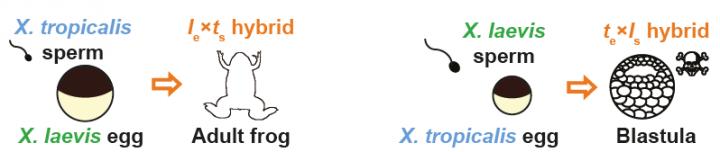
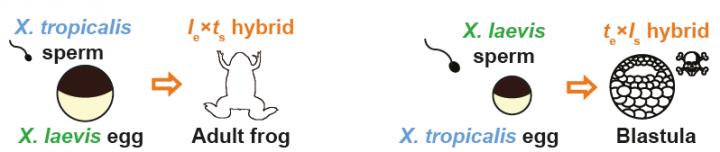
Credit: University of California Berkeley, Radboud University
When two related species crossbreed, their genetic material crosses, which can lead to new species. But every so often there is a difference in the offspring, depending on which of the two species is the mother and which one is the father. A well-known example of a hybrid is a mule, the offspring of a male donkey and a female horse. The other way around, the offspring of a female donkey and a male horse is a different animal: a hinny. It thus makes a difference which species is the father and which one is the mother.
One hybrid is viable, the other hybrid is not
Both mules and hinnies are infertile, because donkeys and horses have a different number of chromosomes, the protein structures on which genetic material is present. Yeasts, plants, fish and amphibians (in contrast to mammals) can however produce fertile hybrids. Professor of Molecular Developmental Biology Gert Jan Veenstra: "For instance, in frogs a duplication of chromosomes can appear, in which the whole set of chromosomes from the father and the mother are passed on to the next generation." However, there is another problem: some hybrids are not viable, while the crossbreeding the other way around is. The embryos are genetically identical, but there is a difference in viability, depending on the father species and the mother species. Veenstra: "Even though it is vital for evolution, the mechanisms of viable and non-viable hybrids are to this date unknown."
Crossbreeding the African and Western clawed frog
The scientists showed this phenomenon in research with two related frog species: Xenopus tropicalis and Xenopus laevis (also known as the Western and African clawed frogs, respectively). When a female African clawed frog is crossbred with a male Western clawed frog, the embryos are viable. However, the other way around, crossbreeding a male African clawed frog and a female Western clawed frog leads to embryos that die in the early stages of development. Why that is, remained unclear.
Not viable due to dysfunctional separation of paternal chromosomes
On 10 January, researchers publish what went wrong during this crossbreeding: the maternal molecular machinery of the Western clawed frog cannot fully recognize the paternal chromosomes of the African clawed frog. Two specific pieces of the paternal chromosomes are incompatible with the maternal cell and thus the separation of the chromosomes during cell division is disrupted. These cells now lack a large number of important genes, such as genes for metabolism, and therefore quickly die.
This shows there is a strong asymmetry when it comes to hybrids, depending on the father species and mother species. "These findings are important, because these type of hybrids are present in nature and in some cases lead to new species. When new species are formed, there seems to be a period of transition: closely related species are able to produce viable offspring, but if the chromosomes are no longer compatible it leads to asymmetric results of crossbreeding. When species further separate, crossbreeding no longer leads to viable offspring. We here show the cellular mechanism behind this phenomenon," states Gert Jan Veenstra.
Viable hybrid also reveals molecular mechanism
The viable hybrid of a male Western clawed frog and a female African clawed frog also revealed a molecular mechanism: parasitic DNA elements (transposons) are activated in one of the genomes. Veenstra: "The female's immune system is not wired to recognize the paternal transposons and hence does not repress them. As a consequence, parasitic DNA elements are now able to fulfill a new role: they can act as regulatory DNA that influences gene activity. This may have a large influence on formation and characteristics of a new species." These findings were published in Genome Biology (Elurbe et al, 2017).
###
Media Contact
Gert Jan Veenstra
[email protected]
31-243-610-541
http://www.ru.nl
Related Journal Article
http://dx.doi.org/10.1038/nature25188