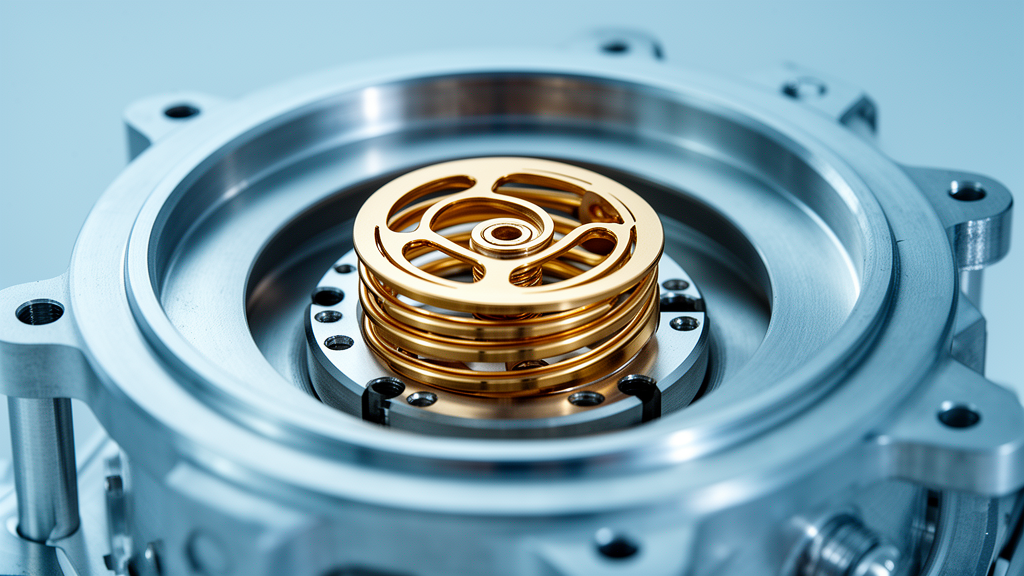
Free-piston Stirling cryocoolers are essential for cooling applications in spaceborne infrared payloads, superconducting devices, and sensitive medical instrumentation, where reliable operation for years without maintenance is a prerequisite. The heart of these machines is the compressor, which must provide energy conversion while maintaining precise dynamic alignment of the piston within its cylinder. This delicate suspension task is typically handled by spiral flexure springs, which allow the reciprocating assembly to oscillate without the sliding contact that would cause friction, wear, and the requirement for lubricants—the latter being problematic because contaminants would freeze and foul heat exchangers at cryogenic temperatures. Despite their importance, the design of these flexure discs remains a complex, coupled challenge where geometric and material parameters dictate cyclic endurance, radial stability, and resistance to resonant failure.
Researchers have now completed a systematic parametric design selection procedure and experimental assessment focused on identifying a manufacturable beryllium-copper spiral flexure spring that meets these demanding requirements. This study addresses a notable research gap: whereas existing literature often addresses isolated aspects such as beam mechanics or finite element modeling, this effort integrates geometry screening, material selection, manufacturability, and high-cycle fatigue endurance into a single traceable design methodology. By treating manufacturing feasibility—specifically photochemical etching constraints—as a hard requirement from the outset, the team ensured the resulting design was not merely numerically optimal but physically realizable.
The parametric screening procedure evaluated six candidate alloys: AISI 302, AISI 304, Be-Cu C17000, Be-Cu C17200 TH, Ti-6Al-4V, and AMPCOLOY® 944. Alongside material choice, the team investigated five key geometric variables: spiral-arm count, spiral-cut width, disc thickness, sweep angle, and disc diameter. Finite element analyses were conducted using ANSYS® Workbench to assess stress-life fatigue, modal behavior, and static structural performance under a maximum stroke of ±5 mm. The selection of Be-Cu C17200 TH was ultimately driven by its favorable combination of mechanical properties, specifically its high yield strength and fatigue limit, and its compatibility with the photochemical etching process, which allows for intricate slot geometry without the introduction of burrs or heat-affected zones that might otherwise serve as sites for crack initiation.
The finalized design features a three-arm spiral configuration with a 0.6 mm cut width, a 560° sweep angle, and a 0.7 mm disc thickness within a 69 mm diameter envelope. For this specific geometry, analytical, numerical, and experimental methods yielded axial stiffness values of 1495.00, 1451.45, and 1460.25 N/m, respectively. The alignment between these three independent routes is notable, with the two experimental and numerical physical models agreeing within 0.6%. This degree of correlation provides confidence that the flexure properties are inherent to the design rather than artifacts of a single modeling approach, establishing a reliable basis for predicting how the suspension will perform when integrated into larger stacks.
Central to the durability of the flexure is its capacity to balance competing stiffness requirements. The design achieved a stiffness ratio—the ratio of radial stiffness to axial stiffness—of approximately 12 to 13. This property is crucial, as it allows the disc to maintain high radial rigidity to keep the piston centered and avoid friction, while remaining compliant along the axial direction to permit the required stroke. The research emphasized that even a small failure in maintaining this radial alignment can lead to excessive wear, illustrating why radial stiffness and fastener configuration are considered first-class design outcomes alongside axial spring rates.
A critical component of the study involved local geometric optimization at the terminations of the spiral cuts, where stresses typically concentrate. By evaluating four discrete endpoint profiles ranging from unmodified to a fully developed curved transition, the team achieved a 15.65% reduction in peak equivalent stress without changing the disc’s diameter, thickness, or arm width. Given that flexure fatigue is governed by local stress maxima at these points, this modest geometric relief translates to a significant extension in predicted fatigue life. This finding underscores the necessity of precise tolerancing and inspection of etched edge finishes in the manufacturing chain.
To validate these design choices, the researchers conducted an ambient fatigue campaign using a purpose-built dynamic test rig. The selected Be-Cu C17200 TH disc was subjected to 100,755,000 fully reversed cycles at 50 Hz and a ±5 mm stroke. The test exceeded the target 108-cycle run-out criterion by 0.76% without the detection of crack initiation, fracture, or abnormal running noise. While this serves as a successful run-out, the researchers clearly delineate that this result should not be misinterpreted as a statistical demonstration of infinite life or a definitive fatigue limit. Establishing scatter bands and locating the true endurance limit would require testing multiple specimens across varied stress levels, which remained outside the present scope.
Modal analysis was also central to ensuring the device operates away from dangerous resonant frequencies. The team extracted the first six natural frequencies, which include a working axial translation mode and several rocking pairs. At the selected 0.7 mm thickness, these modes were spread across the frequency scale, providing a functional operating window. Interestingly, when the researchers moved from component-level modeling to assembly-level FFT measurements on stacked discs, they observed divergence between the model and the experiment. When the permanent magnet was included, agreement was good, but without it, the model under-predicted frequency by as much as 40%. This highlights the dominance of assembly-level effects—such as bolt preload and spacer interaction—over bare component performance, reinforcing the need for physical modal validation in fully assembled compressors.
Despite the success of the ambient validation, the researchers acknowledge several limitations that define the current boundary of the evidence. All experimental assessments were performed under laboratory ambient conditions, and because properties like elastic modulus and fatigue strength can shift at cryogenic temperatures, the ambient-temperature performance cannot be assumed to hold at 77 K. Furthermore, differential thermal contraction between the beryllium-copper disc, the stainless-steel shaft, and the support structure is expected to induce residual stresses not present in the room-temperature model. These factors remain essential areas for future work, requiring coupled thermal-structural analysis and cryogenic fatigue testing.
Ultimately, this study serves as a documented reference design rather than a claim of global optimality across the entire flexure design space. By bringing together material selection, manufacturing feasibility, endpoint stress relief, and experimental verification, the work provides an audit-friendly chain of evidence for high-reliability cryocooler programs. The focus remains on methodological rigor, emphasizing that flexure qualification is a coupled, multi-domain problem that cannot be settled by numerical simulation alone. Future efforts will prioritize cryogenic characterization, multi-specimen statistical reliability testing, and the integration of these findings into formal multi-objective optimization models for future cryocooler systems.
To ensure computational accuracy, the structural simulation used quadratic twenty-node hexahedral and fifteen-node wedge solid elements capable of capturing combined bending and torsion gradients through the thin flexure sheet. Mesh convergence was verified separately for stress and dynamic responses. In the static structural evaluation, five progressively refined meshes spanning 23,598 to 134,087 nodes exhibited a variation of only 0.6 percent, with peak equivalent stress shifting from 305.90 to 307.69 megapascals across a 5.7-fold node increase. Similarly, seven meshes up to 836,547 nodes confirmed modal convergence, where computed natural frequency remained invariant at 25.61 hertz across the three finest grids.
The mechanical simulation revealed a linear elastic response across the displacement range. As central displacement increased in one-millimeter increments from 1 to 5 millimeters, equivalent stress rose by 61.20 megapascals per millimeter and equivalent strain by 453.74 microstrain per millimeter, yielding an implied secant modulus of roughly 134.9 gigapascals. Physical strain measurements with metal-foil gauges connected to a Wheatstone bridge recorded 2427 microstrain at full 5-millimeter travel, giving a surface stress of 327.71 megapascals. Furthermore, numerical fatigue modeling illustrated the impact of alloy choice: under identical geometry, Be-Cu C17000 predicted a finite life of only 8.162 million cycles with failure initiating at outer fastening holes, whereas C17200 TH reached the 100-million-cycle run-out threshold.
The experimental fatigue validation relied on a dynamic test rig engineered to isolate magnetic and mechanical interactions. To prevent magnetic interference with the linear motor, non-magnetic materials were specified throughout the structure, including brass, aluminum, and AISI 302 stainless steel. The oscillating drive comprised a Delrin coil former wound with enameled copper wire, soft-iron pole pieces, a 75-millimeter diameter neodymium-iron-boron disc magnet, and a 270-millimeter reciprocating stainless-steel shaft secured through the disc hub. Operating for 400 to 500 minutes daily under continuous observation, the rig accumulated an average of 1,325,724 cycles each day over approximately 76 days, demonstrating hardware survival under realistic mounting preload and dynamic operating conditions.
Static axial compliance testing corroborated the numerical spring constant through incremental loading. Across eight load increments from 1.0 to 14.7 newtons measured with a dial gauge of 0.01-millimeter least count, deflections scaled from 0.69 to 10.00 millimeters, yielding individual stiffness readings between 1449.28 and 1480.00 newtons per meter that remained within 1.4 percent of the 1460.25 newtons per meter mean. Complementing this, numerical evaluations documented the progression of stress mitigation across four discrete relief configurations. Moving from an unmodified cut termination at 155.97 megapascals to an initial curved relief at 150.89 megapascals, a developed profile at 141.62 megapascals, and a fully developed curved transition at 131.56 megapascals, localized notch stresses dropped steadily without altering external envelope dimensions.
Subject of Research: Engineering development and experimental validation of a spiral flexure suspension for Stirling cryocooler compressors.
Article Title: Parametric design selection and ambient experimental assessment of a beryllium-copper spiral flexure spring for long-life Stirling cryocooler compressors
Article References: Bhojwani, V., Bhoyar, S., Sidheshware, R., Tipole, P., & Kulkarni, S. (2026). Parametric design selection and ambient experimental assessment of a beryllium-copper spiral flexure spring for long-life Stirling cryocooler compressors. Frontiers in Mechanical Engineering, 12, 1958177. https://doi.org/10.3389/fmech.2026.1958177
Image Credits: AI Generated
DOI: 10.3389/fmech.2026.1958177
Keywords: Beryllium copper, Stirling cryocooler, flexure spring, fatigue life, finite element analysis, cryogenics, mechanical suspension, compressor reliability, photochemical etching, spiral flexure, modal analysis, stress concentration, design optimisation, ambient experimental validation, reciprocating machinery
News Source: Denise Maddox. (November 19, 2026). Beryllium-Copper Flexure Spring Design Enhances Long-Life Stirling Cryocooler Compressor Reliability. Scienmag.