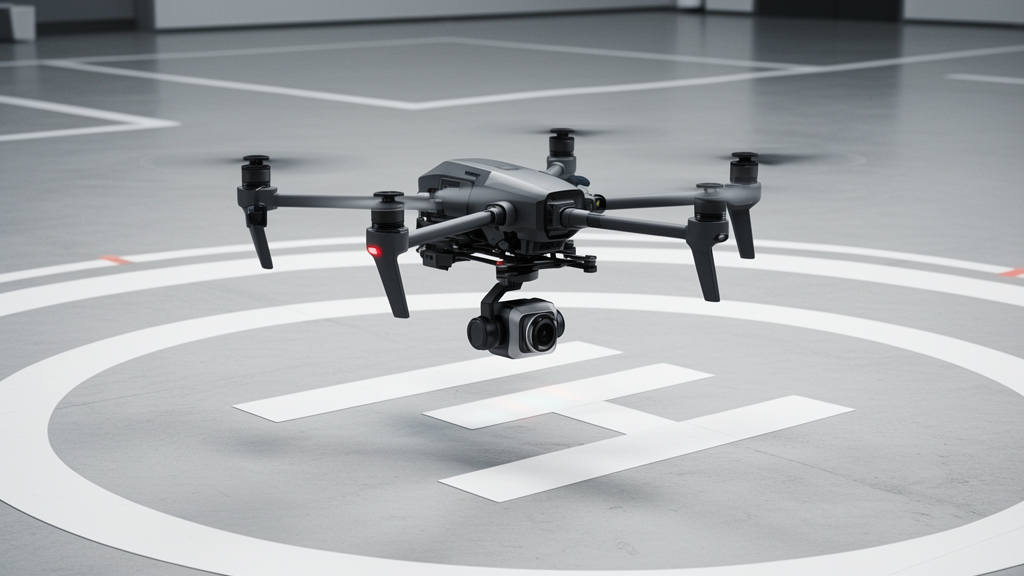
Robotics researchers comparing autonomous terminal landing methods for multirotor aerial vehicles have demonstrated that an evolutionary optimized feedback controller completes vision-guided touchdowns significantly faster than a model-free reinforcement learning policy while maintaining comparable terminal accuracy and reliability. The study, conducted by an engineering research team from Bialystok University of Technology, AVY Amsterdam, and Delft University of Technology, evaluated tabular Q-learning against a genetic-algorithm-tuned feedback controller operating in proportional-derivative form. Both control strategies shared an identical perception pipeline relying solely on a downward-facing monocular camera detecting an ArUco fiducial marker, requiring neither satellite positioning nor external optical motion-tracking systems during the final landing phase. By testing both architectures on the same physical quadrotor platform after identical simulation-based training in ROS 2 and Gazebo, the authors established a controlled benchmark isolating the practical consequences of learning a discrete state-action policy versus tuning continuous feedback gains.
Precision landing represents a critical operational bottleneck for autonomous unmanned aerial vehicles, particularly in logistics, emergency medical delivery, and disaster response scenarios where aircraft must touch down safely in constrained customer zones or drop sites. In dense urban canyons, near structural obstacles, or inside sheltered facilities, global navigation satellite system signals frequently degrade through severe multipath interference, geometric attenuation, or complete signal loss. While artificial visual fiducial markers like ArUco tags provide a reliable local frame of reference by enabling relative pose estimation directly from camera images, closing the loop between visual detection and multirotor motor commands introduces complex trade-offs. Prior investigations into learned visual guidance frequently assessed individual control techniques in bespoke simulated setups, preventing direct comparisons of how distinct adaptation strategies behave when subjected to real-world flight dynamics, latency, and sensor noise.
To overcome this methodological limitation, the investigators configured a unified comparative framework wherein both control pipelines derived guidance from the same vision front end. A physical DJI RoboMaster TT Tello Talent quadrotor, having a total mass of 87 grams, dimensions of 98 by 92.5 by 41 millimeters, and an onboard Intel Movidius Myriad vision processing unit with an ESP32 microcontroller, served as the testbed. A monocular camera captured downward images at a resolution of 320 by 240 pixels. The image processing pipeline detected the four corners of a 178-millimeter ArUco tag placed at the center of a two-meter square platform, computing its horizontal image-plane center coordinates, apparent pixel size, and planar orientation angle. This visual pipeline operated identically in both simulation and physical flight, ensuring that control decisions relied strictly on perceived marker geometry rather than simulated ground truth.
The reinforcement learning architecture employed tabular Q-learning, providing a model-free, highly interpretable policy that mapped quantized visual observations into discrete translation commands without requiring neural network approximations. The continuous visual state was compressed into a tractable discrete space by applying a divisor to the horizontal pixel coordinates and quantizing the apparent marker size into discrete increments of ten. From this state representation, the agent selected among five discrete motion primitives corresponding to fixed translations of 0.25 meters in the forward, backward, left, right, or downward directions in the drone’s local frame. An upward action was intentionally omitted because the terminal landing phase requires monotonic descent toward the target. In simulation, training episodes were initialized at an altitude of three meters with random lateral displacements within a two-meter box, utilizing an error-based shaped reward function that penalized misalignment, rewarded descending when centered, and applied substantial terminal bonuses or penalties for successful approaches or lost visual contact.
In contrast, the evolutionary approach utilized a classical parallel feedback control structure where proportional and derivative gains across four independent axes—lateral translation along X and Y, vertical descent along Z, and yaw rotation—were optimized offline using a genetic algorithm implemented via the PyGAD library. Integral gains were held at zero because the transient nature of the alignment and descent maneuver prioritized rapid convergence over long-term offset elimination, making the deployed architecture an eight-parameter proportional-derivative controller. To evaluate candidate parameter chromosomes, the genetic algorithm simulated a landing approach from a fixed initial pose at an altitude of 2.5 meters with an initial heading offset of one radian. The fitness function scored trajectories using weighted penalties on absolute terminal position errors, time-averaged velocity errors relative to a nominal 0.25 meter per second approach rate, and time-averaged accelerations, while applying substantial penalties for marker loss or terminal altitude overshoots.
Extensive simulation trials revealed distinct behavioral sensitivities for each adaptation mechanism during the training phase. In the Q-learning parameter evaluations, the state-space discretization divisor exerted a profound influence on training efficiency and policy quality. A fine discretization divisor of 10 yielded the highest final average reward of 1,760 over the last 500 episodes but required 7,510 training iterations and over an hour and 45 minutes of computation. An excessively coarse divisor of 100 destabilized learning, failing to converge cleanly after 5,310 iterations. A moderate divisor of 75 achieved the optimal balance, reaching the study’s practical stopping criterion of a 70 percent success rate in just 510 iterations and seven minutes of wall-clock training. Evaluations of learning rates demonstrated that intermediate values of 0.3 to 0.5 enabled rapid, monotonic policy acquisition, whereas elevated learning rates of 0.7 and 0.9 caused volatile Q-value updates, requiring up to 9,410 iterations to reach threshold performance.
Parallel parameter studies conducted for the genetic algorithm indicated that population size and parental selection ratios dictated the quality of the evolved feedback gains. Testing population sizes across 10, 25, 50, 75, and 100 candidate sets showed that optimization performance peaked at a population of 75, which achieved the highest fitness value of 91,325 within 22 minutes. Increasing the population further to 100 yielded a lower peak fitness of 84,500 despite increased computational overhead. Varying the parent-to-population ratio demonstrated that retaining an intermediate ratio of 25 percent produced the most stable evolutionary progress and the highest overall fitness score of 97,025 across 50 generations. Smaller parent ratios of 5 and 10 percent led to sharp fitness fluctuations across generations due to insufficient retention of successful solutions, while overly large ratios restricted population diversity and slowed parameter refinement.
Before conducting physical flight trials, the research team analyzed the environmental robustness of both controllers in simulation under differing illumination regimes. Fifteen trials per controller were executed under bright, uniform lighting and under a degraded poor-lighting scenario featuring an angled spotlight producing non-uniform surface radiance. Statistical analysis combining Welch unequal-variance t-tests and non-parametric Mann-Whitney tests confirmed that neither controller suffered a statistically significant degradation in landing error when lighting diminished. To examine practical equivalence, the authors performed two one-sided tests using a predefined tolerance margin of plus or minus 0.05 meters. For the GA-PID controller, which generated near-degenerate error distributions with standard deviations below 0.004 meters, practical equivalence was conclusively confirmed with a significance value below 0.001. For Q-learning, large sample dispersion spanning 0.41 to 0.51 meters limited test power, meaning equivalence within the tight 0.05-meter window could not be formally confirmed.
Physical flight validation was performed indoors with the Tello quadrotor executing autonomous landing runs initialized from randomized horizontal offsets at an initial altitude of two meters. Both controllers guided the aircraft until reaching a visual terminal threshold corresponding to approximately 0.5 meters above the marker, at which point an automated landing routine commanded a vertical open-loop touchdown. Across ten physical trials per method, the GA-PID controller completed all ten approaches successfully, achieving a 100 percent observed success rate with a 95 percent Wilson confidence interval of 72 to 100 percent. The Q-learning controller successfully completed nine of ten trials, yielding a 90 percent observed success rate with a 95 percent Wilson confidence interval of 60 to 98 percent. A Fisher exact test indicated that this difference in success rates was not statistically significant, confirming that a single trial failure cannot establish a definitive reliability gap between the two approaches.
However, an acute divergence emerged in operational speed. The GA-PID controller executed landings with a mean completion time of 16.9 seconds and a median of 16.5 seconds, with individual runs tightly bounded between 14 and 22 seconds. Conversely, Q-learning produced a mean approach time of 64.2 seconds and a median of 54.0 seconds, ranging widely from 41 to 136 seconds, with the single unsuccessful trial reaching the 50-step timeout at 220 seconds. Non-parametric evaluation confirmed this temporal disparity was statistically significant with a Mann-Whitney p-value below 0.001 and a Cliff delta effect size of 1.0, indicating that every individual GA-PID flight landed faster than every Q-learning flight. This difference arose not only from policy structure but also from the actuation interface: GA-PID updated continuous velocity commands every cycle, whereas Q-learning executed discrete 0.25-meter displacement steps that had to complete fully before processing subsequent visual observations.
Regarding terminal landing accuracy on the ground, the GA-PID controller recorded a mean horizontal error of 14.6 centimeters with a standard deviation of 6.9 centimeters across its ten successful trials, compared to a mean error of 18.9 centimeters with a standard deviation of 4.4 centimeters across the nine successful Q-learning attempts. When including the single Q-learning timeout trial, the overall mean error reached 20.3 centimeters. Median landing errors were remarkably close at 17.0 centimeters for GA-PID and 18.0 centimeters for Q-learning. Statistical testing showed that this difference was not statistically significant, yielding a Mann-Whitney p-value of 0.33, a Welch t-test p-value of 0.12, and a modest Cliff delta of 0.28. These measurements demonstrate that despite operating with discrete 25-centimeter step primitives, the Q-learning policy attained terminal spatial positioning comparable to the continuously regulated controller.
The authors contextualized these experimental findings within the specific design boundaries of the study. Tabular Q-learning offered extreme computational simplicity, transparent inspectability of the learned state-action table, and independence from complex vehicle dynamics models, yet its spatial quantization produced distinctly segmented trajectories and lower control bandwidth. GA-tuned feedback control delivered exceptionally smooth simulated trajectories and rapid real-world execution, but its gains were optimized around a single approach geometry and required continuous attitude-correlated visual tracking. Furthermore, because both systems terminated closed-loop control at an altitude of 0.5 meters to prevent marker loss from camera field-of-view limits, real-world touchdown errors inevitably incorporated open-loop lateral drift accumulated during the final descent. The investigators concluded that future autonomous landing frameworks may benefit from continuous-action actor-critic reinforcement learning architectures or hybrid schemes that combine learned high-level decision policies with structured feedback regulation.
Subject of Research: Comparative evaluation of tabular Q-learning and genetic-algorithm-tuned feedback control for autonomous vision-guided UAV terminal landing
Article Title: Learning-based vision-guided precision landing for autonomous UAVs: comparative evaluation of reinforcement learning and evolutionary controller optimization
Article References: Łobacz, Ł., Ambroziak, L., Bożko, A., Kondratiuk, M., Sharma, S., & Venkatesha Prasad, R. R. (2026). Learning-based vision-guided precision landing for autonomous UAVs: comparative evaluation of reinforcement learning and evolutionary controller optimization. Frontiers in Neurorobotics, 20, 1974605. https://doi.org/10.3389/fnbot.2026.1974605
Image Credits: AI Generated
DOI: 10.3389/fnbot.2026.1974605
Keywords: unmanned aerial vehicles, autonomous landing, precision landing, tabular Q-learning, reinforcement learning, genetic algorithm, PID control, vision-guided navigation, ArUco marker, ROS 2, Gazebo simulation, sim-to-real transfer, quadrotor control, robotics, terminal descent, fiducial markers, controller optimization
News Source: Juliet Wilcox. (November 19, 2026). Vision Guided Drone Landing Tests Compare Genetic Tuning and Q Learning. Scienmag.