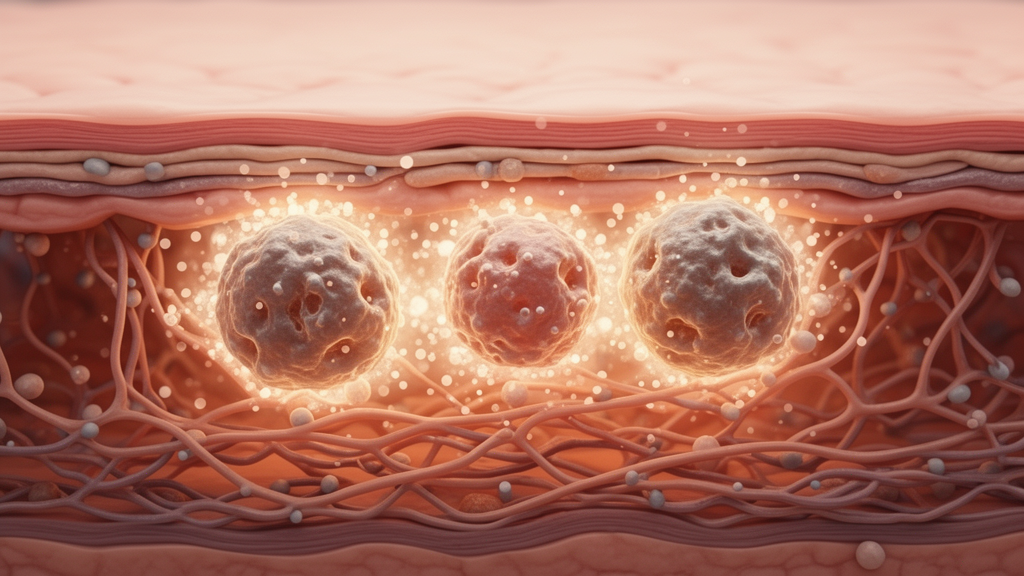
Recent research identifies cellular senescence as a pivotal risk factor and underlying mechanism driving the persistence and progression of chronic inflammatory skin disorders, marking a significant shift from the traditional focus on primary immune dysregulation. While these dermatoses—including psoriasis, atopic dermatitis, and systemic lupus erythematosus—have historically been categorized by immune system imbalances, findings demonstrate that senescent cells act as a hidden driver, creating a self-amplifying feedback loop that disrupts skin homeostasis. Cellular senescence is characterized as an irreversible state of cell cycle arrest accompanied by the senescence-associated secretory phenotype, mitochondrial dysfunction, and significant DNA damage. This complex biological process involves a constellation of morphological and molecular markers, including the accumulation of lipofuscin, elevated senescence-associated β-galactosidase activity, and epigenetic dysregulation, rather than a single specific biomarker.
The regulatory mechanisms of senescence are multi-layered, converging on core pathways that integrate intrinsic stress signals and extrinsic microenvironmental cues to enforce cell cycle arrest. The telomere attrition-DNA damage response pathway is central to this program, where the decline of chromosomal termini to a critical threshold triggers a persistent damage response, locking cells into a G1/G0 phase arrest. Simultaneously, the p53-p21 axis functions as a major stress-responsive network that, upon activation by DNA damage or reactive oxygen species, upregulates cyclin-dependent kinase inhibitors to block cell cycle progression. Complementary to this, the p16-retinoblastoma pathway operates independently to stabilize this arrest, particularly in response to oncogenic stress and chronological aging, where p16 accumulation prevents the dephosphorylation of the retinoblastoma protein, thereby silencing E2F transcription factors.
Triggering these pathways is a confluence of cumulative cellular damage that exceeds the capacity of homeostatic repair systems. Reactive oxygen species generated during oxidative stress represent a primary extrinsic driver, causing irreversible damage to DNA, proteins, and lipids, while chronic inflammatory signals from the microenvironment further accelerate cellular senescence. This creates a dangerous positive feedback loop: senescent cells release a repertoire of bioactive molecules known as the senescence-associated secretory phenotype, which includes pro-inflammatory cytokines such as IL-6, TNF-α, and IL-1β, as well as chemokines like MCP-1. These secretions not only disrupt local tissue homeostasis but also recruit immune cells to the inflammatory site, which in turn produce additional inflammatory mediators that induce further senescence in neighboring cells.
In the context of psoriasis, this pathogenesis is deeply intertwined with Th17-driven immune dysregulation. Evidence suggests that aberrant expression of proteins like IGFBP2 in psoriatic keratinocytes stabilizes p21 to promote senescence, while the PI3K/AKT signaling pathway is abnormally activated, maintaining the senescent state and sustaining chronic inflammation. Similarly, atopic dermatitis is marked by type 2 inflammation that leads to keratinocyte dysfunction and increased numbers of macrophages and fibroblasts exhibiting upregulated senescence markers.
Systemic lupus erythematosus represents another profound example of this interaction, where cellular senescence is prevalent across multiple cell types, including mesenchymal stem cells, T cells, and neutrophils. Molecular investigations have highlighted that the upregulation of SOX4 attenuates senescence in this disease, whereas the p16INK4A pathway acts as a principal mediator of premature arrest. Suppression of p16INK4A has been shown to reverse senescence-related phenotypes through the activation of extracellular signal-regulated kinase signaling pathways. These findings collectively establish that senescence and inflammation are not independent processes but are engage in a tightly coordinated, bidirectional crosstalk that defines the persistence, recurrent flare-ups, and treatment resistance often observed in chronic inflammatory skin diseases.
Therapeutic strategies targeting this axis are emerging as transformative approaches in modern dermatology. Senolytics, which are agents designed to selectively induce apoptosis in senescent cells while preserving healthy ones, have shown promise in preclinical models of psoriasis, atopic dermatitis, and lupus. The dasatinib–quercetin combination, alongside agents like fisetin and navitoclax, has demonstrated efficacy in reducing the abundance of senescent keratinocytes and dermal fibroblasts in lesional skin. Such selective ablation effectively interrupts the feed-forward cycle of SASP-driven inflammation and tissue dysfunction. Early clinical trials assessing intermittent oral administration of these agents have reported measurable declines in disease activity scores and reductions in circulating senescence-associated secretory phenotype factors, though these efforts are currently limited in scale and longitudinal duration.
Senomorphics, or SASP modulators, offer an alternative strategy by functionally neutralizing the proinflammatory effects of the secretory phenotype without necessarily eliminating the cells. JAK inhibitors constitute the most clinically advanced class of these agents, as they effectively suppress SASP factor expression and inhibit STAT1/3 phosphorylation in lesional tissues. Clinical evaluation in phase II and III trials for psoriasis, atopic dermatitis, and systemic lupus erythematosus has shown that these inhibitors provide disease-modifying effects beyond rapid symptom relief.
Conventional biologics, which primarily target cytokines or immune cell activation, also exert indirect influence on the senescent burden. By intercepting upstream inflammatory stimuli—such as IL-17, IL-23, IL-4, IL-13, or BAFF—these agents effectively abrogate the stress signals that propagate senescence. While these biologics do not directly modulate the senescence machinery, they facilitate systemic reprogramming of the inflammatory landscape, leading to sustained lesion clearance and improved patient quality of life. Despite these clinical successes, the broader translation of senescence-targeted interventions faces significant, interrelated challenges that must be addressed to ensure precision and safety.
A critical barrier is the lack of tissue specificity in systemic administration, which risks the inadvertent depletion of beneficial senescent cells in healthy organs. Furthermore, drug delivery remains suboptimal; oral senolytics suffer from low bioavailability in dermal compartments, while topical formulations encounter resistance from the stratum corneum barrier and enzymatic degradation in the epidermis. The heterogeneity of senescence across different cell lineages and the complexity of the stromal microenvironment further complicate the development of universal strategies. Additionally, evidence-based consensus regarding the optimal dosing frequency, intervention windows, and the long-term safety profile of repeated senescent cell depletion remains largely absent, necessitating rigorous, prospective longitudinal studies.
Future research must prioritize an in-depth investigation into the cellular heterogeneity of senescence across specific inflammatory dermatoses to establish a foundation for precision-targeted therapies. The development of novel therapeutics with improved safety profiles, coupled with advanced topical delivery strategies that minimize systemic exposure, remains a primary objective. Concurrently, the identification and validation of robust senescence-associated biomarkers are essential to facilitate early diagnosis, objective disease monitoring, and prognostic assessment. As the field advances toward large-scale multicenter clinical trials, targeting the self-perpetuating cycle of cellular senescence and inflammation holds great potential to transform the standard of care for chronic skin disorders, offering more effective, personalized options for long-term remission.
Although cellular senescence and chronic inflammation frequently coincide within diseased skin, single-cell RNA sequencing and multiparameter imaging reveal that senescent cells and infiltrating immune cells constitute distinct, non-overlapping populations. Transcriptomic profiling demonstrates that senescent cells show marked enrichment in DNA damage responses, cell cycle arrest, and the p53 and p16 pathways, whereas infiltrating inflammatory cells predominantly display immune effector functions, antigen presentation, and cytokine signaling cascades. Reliably distinguishing these groups in human and murine cutaneous tissue faces substantial methodological hurdles. Researchers must navigate the absence of a universally specific single biomarker, confounding signals from the complex inflammatory and stromal microenvironment, and the inherently low frequency and heterogeneous spatial distribution of senescent cells, making multimodal, multi-marker approaches essential.
At the genetic level, specific transcriptional networks govern these processes in distinct dermatoses. In psoriasis, research has identified four critical genes regulating cellular senescence and local immunity: the downregulation of the transcriptional regulator ID4 and cell cycle regulator CCND1 impairs epidermal barrier function and inhibits cell proliferation, whereas the upregulation of the chemokine CXCL1 and interferon regulator IRF7 drives cellular senescence and sustains chronic inflammation. Mechanistic evaluations similarly clarify how individual senolytic compounds exert selective activity. Dasatinib inhibits tyrosine kinase-dependent survival signaling in senescent immune cells and dermal fibroblasts, whereas quercetin preferentially targets senescent keratinocytes and epithelial-derived cells by modulating p53 and p21 expression. Additionally, navitoclax operates as a potent Bcl-2 and Bcl-xL inhibitor with selective efficacy against senescent stromal and mesenchymal cells, demonstrating how pharmacological regimens exploit divergent pro-survival dependencies.
Experimental interventions in systemic lupus erythematosus models further illustrate the therapeutic value of targeting intracellular signaling cascades and restoring mesenchymal stem cell function. In murine lupus models, rapamycin suppresses the hyperactivation of mammalian target of rapamycin signaling, thereby reversing the senescent state of bone marrow-derived mesenchymal stem cells. Subsequent adoptive transfer of these rapamycin-pretreated stem cells significantly ameliorated autoantibody production, glomerulonephritis, and cutaneous inflammation in diseased mice. Furthermore, senescent mesenchymal stem cells from patients with systemic lupus erythematosus exhibit aberrant activation of Wnt/β-catenin and p53/p21 signaling. Targeted intervention using pharmacological Dickkopf-1 or β-catenin-specific small interfering RNA successfully downregulates p53 and p21 expression, rescues mitochondrial function, and restores proliferative capacity, reversing prominent hallmarks of cellular senescence.
Subject of Research: Role of cellular senescence in the pathogenesis and treatment of chronic inflammatory skin disorders
Article Title: Cellular senescence: the “hidden driver” in chronic inflammatory skin disorders
Article References: Liang, H., Li, J., & Zhang, K. (2026). Cellular senescence: the “hidden driver” in chronic inflammatory skin disorders. Immunity & Ageing, 23(1), Article 25. https://doi.org/10.1186/s12979-026-00580-w
Image Credits: AI Generated
DOI: 10.1186/s12979-026-00580-w
Keywords: Cellular senescence, Chronic inflammation, Psoriasis, Atopic dermatitis, Systemic lupus erythematosus, SASP, Senolytics, Senomorphics, JAK inhibitors, Dermatology, Immunology, Tissue repair, Skin barrier, Molecular pathogenesis, Therapeutic targets, Cell cycle arrest
News Source: Beatrice Stafford. (November 19, 2026). Cellular Senescence Identified as Key Pathogenic Driver in Chronic Skin Inflammation. Scienmag.