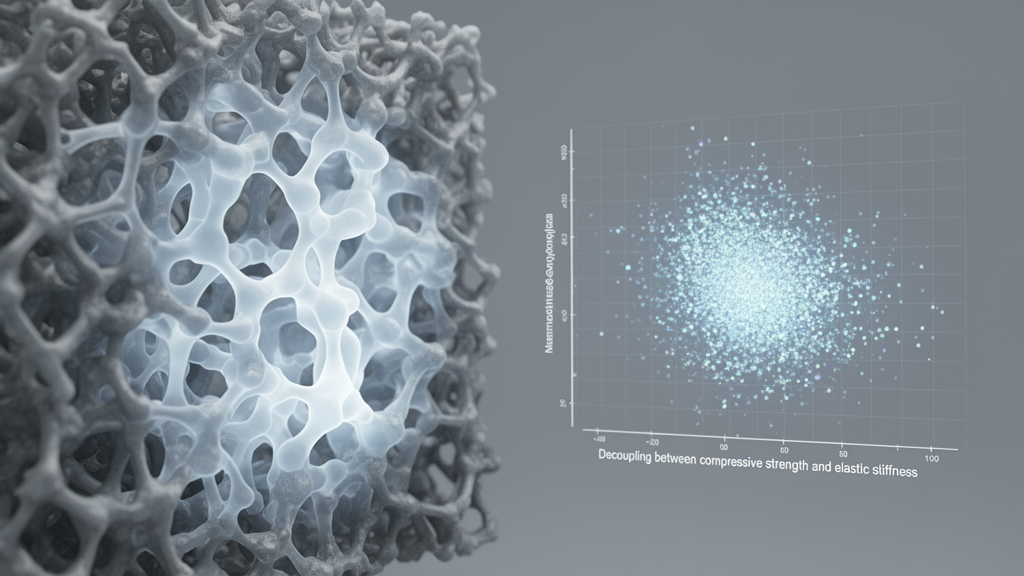
A database-supported synthesis and empirical modeling investigation evaluating geopolymer composites modified with nanomaterials has demonstrated that compressive strength alone is insufficient to reliably predict other principal mechanical properties, showing particularly poor correlation with elastic stiffness. Conducted by researchers Yasmin Hefni Abdel Aziz and Taha A. El-Sayed and published in Discover Civil Engineering, the structured literature analysis established that while nanomaterial additions can substantially alter binder microstructures through filler actions, nucleation effects, pore refinement, and crack-bridging mechanisms, the mechanical responses depend heavily on specific mixture parameters. By synthesizing mixture-level experimental records from across the published literature, the authors revealed that simple single-variable empirical correlations cannot capture the multifaceted behavior of these binder systems, functioning only as preliminary, database-specific empirical tools rather than universal design equations.
Geopolymer composites have gained significant interest across civil engineering as potential alternatives to ordinary Portland cement, whose industrial production accounts for approximately seven percent of global anthropogenic carbon dioxide emissions. To synthesize these binders, researchers have utilized industrial by-products and natural aluminosilicate sources including fly ash, ground-granulated blast-furnace slag, metakaolin, volcanic tuff, and red mud. Although elevated-temperature curing is frequently employed to accelerate geopolymerization in low-calcium fly-ash mixtures, incorporating nanoscale additives has emerged as an approach to modify reaction kinetics, refine pore networks, and improve mechanical performance even under ambient curing conditions.
Despite an expanding body of published experimental studies examining nanomaterial-modified geopolymers, existing research has remained fragmented, with prior review articles primarily offering qualitative discussions of material characteristics or focusing on single additive types. Previous studies often attempted to predict geopolymer mechanical performance using empirical equations originally calibrated for ordinary Portland cement, yet earlier comparisons revealed substantial discrepancies, including splitting tensile strength deviations of up to 1.48 megapascals. To address this methodological gap, the researchers conducted a systematic literature search covering publications from 2000 to January 2024 across Scopus, Web of Science, Google Scholar, and ScienceDirect. The study extracted, standardized, and screened mixture-level experimental records to establish a master database alongside property-specific paired regression datasets, providing an empirical benchmark to assess predictive relationships across heterogeneous experimental systems.
The resulting master database integrated 229 distinct experimental mixture records extracted from 50 reference entries representing 47 unique peer-reviewed experimental publications. Across this dataset, the precursor materials comprised fly ash, ground-granulated blast-furnace slag, metakaolin, volcanic tuff, red-mud blends, and diverse blended combinations. The master compilation documented 193 compressive strength measurements, 96 splitting tensile strength values, 126 flexural strength values, and 33 modulus of elasticity values, with all strength variables standardized into megapascals and elastic modulus standardized into gigapascals.
To ensure rigorous regression modeling without introducing synthetic assumptions, missing values were neither estimated nor mathematically interpolated. Instead, independent property-specific datasets were compiled containing exclusively complete paired observations with compressive strength. Following this screening protocol, the regression dataset for splitting tensile strength comprised 82 complete paired observations from 32 independent studies, covering compressive strengths between 19.00 and 69.00 megapascals and tensile strengths from 0.65 to 6.50 megapascals. The flexural strength regression dataset contained 88 complete paired observations across 35 studies, spanning compressive strengths of 19.00 to 89.00 megapascals and flexural strengths of 0.40 to 12.00 megapascals. The modulus of elasticity dataset was limited to 33 paired observations from 15 independent studies, representing compressive strengths between 11.30 and 65.00 megapascals and elastic moduli between 5.80 and 22.55 gigapascals.
The evaluation of compressive strength responses across the database revealed distinctly nonlinear and system-specific dosage behaviors rather than universal improvements. In the majority of investigated mixtures, compressive strength rose with increasing nanomaterial content until reaching a mixture-specific optimum threshold, beyond which performance leveled off or deteriorated. Nano-silica represented the most widely tested additive, showing favorable additions typically near two to three percent by binder mass, though reported optimums ranged from one to six percent depending on precursor reactivity and activator composition. Nano-clay and nano-alumina exhibited typical optimum dosages near two percent, whereas nano-metakaolin performed effectively between two and four percent. In contrast, carbon nanotubes and graphene oxide demonstrated significant mechanical enhancements at much lower dosages, generally between 0.01 and 0.5 percent, capitalizing on their elevated specific surface areas and aspect ratios to bridge microcracks and transfer internal stresses.
Adverse effects observed when dosages exceeded optimum levels were consistently linked to particle agglomeration, incomplete dispersion, increased liquid demand, and workability loss. Because nanomaterials possess high specific surface areas ranging from 10 to approximately 1300 square meters per gram, excessive additions absorb available alkaline activator solution, increasing mixture yield stress and plastic viscosity while promoting entrapped air and heterogeneous particle clusters. Furthermore, the synthesis highlighted that reported percentage gains can be misleading: a low-strength baseline control mixture can display a dramatic relative percentage gain that does not reflect superior absolute strength. Consequently, the research team emphasized that optimal dosage cannot be generalized as a universal constant, requiring mix-specific tailoring governed by precursor chemistry, activator alkalinity, mixing sequence, and dispersion techniques.
To model relationships between compressive strength and companion mechanical properties, the authors calibrated linear, power, and logarithmic regression equations using original-scale engineering units. When assessed via leave-one-out cross-validation, this linear model maintained a cross-validated coefficient of determination of 0.5836 and a root mean square error of 0.7922 megapascals, offering a modest predictive advantage over the standard Eurocode 2 equation, which produced a coefficient of determination of 0.5775 and an error of 0.7980 megapascals across the same geopolymer dataset.
In contrast to splitting tensile strength, flexural strength was most effectively represented by a logarithmic regression model, which yielded a coefficient of determination of 0.5161, a root mean square error of 1.3614 megapascals, and a mean absolute error of 0.8482 megapascals. Under leave-one-out cross-validation, the logarithmic relationship achieved a cross-validated coefficient of 0.4928 and an error of 1.3938 megapascals, outperforming existing ordinary Portland cement code formulations from ACI 318, AS 3600, and Eurocode 2, while showing close agreement with a previously published geopolymer equation by Mohammed and colleagues. The moderate magnitude of these correlation coefficients underscores that flexural strength is governed by crack distribution, interfacial aggregate-paste bonding, and fiber-bridging mechanisms that compressive strength values cannot inherently capture.
The evaluation of elastic stiffness highlighted the severe limitations of single-variable compressive strength correlations, with all tested regression equations exhibiting poor predictive power for modulus of elasticity. Leave-one-out cross-validation confirmed this instability, producing a cross-validated coefficient of determination of just 0.2235 and an error of 4.4273 gigapascals. While the empirical equation proposed by Samadi and co-authors offered the closest agreement among published literature models with an error of 4.8286 gigapascals, standard ACI relationships substantially overestimated observed geopolymer stiffness across the database.
The researchers cautioned that because the compiled datasets pooled concrete, mortar, and paste specimens to avoid statistically unstable micro-subsets of 8 to 18 samples, specimen geometry and aggregate volume fractions represent unavoidable sources of internal scatter. The authors concluded that the proposed regression equations must be treated strictly as preliminary, database-specific empirical benchmarks within their calibrated numerical boundaries, urging future experimental work to adopt standardized reporting protocols and paired mechanical testing to facilitate advanced predictive modeling.
Subject of Research: Empirical modeling and database analysis of the mechanical properties of geopolymer composites modified with nanomaterials
Article Title: Quantitative analysis and modeling of mechanical properties of geopolymer concrete incorporating nanomaterials
Article References: Aziz, Y. H. A., & El-Sayed, T. A. (2026). Quantitative analysis and modeling of mechanical properties of geopolymer concrete incorporating nanomaterials. Discover Civil Engineering, 3(1), Article 234. https://doi.org/10.1007/s44290-026-00622-8
Image Credits: AI Generated
DOI: 10.1007/s44290-026-00622-8
Keywords: geopolymer concrete, nanomaterials, compressive strength, modulus of elasticity, splitting tensile strength, flexural strength, empirical modeling, nano-silica, carbon nanotubes, graphene oxide, fly ash geopolymer, ground granulated blast-furnace slag, metakaolin, alkali-activated materials, leave-one-out cross-validation, regression analysis, pore refinement, concrete stiffness
News Source: Neil Sanderson. (November 16, 2026). Database Analysis Finds Compressive Strength Poorly Predicts Nanomaterial Geopolymer Composite Stiffness. Scienmag.