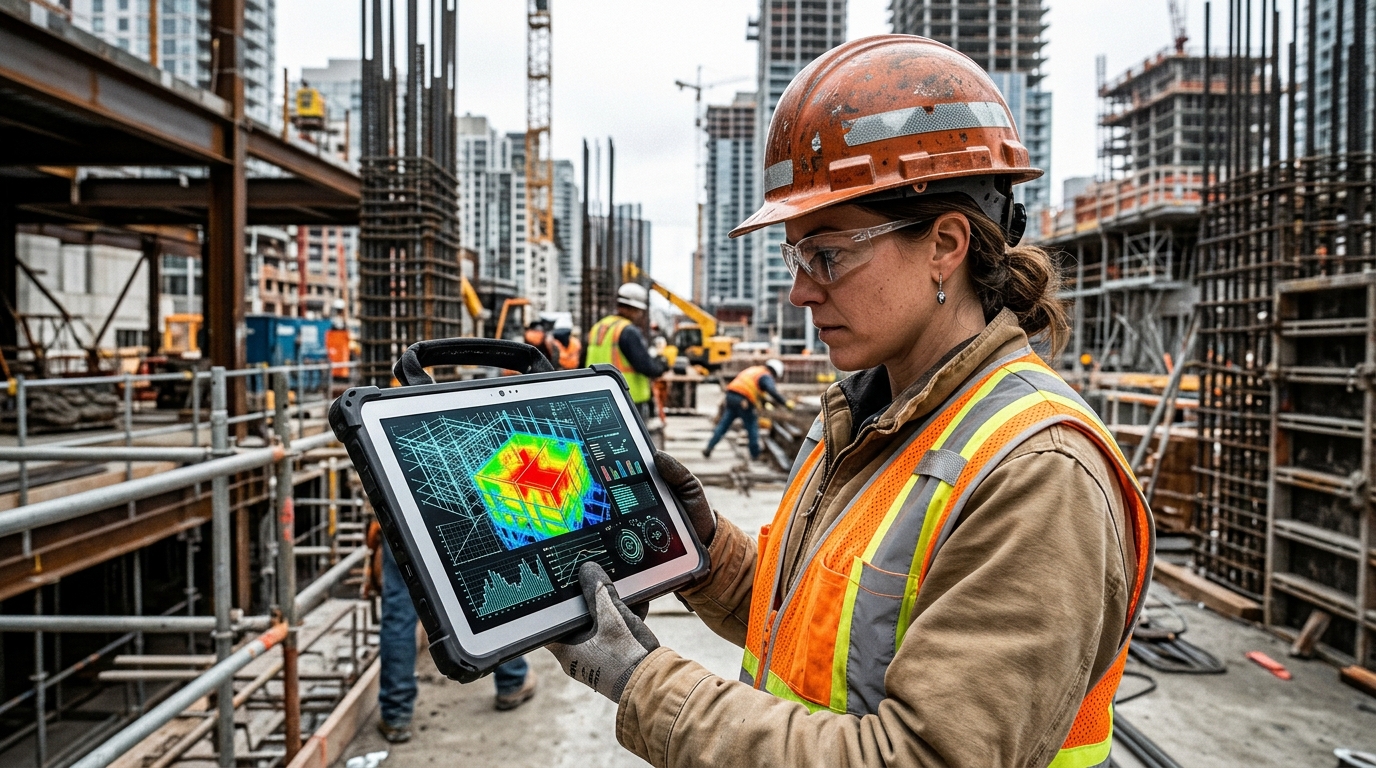
An integrated smart safety platform significantly improved construction site safety, work productivity, perceived usefulness, and operational convenience, according to a multi-stage empirical study published in the journal Architectural Research. Researchers Yeon Cheol Shin and Yu Mi Moon conducted the extensive investigation to assess the practical applicability and overall effectiveness of unified digital management systems within active building environments. The studied platform was developed to address recurring difficulties caused by fragmented site technologies by establishing direct, real-time information sharing between corporate headquarters and construction field sites. Through comprehensive multi-stage empirical testing that combined system design, on-site implementation, stakeholder user interviews, and a quasi-experimental evaluation, the authors analyzed how centralized digital architecture influences safety operations.
The system coordinates automated site access control, systematic risk assessment procedures, video-based monitoring capabilities, and continuous real-time data exchange connecting field locations directly to corporate management headquarters.
Alongside technical design, the researchers explored human and organizational dynamics through in-depth user interviews involving site managers, field workers, and platform developers. These qualitative discussions uncovered meaningful implementation hurdles, including worker resistance to surveillance, communication blind spots across complex worksites, and technical data redundancy.
To address the potential for long-term evolution in smart safety management systems, the authors proposed a strategic implementation model grounded in the Predict–Respond–Learn framework of resilience engineering. Repeated measures analysis of variance (ANOVA) confirmed that the integrated smart platform led to statistically significant enhancements in workplace safety, operational convenience, perceived usefulness, and task productivity. Structural equation modeling also demonstrated high goodness-of-fit for the proposed model, validating that both qualitative and quantitative analyses establish the platform as a foundational reference for advancing future digital construction safety systems.
Subject of Research: Integrated smart platform implementation for construction site safety management
Article Title: Research on Ways to Build an Integrated Smart Platform to Strengthen Construction Site Safety
Article References: Shin, Y. C., & Moon, Y. M. (2025). Research on Ways to Build an Integrated Smart Platform to Strengthen Construction Site Safety. Architectural Research, 27(4), 167–178. https://doi.org/10.5659/AIKAR.2025.27.4.167
Image Credits: AI Generated
DOI: 10.5659/AIKAR.2025.27.4.167
Keywords: construction site safety, integrated smart platform, real-time information sharing, access control, risk assessment, video-based monitoring, multifunctional terminal, centralized data management, resilience engineering, Predict-Respond-Learn framework, quasi-experimental design, repeated measures ANOVA, structural equation modeling, work productivity, user-centered design, institutional linkage, surveillance resistance, system standardization
News Source: Denise Maddox. (November 16, 2026). Integrated Smart Platform Improves Construction Site Safety and Productivity in Empirical Study. Scienmag.