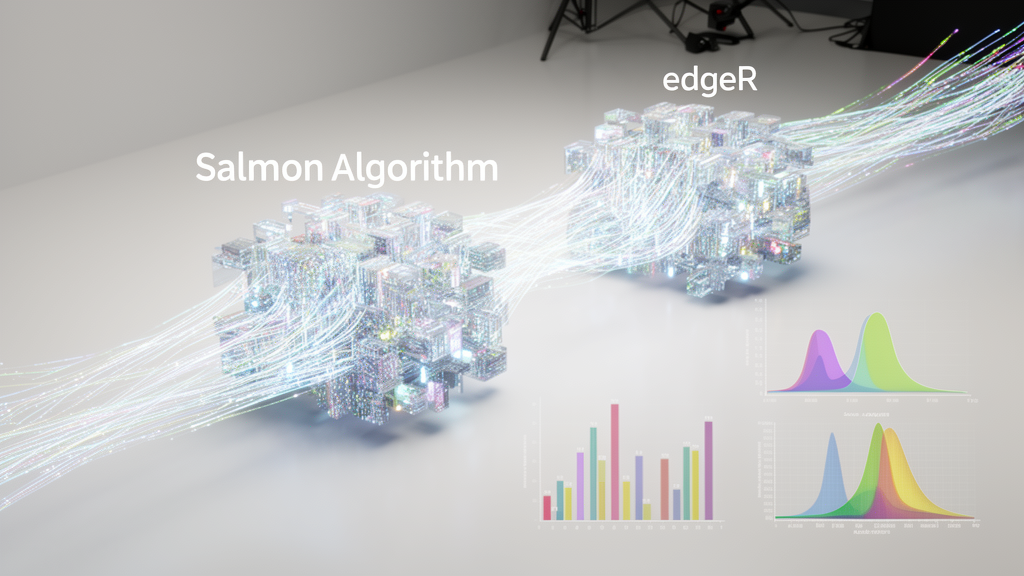
A newly published computational protocol combines Salmon and edgeR into an end-to-end workflow for differential transcript expression and differential transcript usage analyses. Reporting in Nature Protocols, the authors describe how differential transcript expression and differential transcript usage analyses deliver high-resolution insights into transcript-level alterations and underlying regulatory mechanisms. The protocol provides a structured methodology built around recently developed edgeR frameworks to analyze transcriptomes systematically. The researchers emphasize that these analytical methods are general in scope and can be applied to any well-annotated reference transcriptome across diverse organisms.
The protocol is anchored in the recently developed edgeR frameworks for differential transcript expression and differential transcript usage, which incorporate correction for quantification uncertainty alongside new quasi-likelihood methods. According to comparative evaluations, these newly developed quasi-likelihood methods outperform alternative bioinformatics tools in statistical power, computational efficiency, and false discovery rate control. By implementing these statistical techniques, the edgeR framework rigorously evaluates transcript changes while systematically accounting for read-to-transcript mapping ambiguities and variability across biological replicates.
To illustrate the complete workflow, the authors implemented the protocol using the complete telomere-to-telomere human reference genome, designated T2T-CHM13. The improved assembly continuity and refined transcript annotation of this telomere-to-telomere reference offer enhanced accuracy for transcript-level analyses of human biological samples. In addition to reference genome selection, the protocol incorporates practical computational strategies for organizing and formatting complex GFF-based transcript annotations, facilitating their integration into downstream indexing and quantification pipelines.
The end-to-end analytical procedure uses second-generation RNA-sequencing data as its primary input material. The workflow formally begins with the preparation of a dedicated transcriptome index derived from the chosen reference genome and annotation files. Following index generation, the detailed procedure describes subsequent transcript quantification and annotation steps. The protocol employs Salmon to perform fast transcript quantification directly from sequencing reads, enabling rapid estimation of transcript abundances prior to statistical evaluation.
Following transcript quantification in Salmon, the pipeline transitions to edgeR for essential data preprocessing procedures and statistical model fitting. The protocol outlines the systematic preprocessing of transcript count data followed by model fitting to assess differential transcript expression and differential transcript usage. These modeling procedures allow researchers to distinguish between overall changes in transcript abundance and shifts in transcript usage proportions across experimental conditions.
To demonstrate the practical utility and reliability of the workflow, the investigators applied the protocol to an RNA-sequencing dataset from human lung adenocarcinoma cell lines. The application confirmed that combining Salmon and edgeR reliably identifies differentially expressed and differentially used transcripts between distinct experimental conditions. Computational timing evaluations showed that the end-to-end protocol is highly efficient, requiring under two hours for transcript quantification in Salmon and less than ten minutes for statistical modeling and analysis in edgeR.
The final stages of the protocol center on data visualization, plotting, and result interpretation. The workflow generates diagnostic plots to assess input data quality as well as visualization plots displaying differential analysis outcomes. These graphical outputs guide investigators in interpreting transcript dynamics across various expression and transcript proportion scenarios. The resulting framework provides a flexible, high-performance solution for transcript-level analyses across diverse reference genomes, designed to be carried out by researchers with basic experience using the Unix command line and R.
Subject of Research: Computational protocol for differential transcript expression and usage analysis
Article Title: Differential transcript expression and differential transcript usage using Salmon and edgeR
Article References: Dong, X., Chen, L., Nie, J., Smyth, G. K., & Chen, Y. (2026). Differential transcript expression and differential transcript usage using Salmon and edgeR. Nature Protocols. https://doi.org/10.1038/s41596-026-01443-w
Image Credits: AI Generated
DOI: 10.1038/s41596-026-01443-w
Keywords: Salmon, edgeR, differential transcript expression, differential transcript usage, RNA sequencing, T2T-CHM13, telomere-to-telomere reference genome, quasi-likelihood methods, quantification uncertainty, false discovery rate control, transcript quantification, transcriptome index, lung adenocarcinoma, GFF annotation, count data preprocessing, Unix command line, R programming
News Source: Juliet Wilcox. (November 16, 2026). Protocol Couples Salmon and edgeR to Analyze Transcript Expression and Usage. Scienmag.