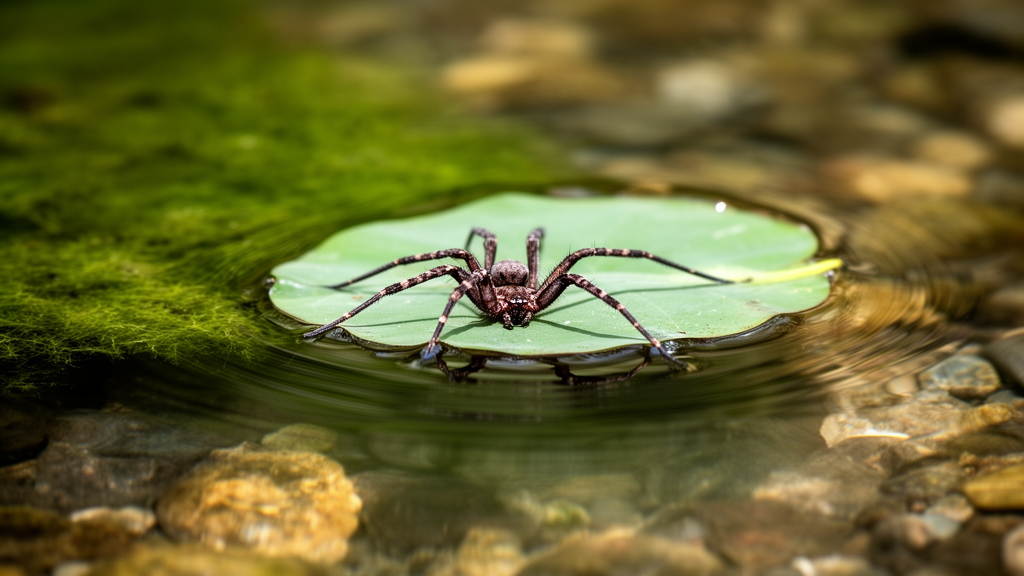
A comprehensive scientific review synthesizes decades of empirical research on fishing spiders of the genus Dolomedes, outlining critical evolutionary adaptations, reproductive complexities, and urgent ecological conservation needs. Published in Frontiers in Arachnid Science, the synthesis led by Kuang-Ping Yu, Zita Roithmair, Christina J. Painting, and colleagues evaluates the morphological, behavioral, and ecological dimensions of these semi-aquatic predators. The genus encompasses 105 valid species distributed across freshwater habitats on every continent except Antarctica and South America. Despite their widespread geographical footprint and substantial prominence as cursorial generalist predators, rigorous biological and ecological evaluations have historically concentrated on only four primary species from Europe and North America: Dolomedes fimbriatus, Dolomedes plantarius, Dolomedes triton, and Dolomedes tenebrosus. The authors establish that while Dolomedes spiders offer profound utility as model organisms for investigating animal personality, sexual selection, biomechanics, and aquatic pollution, broad geographic regions including Africa, Australia, and Southeast Asia remain critically under-sampled in global arachnological surveys.
Taxonomically, the genus dates back to Pierre André Latreille in 1804, though the earliest formal species descriptions—Araneus fimbriatus and Araneus plantarius by Carl Alexander Clerck in 1757—predated the formal Linnaean nomenclatural system by a year. For more than a century, Dolomedes was classified within the family Pisauridae, but recent phylogenomic analyses sampling over half of all valid species and related pisaurid genera have formally placed the genus within the resurrected family Dolomedidae Simon, 1876. Phylogenomic trees indicate that the lineage originated during the Cenozoic era, approximately 16 to 9 million years ago during the mid-Miocene epoch, suggesting that historical climate oscillations and glacial land bridges profoundly shaped their diversification. Ancestral character state reconstructions demonstrate that Dolomedes and its closest confamilials were ancestrally semi-aquatic hunters that completely lacked prey capture webs. While ancestral semi-aquatic habits predominate across the group, at least eight distinct species across New Zealand, North America, and East Asia, including Dolomedes minor, Dolomedes schauinslandi, Dolomedes tenebrosus, Dolomedes albineus, and Dolomedes sulfureus, independently underwent evolutionary reversals toward fully terrestrial forest and tree-dwelling lifestyles.
Morphological investigations reveal that semi-aquatic Dolomedes possess significantly wider carapaces than their terrestrial relatives, an anatomical feature hypothesized to facilitate breaking the physical surface tension of water when diving and foraging. The general body plan remains remarkably conserved, featuring an oval, unmodified abdomen and eight eyes arranged in two rows where the posterior row is strongly recurved and distinctly separated from the anterior row. The spiders exhibit iconic dorsal coloration composed of bright white or light lateral bands, spots, or patches set against a darker background. In Dolomedes plantarius, breeding experiments examining 47 broods demonstrated that the presence or absence of these prominent lateral bands is governed by a Mendelian single-gene inheritance system in which the banded allele is dominant. Genital structures, including the female sclerotized epigyne and the male pedipalp with its U-shaped tegular ring and round sclerotized saddle, provide conserved diagnostic features, although species-level diagnostic distinctions frequently depend on the fine structure of the male retrolateral tibial apophysis and the female spermathecal pathways.
Dolomedes species display notable sexual size dimorphism (SSD), with female linear body dimensions typically exceeding those of males by ratios between 1.00 and 1.88. However, extreme sexual size dimorphism (eSSD) occurs in select taxa, reaching female-to-male size ratios of 2.40 in Dolomedes tenebrosus, 2.46 in Dolomedes okefinokensis, and 2.46 in Dolomedes raptoroides. In species displaying extreme size asymmetry, male life histories are profoundly altered by morphological and behavioral adaptations tied directly to reproduction. Phenological patterns show that while adult spiders can be observed across seasons, population activity peaks sharply during mating periods, extending from May to October in the northern hemisphere and from September to May in the southern hemisphere. Many species require one to two full years to reach reproductive maturity, frequently overwintering as juveniles. Developmental rates often diverge sharply between the sexes; for instance, male Dolomedes raptor reach maturity within a single year, whereas the substantially larger females require up to two additional developmental years.
To navigate water surfaces, Dolomedes utilize specialized biomechanical gaits enabled by dense hydrophobic cuticular hairs that generate air cushions and repel water. Locomotion across water occurs primarily via two distinct kinematic patterns: rowing and galloping. Rowing, utilized during routine movements, achieves velocities under 0.27 meters per second by synchronously sweeping the second and third pairs of walking legs while holding the first and fourth pairs motionless and aligned with the direction of travel. Galloping or running, which is typically deployed during rapid prey pursuit and escape responses, achieves speeds exceeding 0.4 meters per second by coordinating the first, second, and third leg pairs simultaneously. Additionally, spiders such as Dolomedes triton exhibit passive sailing behaviors by elevating their bodies or anterior legs to catch wind currents across open water. When threatened by predators, spiders submerge below the surface film for extensive durations, sustained by plastron air bubbles trapped within their body hairs; experimental tests have documented voluntary dives lasting from 4 to 30 minutes in Dolomedes triton and Dolomedes aquaticus, with individual immersion exceeding three hours.
Foraging behavior relies heavily on specialized mechanoreceptive organs that detect minute physical disturbances across the aquatic boundary layer. Dolomedes detect water surface waves using metatarsal lyriform organs and perceive airborne vibrations using long, slender sensilla known as trichobothria. Behavioral bioassays indicate that hunting spiders respond maximally to irregular surface wave frequencies ranging from 30 to 40 Hertz, which contrast sharply with abiotic wind-generated waves that rarely exceed 10 Hertz. Although adult spiders lack capture webs and rely on sit-and-wait ambush postures with their anterior legs resting on the water surface film, visual systems also contribute to target acquisition. Blinding experiments on Dolomedes triton demonstrated significant reductions in pursuit speed and distance toward prey items. While aquatic and terrestrial insects comprising Diptera, Hemiptera, Trichoptera, and Ephemeroptera make up the vast majority of their food intake, Dolomedes are opportunistic generalist predators capable of subduing small vertebrates, including freshwater fish across at least 11 recorded species, amphibians, tadpoles, lizards, bats, and crustaceans.
Trophic interactions place Dolomedes in a pivotal dual position within riparian and freshwater food webs, serving simultaneously as influential apex invertebrate predators and as prey for higher vertebrates and specialized parasitoids. Field records document predation on fishing spiders by little blue herons, morepork owls, bullfrogs, leopard frogs, bluegill sunfish, and web-building cobweb spiders. In New Zealand, the endemic fernbird (Megalurus punctatus) functions as a specialized predator of all three mainland Dolomedes species, routinely harvesting developing spiderlings directly from maternal nursery webs to feed its nestlings. Furthermore, solitary spider-hunting wasps of the family Pompilidae impose intense parasitoid pressure across North America, Europe, Asia, and Oceania. Pompilid wasps, including Anoplius depressipes and Anoplius eous, frequently track Dolomedes via chemical scent trails or visual cues, paralyzing the spiders with venom before dragging their hydrophobic bodies across water surfaces to serve as larval food provisions.
Courtship and mating dynamics across the genus encompass striking behavioral divergence, spanning from multi-partner polygamy to obligate male suicide. Male courtship involves stereotyped leg movements, such as tapping, waving, and jerking, accompanied by tactile stimulation of the female’s body and abdomen. While species like Dolomedes fimbriatus and Dolomedes scriptus exhibit polygynous mating structures where males mate with multiple partners, Dolomedes tenebrosus exhibits obligate monogyny driven by spontaneous male death during initial copulation. In this species, the male experiences heart cessation during pedipalpal insertion, leaving his body suspended from the female epigynum for an average copulation duration of 22 minutes. Empirical feeding trials revealed that post-copulatory consumption of the deceased male by the female provides direct nutritional fitness benefits, resulting in larger clutches of offspring that exhibit significantly higher body mass and superior post-hatching survival rates compared to females fed cricket control diets.
Female aggression represents a prominent evolutionary force shaping sexual interactions, giving rise to frequent pre-copulatory and post-copulatory sexual cannibalism. Investigations into the aggressive spillover hypothesis—which posits that sexual cannibalism represents an evolutionary carryover of high foraging voracity selected in juvenile feeding contexts—have yielded divergent, species-specific findings. In Dolomedes fimbriatus, female voracity toward prey does not correlate with aggression toward courting males, as females flexibly adjust their courtship attacks according to the relative physical size of the male suitor. In contrast, Dolomedes triton displays consistent behavioral syndromes across ecological contexts, exhibiting significant positive correlations between high foraging voracity, increased rates of sexual cannibalism, elevated boldness under predation threats, and enhanced reproductive fecundity. Across species, previous female mating status strongly elevates sexual aggression, with mated females consistently demonstrating higher probabilities of attacking courting males than virgin individuals.
Parental care across all studied Dolomedes species is exclusively maternal and energetically demanding. Following oviposition, the female constructs a thick silken egg sac that she continuously transports within her chelicerae, reinforced by supportive pedipalps and an anchor dragline attached to her spinnerets. In Dolomedes triton, the egg sac features a specialized hydrophobic outer coating, allowing the mother to submerge the brood beneath the water surface when evading approaching threats despite the opposing buoyant forces generated by the enclosed air. Egg clutch sizes vary markedly among taxa, averaging roughly 300 eggs in Dolomedes aquaticus, 362 in Dolomedes albineus, 558 in Dolomedes scriptus, 768 in Dolomedes triton, and reaching up to 1,873 eggs in Dolomedes tenebrosus. Females cease normal hunting while carrying egg sacs, only releasing the clutch momentarily to capture food when body condition declines substantially. As embryonic hatching nears, the female secures the egg sac within tall shoreline vegetation—frequently selecting specific structural plants like Juncus effusus or Carex sedges—constructs an expanded silken nursery web, tears the sac open with her chelicerae, and fiercely guards the emerging spiderlings against predators.
Conservation assessments underscore that freshwater habitat degradation represents an escalating threat to semi-aquatic spider lineages worldwide. Global freshwater wetlands, which harbor over 40 percent of planetary biodiversity despite occupying only 1 percent of Earth’s total land area, have suffered estimated cumulative declines between 33 percent and 87 percent since the eighteenth century due to urban expansion, agricultural drainage, and climate shifts. On the IUCN Red List, Dolomedes plantarius is currently cataloged as Vulnerable, with strict legal protection established across nine European nations. In the United Kingdom, where the species was historically restricted to three isolated natural populations, systematic fenland restoration and structured conservation translocation programs initiated in 2010 expanded the total number of established populations to seven by 2021. Meanwhile, Dolomedes schauinslandi persists solely on three tiny offshore islands within the Chatham archipelago of New Zealand, classified as At Risk: Relict following its local extinction on Pitt Island during the early twentieth century.
Given their intimate physiological association with freshwater boundaries and rapid accumulation of contaminants through aquatic food chains, Dolomedes species represent prime bioindicators for monitoring anthropogenic degradation. Expanding research across understudied tropical regions, coupled with systematic molecular barcoding of dietary intake and high-resolution neuroanatomical investigations of sensory processing, will be vital to resolve remaining evolutionary questions. The synthesis demonstrates that bridging gaps in taxonomy, behavioral ecology, and genomic sequencing will firmly establish Dolomedes as an indispensable model lineage for understanding adaptive radiation, sexual conflict, and wetland conservation in an era of rapid environmental change.
Subject of Research: Evolutionary biology, behavioral ecology, and conservation status of Dolomedes fishing spiders
Article Title: Dolomedes fishing spider biology: gaps and opportunities for future research
Article References: Yu, K.-P., Roithmair, Z., Kurovski, J., Connolly, S. J., Vink, C. J., Johnson, J. C., Kralj-Fišer, S., Kuntner, M., Hebets, E. A., & Painting, C. J. (2024). Dolomedes fishing spider biology: gaps and opportunities for future research. Frontiers in Arachnid Science, 3, Article 1501653. https://doi.org/10.3389/frchs.2024.1501653
Image Credits: AI Generated
DOI: 10.3389/frchs.2024.1501653
Keywords: Dolomedes, Dolomedidae, fishing spiders, raft spiders, semi-aquatic spiders, sexual cannibalism, spontaneous male death, sexual size dimorphism, lyriform organs, trichobothria, water-surface locomotion, wetland conservation, Dolomedes plantarius, Dolomedes triton, Dolomedes tenebrosus, nursery web spiders, pompilid parasitoids
News Source: Margaret Porter. (November 16, 2026). Comprehensive Review Synthesizes Fishing Spider Evolution Behavior and Conservation Status. Scienmag.