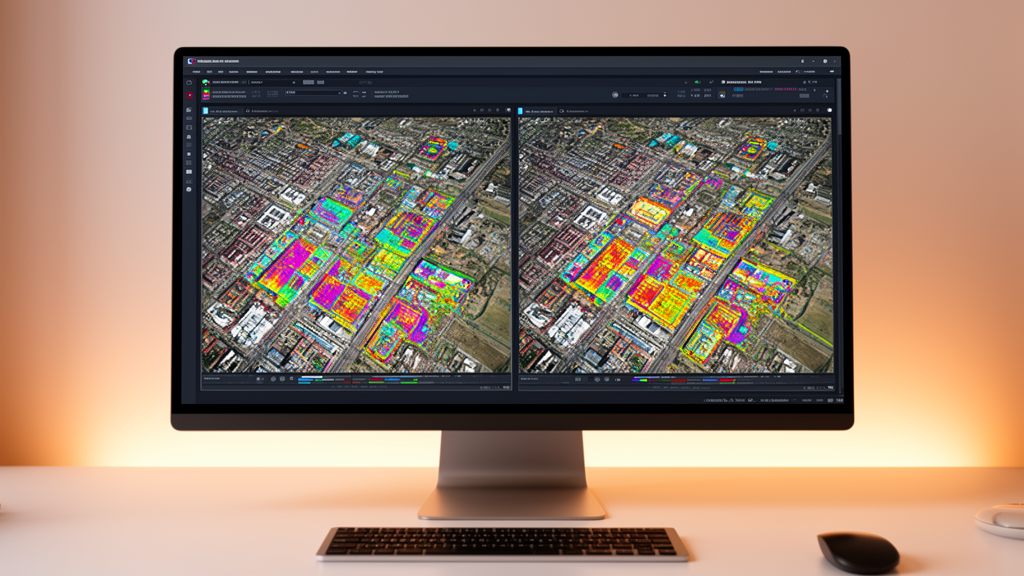
Unified remote sensing change detection aims to interpret diverse observation datasets and detection objectives within a single computational model. In a study published in Complex & Intelligent Systems, researchers Yinuo Zhu and Xingheng Wang introduce DHChange, a framework engineered to learn under source and supervision heterogeneity. The development targets fundamental performance barriers that arise when single architectures attempt to jointly process disparate satellite imagery distributions alongside distinct change detection tasks.
According to the authors, previous approaches to unified change detection concentrated predominantly on standardizing task inputs and outputs. However, those methods gave limited consideration to two significant obstacles encountered during joint model training. The first problem is negative transfer among multiple data sources characterized by differing visual distributions.
To resolve these joint learning conflicts, the DHChange architecture applies a factorized task-role query design. This configuration provides a unified, instruction-conditioned interface capable of simultaneously handling change localization and bi-temporal content interpretation. To mitigate representational interference across contrasting data sources, the framework introduces a shared-private prototype collaboration strategy. Under this mechanism, shared prototypes encode transferable changed and unchanged visual patterns, whereas source-private prototypes preserve complementary, source-dependent characteristics that are dynamically retrieved through an adaptive router supervised by source labels.
The framework also integrates a bidirectional cross-granularity interaction module to foster mutual collaboration between binary and semantic supervision. Within this module, category-agnostic change localization responses serve to enhance bi-temporal content representations, after which content differences between the temporal pairs are utilized to refine change localization maps. Additionally, for semantic prediction, DHChange replaces conventional fixed-dimensional linear classifiers with a parameter-shared pixel-to-text matching interface that decouples semantic classification from rigid structural dimensions.
The researchers validated DHChange through extensive experimental evaluations across three benchmark datasets for binary change detection and the SECOND benchmark for semantic change detection. In comparisons against common-encoder variants of both task-specific models and unified baselines, DHChange achieved measurable performance improvements. Controlled ablation analyses further confirmed the effectiveness of the source-aware prototype collaboration mechanism and supported the integration of complementary binary and semantic supervision streams in remote sensing analysis.
Subject of Research: Unified remote sensing change detection under source and supervision heterogeneity
Article Title: DHChange: learning under source and supervision heterogeneity for unified remote sensing change detection
Article References: Zhu, Y., & Wang, X. (2026). DHChange: learning under source and supervision heterogeneity for unified remote sensing change detection. Complex & Intelligent Systems. https://doi.org/10.1007/s40747-026-02582-z
Image Credits: AI Generated
DOI: 10.1007/s40747-026-02582-z
Keywords: remote sensing, change detection, binary change detection, semantic change detection, DHChange, supervision heterogeneity, source heterogeneity, bi-temporal content interpretation, task-role query, shared-private prototypes, adaptive router, cross-granularity interaction, pixel-to-text matching, negative transfer, SECOND benchmark, change localization
News Source: Denise Maddox. (November 15, 2026). Unified Framework Advances Remote Sensing Change Detection Across Diverse Image Sources. Scienmag.