Published in EJNMMI Radiopharmacy and Chemistry, the study details the translation of a preclinical protocol into a clinically applicable workflow, supporting both automated synthesis on two distinct platforms and a manual, kit-based approach. This development aims to facilitate broader access to single-domain antibody-based PET imaging across clinical centers, addressing previous limitations in the robust manufacturing of such tracers.
Fibroblast activation protein is a well-established target for tumor imaging, widely expressed by cancer-associated fibroblasts across various malignancies including breast, ovarian, and colorectal cancers. While generally low or absent in healthy adult tissues, FAP can be upregulated in pathological tissue-remodeling processes. Single-domain antibodies offer favorable pharmacokinetic properties for PET applications due to their small size of approximately 15 kilodaltons, which allows for rapid blood clearance and efficient tumor penetration. This results in high target-to-background ratios while maintaining strong affinity and specificity, making them particularly suitable for labeling with short-lived radionuclides such as gallium-68.
The study focused on adapting previously reported preclinical production conditions for clinical use. The core reaction involves a 10-minute incubation at 50 degrees Celsius in an ammonium acetate solution. To enable the production of limited multi-patient batches, the precursor amount was increased to 3 milligrams. Additionally, the administered protein dose was raised to 1 milligram, a change previously shown to improve biodistribution by decreasing liver uptake while maintaining appropriate molar activity and radiochemical stability. The team utilized a GalliaPharma 68Ge/68Ga generator system, eluting the radionuclide in 5 milliliters of 0.1 N hydrochloric acid.
Because a GMP-compliant ammonium acetate preparation kit was unavailable, the researchers tested a commercially available sodium acetate solution as an alternative buffer. This substitution had no measurable effect on labeling efficiency, with radiochemical conversion exceeding 97 percent. Sterile filtration was performed at the end of the process for clinical use and did not affect the final radiochemical purity, which remained above 97 percent. These initial manual experiments confirmed that the original labelling conditions were directly applicable to clinical production without the need for a purification step.
The process was subsequently translated to the Modular-Lab Eazy synthesizer. Initial automated runs revealed activity losses during filtration, resulting in moderate overall recovery. To address this, a rinsing step was introduced using a dedicated vial containing 0.9 percent sodium chloride to flush the reaction vial and filters. This modification reduced residual activity within the system to less than 2 percent and improved recovery to over 80 percent. The optimized process was then implemented on a second automated platform, the Modular-Lab PharmTracer, using the same sequence of steps.
A stress study was conducted to evaluate the impact of variations in key process parameters, including reaction temperature, time, buffer conditions, and starting activity. The study identified reaction temperature and time as critical factors. At temperatures below 35 degrees Celsius, labeling efficiency decreased, while temperatures above 60 degrees Celsius caused filter blockage due to air bubble formation and protein precipitation. A reaction time of 10 minutes provided the best balance between efficiency and yield, as longer times did not improve product quality and led to decreased recovery due to radioactive decay.
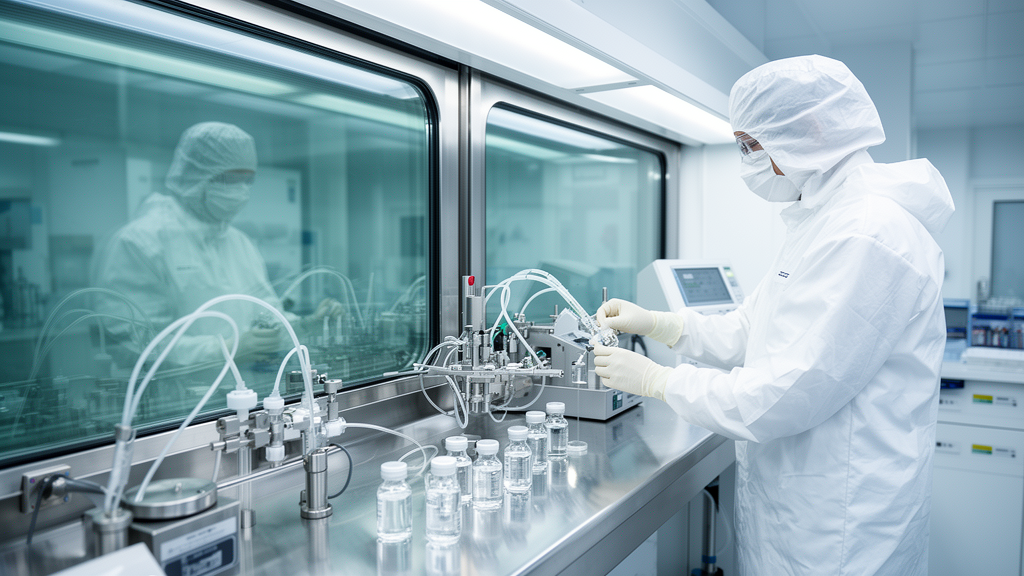
Process performance runs were performed under non-GMP conditions on both automated synthesizers, each starting with approximately 1 gigabecquerel of gallium-68. Production was completed within 17 to 18 minutes and met all predefined acceptance criteria. Radiochemical purity consistently exceeded specifications, with values greater than 98 percent by iTLC-SG and greater than 95 percent by SE-HPLC. Non-decay-corrected radiochemical yields were consistent across all runs, exceeding 70 percent. The final product exhibited a pH between 4.5 and 5.0 and appeared as a clear, colorless solution practically free of visible particles.
To facilitate implementation in centers without automated synthesis platforms, a manual, kit-based process was also developed. This procedure involved direct elution of gallium-68 into a reaction vial containing the precursor and buffer, followed by heating at 50 degrees Celsius for 10 minutes. After labeling, the mixture was diluted with an ascorbic acid solution in saline and sterile-filtered. Three process performance runs were performed, all meeting predefined acceptance criteria with consistently high radiochemical purity and yields within specification. The performance observed during manual runs was similar to that of the automated systems, supporting the reliability of the manufacturing process in various clinical settings.
The team also investigated the compatibility of the manufacturing process with two commonly used 68Ge/68Ga generator systems: the GalliaPharma generator and the Galli Eo generator. These systems differ primarily in elution volume, with GalliaPharma delivering 5 milliliters of 0.1 N hydrochloric acid and Galli Eo delivering 1 milliliter. To ensure comparable reaction conditions, the volumes of sodium acetate buffer and final formulation components were adjusted. Production runs with both generators showed similar performance, with radiochemical purity and yields consistently meeting acceptance criteria. No significant activity losses were observed, and the final product maintained a pH between 4.6 and 4.7.
Product quality was further evaluated using analytical methods including ELISA and a bead-based assay. All results confirmed the preservation of binding capacity, with relative binding potency exceeding 90 percent, indicating that process changes did not affect the biological functionality of the single-domain antibody. Stability studies showed that radiochemical purity remained within specification for at least 3 hours at room temperature, with minimal formation of high-molecular-mass species. Endotoxin levels were below the detection limit, and microbiological analysis demonstrated the sterility of the final product.
The main source of activity loss in the process was identified as the radioactive decay of gallium-68. The process remained stable across a range of activities and buffer conditions, demonstrating robustness to variations in buffer composition and starting activity. This tolerance is an important feature for routine clinical production. The final formulation included an ascorbic acid solution in saline to limit radiolysis, with the concentration increased to 10 milligrams per milliliter to reduce the risk of radiolysis when using higher starting activities in future applications.
Some limitations of the study should be noted. The work focuses on a single single-domain antibody construct, so further studies are needed to confirm if this method works for other antibody-based tracers. While the radiochemical and biological properties of the tracer seem promising, clinical studies are still necessary to fully determine its diagnostic value. Future work could explore the use of alternative chelators such as NOTA to enable efficient room temperature complexation with gallium-68, which may further improve radiolabeling robustness and facilitate translation to more temperature-sensitive constructs.
Overall, this work demonstrates that single-domain antibody-based radiopharmaceuticals can be produced using practical, scalable processes that approach the simplicity and robustness of small-molecule tracers. The consistency of results across platforms, production methods, and generator systems supports the practical implementation of this tracer in routine clinical settings. This approach provides a framework that could help use protein-based tracers in routine clinical settings, facilitating broader access to FAP-targeted PET imaging.
Beyond establishing baseline feasibility, the researchers examined specific operational boundaries and analytical thresholds across both automated systems. Transfer mechanisms differed between the platforms, with the Modular-Lab Eazy driving liquids through gas pressure while the Modular-Lab PharmTracer utilized an automated syringe module. Before each automated production run, operators performed filter and cassette integrity tests, verifying pressure retention over a one-minute interval. In the Modular-Lab Eazy cassette configuration, an overflow vial was incorporated alongside the reaction and final product vials as an operational safety feature. Across the non-GMP automated validation campaign, production completed within 17 to 18 minutes, with radiochemical conversion surpassing 90 percent during the initial 10-minute heating stage and overall non-decay-corrected yields consistently exceeding 70 percent.
The study also detailed the specific quality control techniques applied to confirm product specifications. Radiochemical purity was evaluated through thin-layer chromatography using silica gel strips developed with a 0.1 M sodium citrate mobile phase at pH 4.5, effectively resolving radiolabeled conjugate from free gallium species. Complementary size-exclusion high-performance liquid chromatography using dedicated resin columns and phosphate-buffered saline verified radiochemical identity against an unlabelled reference standard while monitoring chemical purity and the formation of high-molecular-mass species at 280 nanometers. Automated runs also underwent bubble point integrity testing, which required surpassing a pressure threshold of 3.6 bar to ensure proper membrane function.
Biological binding capacity was quantitatively assessed through specialized in vitro assays following radioactive decay. A dual-antibody sandwich enzyme-linked immunosorbent assay measured binding across microtiter plates coated with recombinant human antigen, calculating relative potency from half-maximal effective concentrations relative to unmodified precursor. In addition, an antigen-coated magnetic bead binding assay evaluated the immunoreactive fraction across serial dilutions of human target protein, using gamma counting of separated supernatant and bead-bound fractions to confirm that chemical processing preserved receptor binding functionality above 90 percent.
Subject of Research: Clinical manufacturing process development for [68Ga]Ga-DOTA-4AH29 PET imaging agent
Article Title: Automated and manual synthesis of [68Ga]Ga-DOTA-4AH29 intended for PET-imaging of FAP-expression
Article References: Berdal, M., Nagachinta, S., Langsberg, X., Gaspariunaite, V., Massa, S., Pombo Antunes, A. R., Mantzilas, D., D’Huyvetter, M., & Navarro, L. (2026). Automated and manual synthesis of [68Ga]Ga-DOTA-4AH29 intended for PET-imaging of FAP-expression. EJNMMI Radiopharmacy and Chemistry, 11(1), Article 62. https://doi.org/10.1186/s41181-026-00465-9
Image Credits: AI Generated
DOI: 10.1186/s41181-026-00465-9
Keywords: PET imaging, Fibroblast activation protein, Gallium-68, Radiopharmacy, Single-domain antibodies, Clinical translation, Automated synthesis, Manual synthesis, Radiochemical purity, Process validation, Tumor microenvironment, Nuclear medicine, Molecular imaging, Drug production, Generator systems, Stress study, Binding potency, Sterile filtration, Ascorbic acid, EJNMMI
News Source: Bethany Barker. (November 13, 2026). Clinical production process established for FAP-targeting PET tracer. Scienmag.