• HOME
  • NEWS
  • EXPLORE
    • CAREER
      • Companies
      • Jobs
    • EVENTS
    • iGEM
      • News
      • Team
    • PHOTOS
    • VIDEO
    • WIKI
  • BLOG
  • COMMUNITY
    • FACEBOOK
    • INSTAGRAM
    • TWITTER
Monday, November 16, 2026
BIOENGINEER.ORG
No Result
View All Result
  • Login
  • HOME
  • NEWS
  • EXPLORE
    • CAREER
      • Companies
      • Jobs
        • Lecturer
        • PhD Studentship
        • Postdoc
        • Research Assistant
    • EVENTS
    • iGEM
      • News
      • Team
    • PHOTOS
    • VIDEO
    • WIKI
  • BLOG
  • COMMUNITY
    • FACEBOOK
    • INSTAGRAM
    • TWITTER
No Result
View All Result
Bioengineer.org
No Result
View All Result
Home NEWS Science News Biology

Dynamic 4D Bioprinted Skin Constructs Face Practical Roadblocks in Early Wound Research

by
November 13, 2026
in Biology
Reading Time: 2 mins read
0
Dynamic 4D Bioprinted Skin Constructs Face Practical Roadblocks in Early Wound Research

Dynamic 4D Bioprinted Skin Constructs Face Practical Roadblocks in Early Wound Research

Share on FacebookShare on TwitterShare on LinkedinShare on RedditShare on Telegram

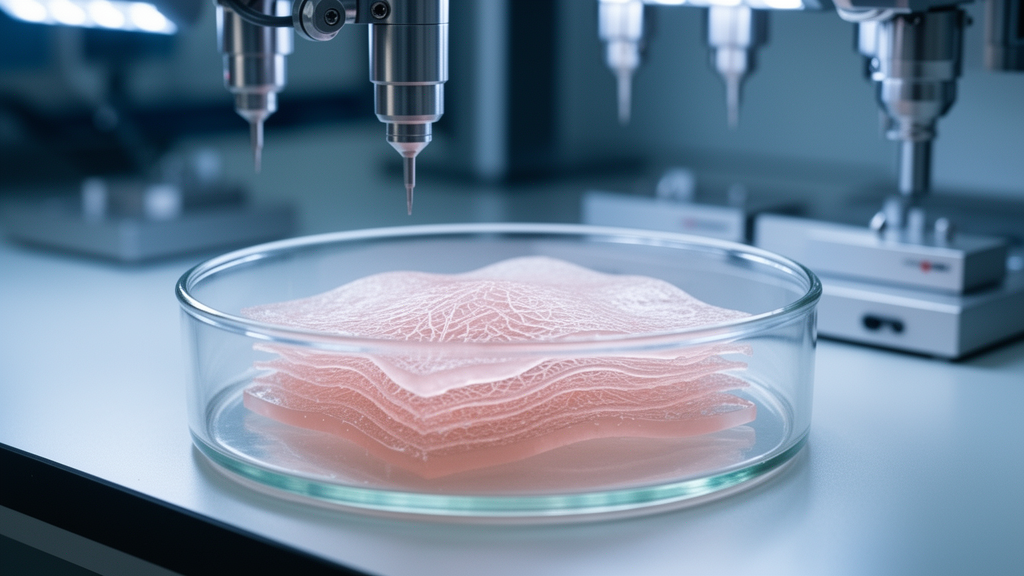
Wound healing remains a substantial clinical challenge, especially for individuals suffering from chronic medical conditions such as diabetes where impaired tissue repair drives considerable morbidity and mortality. Conventional static wound dressings and standard three-dimensional bioprinted constructs fail to adapt dynamically to the rapidly evolving biochemical and biophysical microenvironment found within an active healing wound. To address these operational shortcomings, four-dimensional bioprinting incorporates time as a programmable fabrication dimension, introducing printed tissue scaffolds capable of undergoing controlled physical shape morphing, triggered therapeutic drug release, and functional adaptation when exposed to microenvironmental cues such as temperature changes, fluctuating pH levels, reactive oxygen species, light, magnetic fields, and local enzymatic activity.

A critical narrative review adopts an operational definition of four-dimensional bioprinting and applies it as an inclusion criterion to evaluate current research. Under this inclusion framework, genuine four-dimensional bioprinting requires additive fabrication that positions living cells or cell-instructive matrix under precise spatial control, embeds an intended transformation directly into that spatial layout during printing, and yields a measurable post-fabrication physical or functional change governed by a clearly defined trigger, threshold, and actuation rate.

When evaluated strictly against these three additive fabrication benchmarks, a significant portion of current published work presented as four-dimensional bioprinting actually comprises cast responsive hydrogels, electrospun fibrous meshes, microneedle arrays, and conventional smart dressings.

The review closely examines the foundational design levers that govern the physical magnitude, geometric direction, and kinetic rate of post-printing shape morphing in dynamic matrices. Alongside external stimulus triggers, the authors highlight cell-generated contractile force operating as an endogenous mechanical actuator capable of driving scaffold architectural changes from within the cellularized structure itself.

Designing effective responsive scaffolds also demands careful attention to specific physiological measurement caveats that qualify wound pH, localized tissue temperature, and elevated reactive oxygen species as clinical targets.

The evaluation identifies critical failure modes peculiar to four-dimensional bioprinting platforms that currently impede reliable wound care deployment.

Substantial translation gaps persist across the entire biofabrication sector, as experimental evidence remains overwhelmingly confined to rodent-based animal models.

Crucially, the investigators emphasize that virtually no published research compares an adaptive, stimuli-responsive dynamic construct directly against a compositionally identical static control scaffold.

Subject of Research: Evaluation of 4D bioprinted dynamic skin constructs and stimuli-responsive materials for adaptive wound healing

Article Title: 4D bioprinting of dynamic skin constructs: stimuli-responsive materials for adaptive wound healing

Article References: Chandrasekaran, S., Duraisamy, N., Jagadeesan, M., Pachaiappan, R., Digala, P., & Anbu, P. (2026). 4D bioprinting of dynamic skin constructs: stimuli-responsive materials for adaptive wound healing. 3 Biotech, 16(12), Article 506. https://doi.org/10.1007/s13205-026-05118-x

Image Credits: AI Generated

DOI: 10.1007/s13205-026-05118-x

Keywords: 4D bioprinting, wound healing, stimuli-responsive materials, skin constructs, biofabrication, shape morphing, chronic wounds, diabetes, hydrogels, biomaterials, tissue engineering, ASTM biofabrication families, reactive oxygen species, wound microenvironment, cell-generated contractile force, smart dressings, preclinical research

News Source: Gregory Coleman. (November 13, 2026). Dynamic 4D Bioprinted Skin Constructs Face Practical Roadblocks in Early Wound Research. Scienmag.


Tags: 4D bioprintingASTM biofabrication familiesbiofabricationbiomaterialscell-generated contractile forcechronic woundsDiabeteshydrogelspreclinical researchreactive oxygen speciesshape morphingskin constructssmart dressingsstimuli-responsive materialsTissue EngineeringWound Healingwound microenvironment
Share12Tweet7Share2ShareShareShare1

Related Posts

Quercetin Inhibits Lung Cancer Progression Through Multiple Molecular Mechanisms

Quercetin Inhibits Lung Cancer Progression Through Multiple Molecular Mechanisms

November 16, 2026
HAT1 Depletion Accelerates Glioblastoma Proliferation and Alters Cell Membrane Lipids

HAT1 Depletion Accelerates Glioblastoma Proliferation and Alters Cell Membrane Lipids

November 16, 2026

Disruption of piRNA Pathway Frequently Accompanies Human Pachytene Spermatogenic Arrest

November 16, 2026

Histone lactylation feedback loop promotes cisplatin resistance in intrahepatic cholangiocarcinoma

November 16, 2026

POPULAR NEWS

  • White Analytical Chemistry Framework Unifies Quality and Sustainability in Liquid Chromatography

    White Analytical Chemistry Framework Unifies Quality and Sustainability in Liquid Chromatography

    29 shares
    Share 12 Tweet 7
  • Palliate Carer Training Demonstrates High Acceptability and Usability in Simulation

    29 shares
    Share 12 Tweet 7
  • Hepatocyte Hedgehog Activation Protects Mice From Acetaminophen Liver Injury Through Vegfa

    29 shares
    Share 12 Tweet 7
  • Refrigerated Storage and Matrix Compactness Lower Starch Digestibility in Maize Foods

    29 shares
    Share 12 Tweet 7

About

We bring you the latest biotechnology news from best research centers and universities around the world. Check our website.

Follow us

Recent News

Stem Cell Arterial Organoids Assemble Into Perfusable Vascular Networks in Mice

Brain Perfusion Pattern Distinguishes Lewy Body Dementia in MRI Study

Resting Brain Connectivity Patterns Reveal Distinct Profiles Across Core Depression Dimensions

Subscribe to Blog via Email

Enter your email address to subscribe to this blog and receive notifications of new posts by email.

Join 88 other subscribers
  • Contact Us

Bioengineer.org © Copyright 2023 All Rights Reserved.

Welcome Back!

Login to your account below

Forgotten Password?

Retrieve your password

Please enter your username or email address to reset your password.

Log In
No Result
View All Result
  • Homepages
    • Home Page 1
    • Home Page 2
  • News
  • National
  • Business
  • Health
  • Lifestyle
  • Science

Bioengineer.org © Copyright 2023 All Rights Reserved.