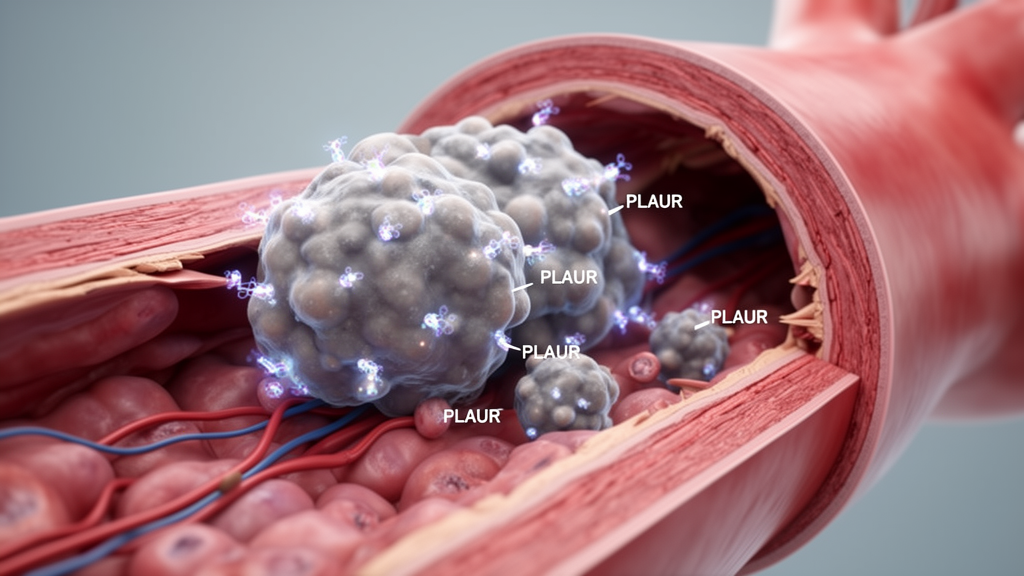
Researchers integrating bulk and single-cell transcriptomics with tissue histology have identified PLAUR, encoding the urokinase plasminogen activator receptor, as a candidate marker linked to macrophage-enriched inflammatory remodeling, pericellular proteolysis, and programmed cell death in type A aortic dissection. Type A aortic dissection is a life-threatening cardiovascular emergency involving disruption of the ascending aortic wall, medial degeneration, elastic fiber fragmentation, extracellular matrix breakdown, and regulated cell death. While clinical diagnosis and surgical interventions have advanced, the exact molecular pathways and cell-specific transcriptional architectures accompanying aortic wall fragility remain incompletely understood. To investigate which cellular compartments simultaneously manifest immune activation and cell death signatures during acute aortic failure, an investigative team conducted an exploratory multi-tier study published in Frontiers in Cardiovascular Medicine. The investigators integrated publicly available bulk profiles, single-cell transcriptomics, curated cell death gene sets, computational deconvolution, in silico gene perturbation, and human histological examinations to map disease-associated cellular programs without claiming a causal role for PLAUR.
The study design integrated several public genomic datasets from the Gene Expression Omnibus database to establish training and independent validation frameworks. For bulk transcriptomic investigations, the primary training cohort merged two datasets: GSE153434, comprising ten dissection tissue specimens and ten normal aortic controls, and GSE98770, containing six acute dissection samples and five donor controls. To assess the consistency of candidate expression patterns, the researchers incorporated GSE147026 as an external validation dataset, containing four dissection samples and four normal controls. Bulk expression matrices underwent probe re-annotation, gene symbol conversion, dataset-specific background correction, and normalization. Following the matching of common genes across training datasets, batch-effect adjustments were applied to minimize systematic technical variance between platforms, with principal component analysis conducted before and after correction to evaluate sample alignment. Single-cell RNA sequencing was retrieved from dataset GSE213740, generated on the GPL18573 platform using the 10x Genomics Cell Ranger pipeline, spanning nine dissection specimens and three normal aorta samples.
Single-cell transcriptomic data were analyzed using the Seurat R package under defined quality control thresholds, retaining cells with RNA counts between 700 and 15,000 and mitochondrial transcript proportions below 25 percent. Following LogNormalize processing, identification of highly variable genes, and data scaling, principal component analysis was performed across variable features. The first 20 principal components guided shared nearest-neighbor graph construction, Louvain clustering, and two-dimensional visualization using uniform manifold approximation and projection. Across analyzed aortic tissues, the algorithms resolved 22 clusters annotated into seven primary cell types using canonical markers: endothelial cells, fibroblasts, macrophages, monocytes, plasma cells, smooth muscle cells, and T cells. Although macrophage-annotated cells tended to represent a larger fraction of profiled cells in dissected samples compared to non-diseased controls, the authors noted that single-cell recovery is influenced by tissue dissociation, cell viability, and capture efficiency, meaning these cell-type proportions provide descriptive profiles rather than conclusive proof of in vivo macrophage expansion.
To systematically assess regulated cellular demise across cell types, the investigators curated 1,382 unique programmed cell death genes across 13 functional categories from FerrDb V2 and literature resources, covering apoptosis, necroptosis, autophagy, ferroptosis, pyroptosis, and cuproptosis. Cell death transcriptional activity was scored at single-cell resolution using the AUCell package, which evaluates gene-set enrichment within ranked cellular expression profiles. When AUCell scores were summarized across annotated lineages, macrophage-enriched clusters exhibited the highest cell death-related gene-set activity among profiled vascular compartments. Feature plotting further revealed that PLAUR transcripts were concentrated predominantly within these same macrophage clusters and appeared more prominent in dissection tissues than in control tissues. To prevent disproportionate weighting from samples yielding higher captured cell numbers and avoid pseudoreplication, cell-type AUCell scores were averaged at the sample level to serve as independent observations for statistical comparisons, linking PLAUR expression directly to macrophage transcriptional programs.
In the merged and batch-corrected bulk training dataset, exploratory differential expression screening between dissection specimens and controls was conducted using the limma package, applying thresholds of nominal P < 0.05 and an absolute log2 fold change exceeding log2(1.5). This initial screen identified 2,217 differentially expressed genes, comprising 562 upregulated and 1,655 downregulated transcripts, which were subsequently evaluated with Benjamini–Hochberg adjustments. When intersected with the 1,382 programmed cell death genes, the overlapping candidates clearly separated disease tissues from control tissues in hierarchical clustering heatmaps. Sample-level programmed cell death activity was quantified using single-sample gene set enrichment analysis, revealing significantly elevated scores in dissected aortic tissues compared with controls by Wilcoxon rank-sum testing (P = 0.00085). PLAUR was prioritized from this intersection due to its elevated expression in disease, biological relevance to extracellular matrix turnover and pericellular proteolysis, and strong positive correlation with sample-level programmed cell death scores (Spearman R = 0.85, P = 5.1 × 10⁻⁷ across 31 samples).
To examine biological signaling networks associated with PLAUR abundance, the researchers divided the bulk training cohort into PLAUR-high and PLAUR-low groups based on median expression and performed gene set enrichment analysis across whole-transcriptome rankings. Tissues characterized by low PLAUR expression showed enrichment in Apelin signaling and pluripotency regulatory pathways. In contrast, samples exhibiting high PLAUR expression demonstrated significant enrichment in hypoxia-inducible factor 1 (HIF-1) signaling, Janus kinase-signal transducer and activator of transcription (JAK-STAT) cascades, apoptosis, and necroptosis pathways. Bulk PLAUR expression was confirmed to be significantly elevated in dissection specimens within the training cohort (P = 0.00037) and was reproducibly elevated in the independent external validation dataset GSE147026 (P = 0.0038). Receiver operating characteristic curve analysis in the training set yielded an exploratory area under the curve of 0.858 (95% confidence interval: 0.680 to 0.952) for discriminating dissection from control tissues, though the authors emphasized that this represents preliminary mathematical separation rather than a clinically validated diagnostic tool.
To infer immune microenvironment compositions from bulk tissue transcriptomes, the investigators deployed CIBERSORTx against established leukocyte signature matrices, detecting 21 distinct immune cell subsets across samples. Dissected aortic tissues exhibited distinct computational infiltration patterns characterized by significantly higher estimated proportions of neutrophil-, M0 macrophage-, and resting natural killer cell-associated signatures, paired with lower estimated proportions of naive B cells and activated dendritic cells. Correlation analyses between PLAUR expression and inferred cell fractions revealed positive associations with M0 macrophage and neutrophil signatures, alongside negative correlations with naive B cells and naive CD4-positive T cells across the 31 analyzed samples. However, the researchers cautioned that deconvolution algorithms generate computational approximations from bulk mixtures rather than physical measurements of cell numbers. Furthermore, the algorithmically defined M0 macrophage category reflects a mathematical expression signature rather than an experimentally verified biological phenotype, underscoring the necessity of combining computational deconvolution with spatial profiling and direct tissue staining.
As an exploratory functional extension, the researchers used the scTenifoldKnk R package to simulate single-cell gene regulatory network perturbations following virtual PLAUR knockout in the dissection single-cell dataset. Applying an adjusted P-value threshold below 0.05, the simulation identified 81 significantly perturbed downstream genes, representing approximately 2.5 percent of the analyzed network. Functional enrichment and gene set enrichment analyses revealed that these perturbed genes were predominantly involved in cytoskeletal organization, actin binding, actin filament dynamics, cell projection organization, and defense responses, suggesting theoretical links between PLAUR expression and cellular motility or structural remodeling. In parallel, exploratory screening via Connectivity Map and DSigDB databases identified six candidate compounds displaying expression profiles inverse to the PLAUR-high signature. Subsequent blind molecular docking via AutoDock Vina predicted potential compound-PLAUR binding conformations, with valsartan exhibiting the lowest predicted binding free energy. The authors emphasized that these computational perturbations and docking calculations serve exclusively for hypothesis generation without proving physical target engagement, biochemical inhibition, or therapeutic clinical efficacy.
To ground transcriptomic predictions in physical tissue pathology, the authors performed histological and immunohistochemical analyses on thoracic aortic specimens collected from three patients undergoing surgical repair for acute type A aortic dissection. For each patient, paired specimens were harvested from the active dissection tear and an adjacent non-dissected segment, with the adjacent tissue serving as a within-patient reference rather than a healthy control. Hematoxylin and eosin staining revealed widespread disruption of lamellar aortic architecture, Masson trichrome staining confirmed altered collagen fiber distribution and fibrotic remodeling, and Elastic Van Gieson staining demonstrated extensive elastic fiber fragmentation and loss. Terminal deoxynucleotidyl transferase dUTP nick-end labeling (TUNEL) assays demonstrated an increase in DNA fragmentation-positive dying cells within dissection lesions. Immunohistochemical staining confirmed significantly increased PLAUR protein expression, covering larger cross-sectional tissue areas in dissected lesions than in adjacent segments, alongside parallel immunohistochemical assessments of JAK2 protein, semi-quantitatively evaluated using ImageJ.
In contextualizing their findings, the investigators emphasized several fundamental methodological caveats that preclude interpreting PLAUR as a causal driver of aortic dissection. First, TUNEL staining detects in situ DNA breaks via enzymatic terminal deoxynucleotidyl transferase labeling but cannot distinguish between distinct programmed cell death modalities such as apoptosis, necroptosis, or pyroptosis. Second, because immunohistochemistry was performed without multiplex co-localization or macrophage-specific co-staining, the cellular source of PLAUR protein in tissue sections remains unconfirmed, leaving the macrophage link based largely on transcriptomic evidence. Third, bulk programmed cell death scores are influenced by shifting tissue cellularity and immune infiltration, which may not reflect uniform cell death activation across resident vascular cells. Finally, the histological validation was limited to three paired surgical specimens, and bulk transcriptomic discoveries relied on modest sample cohorts and exploratory nominal P-value thresholds. Consequently, the authors concluded that PLAUR represents an informative candidate marker associated with macrophage-enriched inflammatory and proteolytic remodeling, requiring prospective functional and spatial studies to determine whether it plays an active mechanistic role in aortic pathogenesis.
Subject of Research: Transcriptomic and histological profiling of PLAUR and programmed cell death in type A aortic dissection
Article Title: Integrative bulk and single-cell transcriptomic analysis identifies a PLAUR-centered macrophage-associated programmed cell death signature in type A aortic dissection
Article References: Chen, T., Zhang, Y., Yang, X., Bin, S., Cheng, J., & Lei, M. (2026). Integrative bulk and single-cell transcriptomic analysis identifies a PLAUR-centered macrophage-associated programmed cell death signature in type A aortic dissection. Frontiers in Cardiovascular Medicine, 13, Article 1932413. https://doi.org/10.3389/fcvm.2026.1932413
Image Credits: AI Generated
DOI: 10.3389/fcvm.2026.1932413
Keywords: Type A aortic dissection, PLAUR, macrophages, programmed cell death, single-cell RNA sequencing, bulk transcriptomics, aortic remodeling, biomarkers, Integrative, bulk, single-cell, transcriptomic
News Source: Ophelia Keating. (November 12, 2026). Study Links Macrophage Marker PLAUR to Cell Death in Aortic Dissection. Scienmag.