A comprehensive three-dimensional numerical evaluation has revealed that geosynthetic-encased stone columns deliver superior performance in mitigating earthquake-induced liquefaction and lateral ground movement on mildly sloping terrain when compared to traditional stone columns and micro-piles. In a study published in City and Built Environment, geotechnical researchers investigated how these three sustainable ground improvement techniques alter excess pore water pressure generation and permanent soil displacement under simulated seismic shaking. Soil liquefaction represents a major hazard during intense earthquakes, occurring when saturated, loose granular deposits experience rapid cyclic shearing that abruptly spikes pore water pressures and breaks grain-to-grain contact stresses. Under these conditions, the soil temporarily loses its shear strength and behaves like a viscous fluid, triggering catastrophic flowslides and lateral spreading that devastate foundation systems and surface superstructures. By deploying finite-element simulations calibrated against physical centrifuge data, the investigators quantified the comparative mechanics governing structural stabilization and fluid drainage across complex sloping ground deposits.
The destructive potential of earthquake-induced liquefaction flow failure has been repeatedly documented across modern seismic history, including major occurrences during the 1940 El Centro, 1964 Alaska, 1989 Loma-Prieta, 1995 Hyogoken-Nambu in Kobe, 1999 Chi-Chi in Taiwan, 1999 Kocaeli in Turkey, 2001 Bhuj in India, 2011 Tohoku in Japan, and the 2018 Palu-Donggala earthquake in Indonesia. During the 2018 Palu-Donggala event, massive liquefaction-induced flowslides severely moved slightly inclined ground, leveling critical infrastructure and highlighting the vulnerability of gently sloped urban environments. While conventional countermeasures such as the installation of vertical drains have historically been utilized to relieve excess pore water pressures, practicing engineers often find these interventions unsustainable because of their substantial capital costs, intensive energy consumption, and high resource utilization. Consequently, geotechnical engineering research has increasingly turned toward assessing sustainable physical reinforcement strategies, particularly conventional stone columns, structural micro-piles, and geosynthetic-encased stone columns, whose relative efficacy in sloping ground has hitherto lacked systematic comparative numerical evaluation.
To establish a rigorous computational benchmark, the research team implemented advanced three-dimensional finite-element simulations using the OpenSeesPL modeling platform, an established computational environment designed specifically for geotechnical earthquake engineering and soil liquefaction analyses. The platform incorporates a specialized twenty-by-eight-node brick element formulation, wherein twenty outer nodes track solid translation degrees of freedom while eight interior corner nodes simultaneously capture fluid pore pressure dynamics within the porous matrix. Soil constitutive behavior was governed by multi-yield surface plasticity theory accounting for phase transformation, coupled with a non-associative flow rule that previously underwent rigorous calibration against laboratory centrifuge tests. This robust constitutive formulation successfully captured the cyclic response of loose liquefiable sands, accurately representing cyclic pore water pressure accumulation, non-linear soil softening, and the post-liquefaction accumulation of shear strains. Across their parametric investigation, the authors executed a total of seventy-five distinct numerical simulations to systematically isolate the interdependent influences of column diameter, installation spacing, material permeability, structural embedment depth, ground inclination, and geosynthetic sleeve thickness.
The baseline stratigraphy adopted for the numerical domain mirrored a representative liquefiable alluvial deposit from the Chuoshui River alluvial fan-delta in Taiwan, utilizing detailed field characterization from Borehole W5-3. At this reference location, the groundwater table rests at a depth of 3.84 meters beneath the ground surface, overlying stratified clay and silt strata that sit beneath very loose to medium dense sand deposits highly susceptible to earthquake-induced liquefaction. The modeled soil column extended to a depth of thirty meters, bounded by periodic boundaries along its vertical lateral faces and a fixed base condition. Due to geometric symmetry, only one-half of the representative soil column was discretized within the three-dimensional mesh. The dynamic seismic excitation applied at the column base was derived from the recorded CHY002 station motion during the 1999 moment magnitude 7.6 Chi-Chi earthquake, accessed via the PEER NGA database. This surface motion was scaled in accordance with the Taiwan Seismic Resistance Design Code to reflect a local design earthquake of moment magnitude 7.1 with a peak ground acceleration of 0.308 g, and was deconvoluted to the thirty-meter base depth using a Butterworth filter to achieve a maximum deconvoluted base acceleration of 0.250 g.
The quantitative outcomes demonstrated pronounced disparities in how each mitigation strategy counteracts seismic excitation, particularly when evaluating excess pore pressure and lateral deformation within the critical loose sand horizon at a depth of seven meters. When evaluating the comparative performance metrics across all models, the conventional stone column technique achieved the greatest overall reduction in excess pore water pressure generation, decreasing peak pressures by 69 percent relative to the untreated original ground. The geosynthetic-encased stone column followed closely, securing an excess pore pressure reduction of 59 percent, whereas the micro-pile configuration exerted a negligible influence on drainage, reducing pore pressure generation by a mere 4 percent. However, when evaluating lateral deformation control on a three-degree slope, the rankings reversed dramatically. The geosynthetic-encased stone column outperformed both alternative techniques by achieving a substantial 73 percent reduction in lateral deformation compared to untreated ground, whereas micro-piles and conventional stone columns provided modest deformation reductions of only 13 percent and 12 percent, respectively.
Detailed inspection of conventional stone columns revealed that column diameter, spacing, and gravel permeability govern drainage efficiency and cyclic stabilization. Increasing the stone column diameter up to 1.2 meters substantially accelerated the rate of pore pressure dissipation and lowered soil displacement by expanding the area replacement ratio within the soil matrix. Similarly, tightening the column spacing to 1.4 meters facilitated rapid consolidation of the surrounding native sand through improved drainage access and shortened fluid migration pathways. When stone columns possessed high hydraulic conductivity, specifically at 1.0 meter per second, the drainage network swiftly relieved cyclic pore pressures, preventing the sustained loss of effective stress. Conversely, stone columns simulated with a low hydraulic conductivity of 0.0001 meter per second severely impeded fluid drainage, causing excess pore pressure to build up and oscillate erratically while yielding lateral displacement magnitudes that mirrored the untreated original ground. Although permeable stone columns successfully suppress liquefaction triggering, their lack of tensile resistance and flexural rigidity limits their ability to resist downslope shear deformations in sloping ground.
Analyses examining micro-pile configurations demonstrated that pile diameter, installation spacing, and total embedment depth dictate soil reinforcement and seismic lateral stability. Because micro-piles function primarily through structural stiffness and confinement rather than fluid drainage, they provide negligible pore pressure dissipation, and their dynamic interaction with the surrounding soil generates marked oscillations in excess pore pressure histories during cyclic shaking. Micro-piles exhibited effective lateral displacement control only when designed with sufficiently long embedment depths, such as twenty-seven meters, which allowed the piles to fully penetrate through the shallow liquefiable loose sand zone and securely anchor into underlying non-liquefiable strata. In contrast, shallow micro-piles with an embedment length of only 4.5 meters proved counterproductive, resulting in larger lateral deformations and higher excess pore pressures than untreated ground. This unfavorable response occurred because short piles terminated within the liquefied layer, failing to establish stable base anchorage while generating detrimental inertial forces that increased soil shear stresses during cyclic ground shaking.
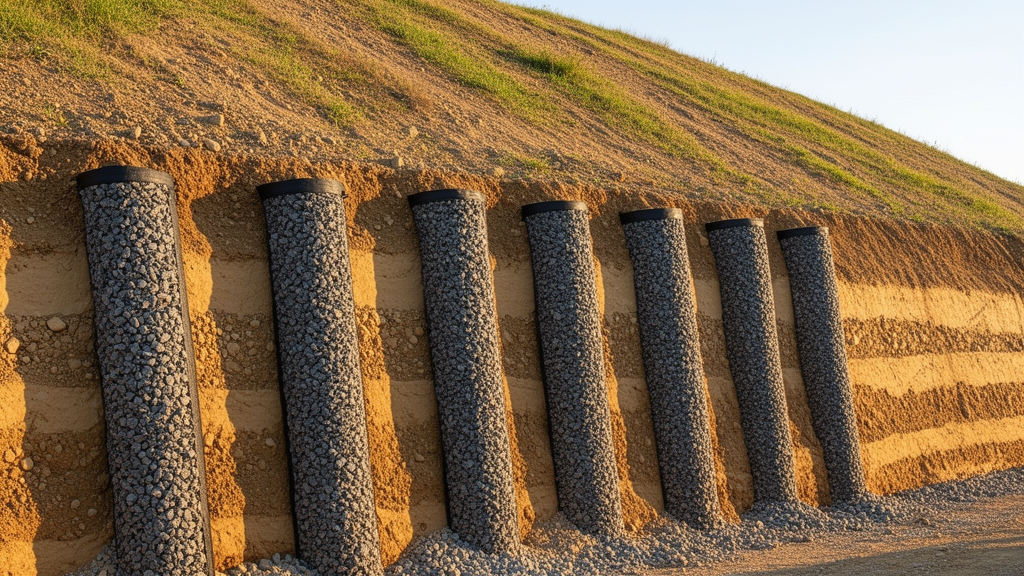
The geosynthetic-encased stone column technique successfully combined the high fluid drainage capacity of aggregate columns with the structural confinement of synthetic geotextiles, providing a balanced countermeasure against both pore pressure buildup and downslope lateral flow failure. Parametric simulations established that increasing the encased column diameter to 1.2 meters and decreasing installation spacing to 1.4 meters greatly accelerated pore pressure dissipation while substantially reducing lateral deformation across the upper and middle soil strata. While incorporating thicker geosynthetic encasements, such as 0.009 meters, marginally augmented radial confinement and reduced downslope movement, the overall influence of encasement thickness on pore pressure reduction was minor compared to the dominant effects of column diameter and spacing. By maintaining column integrity throughout shaking, the encased configuration stabilized the entire deposit and promoted uniform deformation profiles.
The full-depth displacement profiles calculated across the thirty-meter soil deposit highlighted profound structural distinctions between untreated sloping ground and ground reinforced by each improvement option. Conventional stone columns reduced lateral movements in deeper zones but failed to adequately arrest downslope shearing within the shallow liquefiable horizon, where column shear stiffness proved insufficient against dynamic driving stresses.
These numerical findings provide essential engineering design criteria for geotechnical practitioners selecting seismic hazard countermeasures for infrastructure sited on liquefiable, gently sloping terrain. The comparative data indicate that while traditional stone columns offer an economical and highly effective solution for level sites where the primary engineering objective is rapid pore pressure dissipation, they are inadequate for sloping ground vulnerable to lateral spreading. Conversely, micro-piles deliver robust lateral resistance against ground displacement when properly socketed into competent underlying strata, yet they do not alleviate excess pore water pressures or eliminate liquefaction triggering within the surrounding soil. The geosynthetic-encased stone column emerges from this comparative investigation as the most versatile and robust countermeasure for sloping liquefiable ground, uniquely achieving both substantial excess pore pressure reduction and superior lateral deformation control. Geotechnical engineers must nevertheless recognize that these predictive insights stem from idealized finite-element simulations under a single scaled earthquake record, emphasizing the continued necessity of site-specific field validation and dynamic testing before full-scale implementation.
Subject of Research: Comparative seismic performance of stone columns, micro-piles, and geosynthetic-encased stone columns for soil liquefaction mitigation
Article Title: A comparative study of seismic performance evaluation of stone column, micro-pile, and geosynthetic-encased stone column for liquefaction flowslide mitigation
Article References: Fansuri, M. H., Chang, M., Lin, H.-J., Rayhansah, R. R., Upomo, T. C., & Kusumawardani, R. (2025). A comparative study of seismic performance evaluation of stone column, micro-pile, and geosynthetic-encased stone column for liquefaction flowslide mitigation. City and Built Environment, 3(1), Article 7. https://doi.org/10.1007/s44213-025-00048-5
Image Credits: AI Generated
DOI: 10.1007/s44213-025-00048-5
Keywords: soil liquefaction, geosynthetic-encased stone columns, stone columns, micro-piles, lateral spreading, liquefaction flowslides, excess pore water pressure, OpenSeesPL, finite-element simulation, seismic ground improvement, Chi-Chi earthquake, sloping ground stability, soil-structure interaction, pore pressure dissipation, geotechnical earthquake engineering, Chuoshui River alluvial fan-delta
News Source: Denise Maddox. (November 12, 2026). Encased Stone Columns Best Mitigate Sloping Ground Liquefaction Deformation In Simulation. Scienmag.