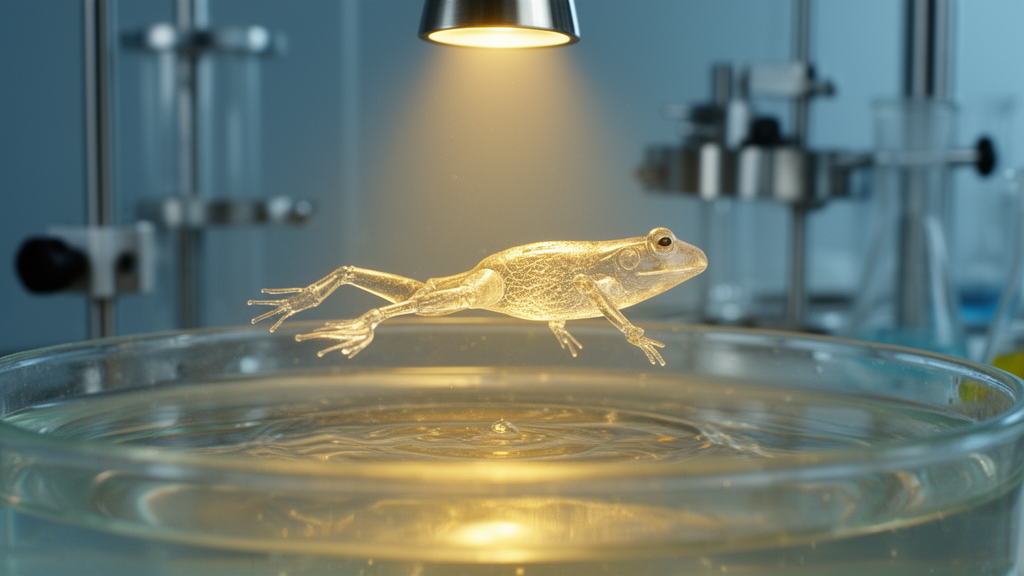
Researchers at Aarhus University have developed a small robotic frog that swims across the water’s surface using six artificial muscles activated by near-infrared light. The device, created by PhD student Cecilie Ryberg from the Department of Chemistry, operates without motors, batteries, or wires. By illuminating the dark patches on the frog’s legs with a lamp, the researchers trigger coordinated contractions that propel the robot forward. This achievement represents a significant step in the field of soft robotics, demonstrating a systematic approach to linking molecular design with functional robotic movement.
The core innovation of the study lies in the material composition of the artificial muscles. The team utilized liquid crystal elastomers, materials that contract when heated and return to their original shape as they cool. To enable optical control, the researchers incorporated a specific molecule into the elastomer that absorbs near-infrared light and converts it into heat.
A major challenge in the development process was ensuring that the six individual muscles worked in a coordinated manner. Professor Brigitte Städler, who led the research project, explained that if the muscles do not contract in a synchronized way, the frog will not swim forward but may simply spin around in place.
The researchers 3D-printed both the artificial muscles and the flexible silicone body in a single continuous process. The material used for the muscles behaves like a very thick syrup or icing, which the printer places precisely where needed, rather than the solid plastic filament used in conventional 3D printing. This chemical bonding is critical because even the most effective artificial muscle is of limited utility if its movement cannot be efficiently transferred to the rest of the robot’s body.
In laboratory experiments, the robotic frog demonstrated its swimming capabilities by traveling eight centimeters in almost two minutes. While this speed is not particularly fast, the primary interest in the device lies in its mode of propulsion and the underlying material science. To further validate their approach, the researchers also created a second swimming robot resembling a whale.
The systematic investigation conducted by Cecilie Ryberg focused on how different molecular ingredients and chain lengths affect both the printing properties of the inks and the movements of the finished muscles. By varying these parameters, the team established clearer guidelines for selecting materials for artificial muscles. This methodology aims to reduce the amount of trial and error involved in developing new soft robots.
Despite these advances, the current designs have notable limitations. The robots still require an external light source to operate and cannot yet navigate independently around obstacles.
Looking toward future applications, the researchers envision that soft robots of this kind could be used for environmental monitoring and search-and-rescue operations. However, the immediate practical application may be less ambitious. Cecilie Ryberg suggested that these robots could be used as toys before they are deployed in rescue missions, noting that people would likely enjoy playing with a light-driven frog.
Subject of Research: Development of a 3D-printed soft robotic frog using light-activated liquid crystal elastomer muscles
Article Title: Researchers 3D-print swimming frog with six artificial muscles
Article References: Researchers 3D-print swimming frog with six artificial muscles. Original publication (Bibliographic details unavailable.)
Image Credits: AI Generated
DOI: Not provided
Keywords: Aarhus University, soft robotics, 3D printing, liquid crystal elastomers, artificial muscles, near-infrared light, Cecilie Ryberg, Brigitte Städler, photothermal actuation, silicone body, swimming robot, molecular design, chemical bonding, Advanced Materials Technologies, wireless actuation, soft silicone, robotic propulsion, material science, lab-on-a-chip, autonomous navigation
News Source: Denise Maddox. (November 12, 2026). Aarhus University 3D-prints light-driven swimming frog robot. Scienmag.