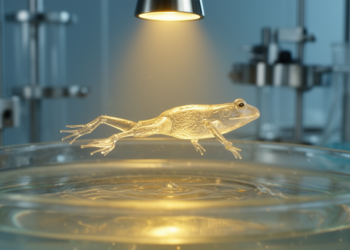
Aarhus University 3D-prints light-driven swimming frog robot
Researchers at Aarhus University developed a light-driven robotic frog with six 3D-printed artificial muscles that swims without motors or batteries.
Researchers at Aarhus University developed a light-driven robotic frog with six 3D-printed artificial muscles that swims without motors or batteries.
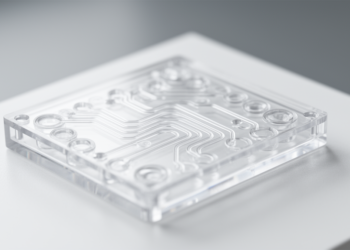
A comprehensive review examines how microfluidic architectures leverage low Reynolds number fluid dynamics, advanced fabrication techniques, and machine learning to ...
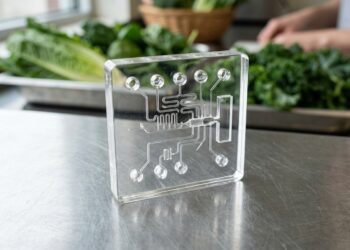
A comprehensive review outlines how integrating nucleic acid aptamers into microfluidic devices enables rapid, highly sensitive detection of foodborne pathogens, ...
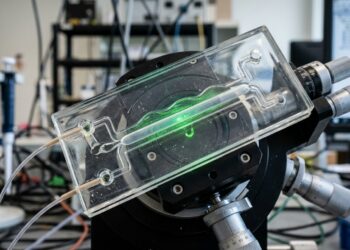
An open access analytical study models electroosmotic peristaltic transport of a Bingham fluid in an inclined microchannel, finding that electroosmotic ...

A narrative review synthesizes how nanosensors, nanoimaging and machine-learning pipelines could enable earlier crop disease detection, while flagging unresolved gaps ...

A new three-dimensional simulation shows that redox-magnetohydrodynamic forces on a microfluidic chip can steer, retain, or redirect picoliter sample plugs ...

A microfluidic lab-on-a-chip developed in Atlanta measures how a child's leukemia cells respond to drug combinations from a single sample, ...
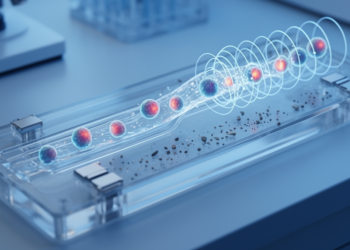
A 3.75 MHz surface-acoustic-wave microchip achieved up to 99.4 percent recovery of MCF-7 tumor-cell models while routing cellulose-nanofiber suspensions to ...

Researchers in Portugal have developed a passive microfluidic multiplexer that mixes fluids at flow rate ratios up to 1:6 and ...

Researchers have built a digital microfluidic platform in which AI-guided nanolitre droplets autonomously run, adapt and optimize colorimetric biochemical assays ...