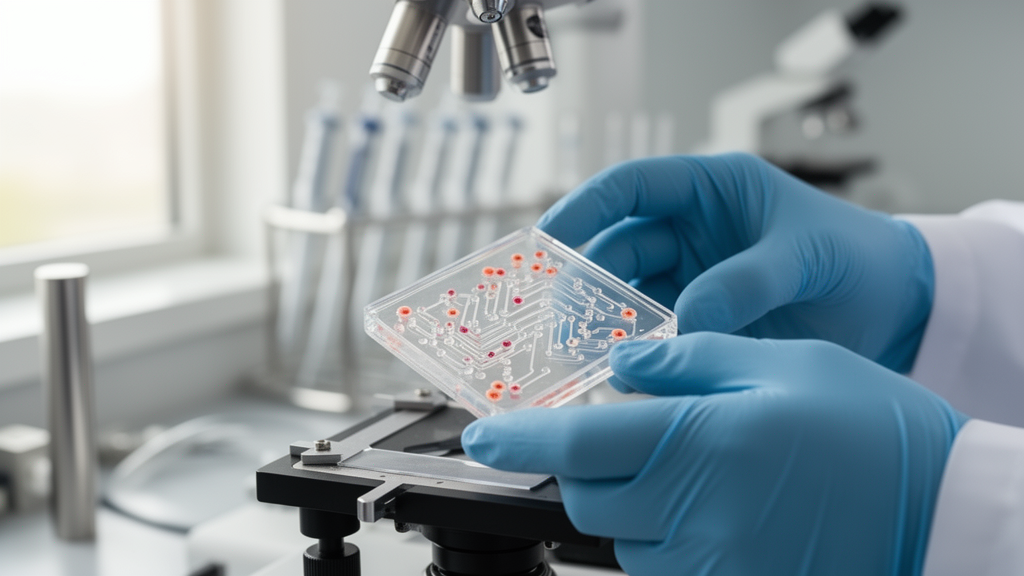
A microfluidic technology called GradientScreen can measure how a child’s leukemia cells respond to drug combinations before treatment starts, according to a study published in Nature Biomedical Engineering by researchers at Emory University, Children’s Healthcare of Atlanta and Georgia Tech. The “lab-on-a-chip” assay uses a single blood or bone marrow sample to rapidly test how a patient’s own leukemia cells react to various three-drug regimens, offering clinicians an additional layer of information at the time of diagnosis rather than after standard chemotherapy has been administered.
Acute lymphoblastic leukemia (ALL) is the most common pediatric leukemia, responsible for 75% of childhood leukemia diagnoses. More than 120,000 people in the United States are living with the disease, and 6,000 new cases are diagnosed each year, more than 3,500 of them in children. ALL is a rapid-onset blood cancer that prevents the body from producing mature, infection-fighting white blood cells, sometimes within a matter of months, and requires immediate treatment—often a combination of chemotherapy, targeted therapy, immunotherapy and bone marrow transplants. Yet clinicians today have no way of knowing in advance how specific drug combinations and dosages will affect an individual patient, or whether the treatment will succeed.
Current treatment strategies incorporate some personalization based on leukemia subtype and risk classification, but most patients ultimately receive similar regimens. While genomic sequencing has raised the possibility of truly personalized therapy, two patients with the same genetic mutation can respond very differently to targeted therapy. That gap has created a need for complementary functional assays that test live cancer cells directly against treatments to see which interventions actually work, the researchers note.
GradientScreen addresses this by exposing leukemia cells to three-drug combinations and measuring how many cancer cells survive. Rather than testing each drug pair and dose ratio individually—which would be time-consuming and resource-intensive—the assay uses microfluidic technology to evaluate the full range of combination ratios within a three-drug regimen in a single, efficient experiment. By comparing how cells respond to single drugs versus combinations, the platform identifies which drug combinations and ratios work better together, producing detailed “response patterns” that reflect how a patient’s type of leukemia might react to treatment.
In the retrospective study, the team analyzed 17 leukemia cell and bone marrow samples from ALL patients provided by the Aflac Cancer and Blood Disorders Center of Children’s Healthcare of Atlanta. Results from the platform correlated with patient treatment outcomes, including the amount of residual disease after induction treatment—the first month of chemotherapy—as well as whether the patient relapsed. The researchers emphasize that this is an early, retrospective study with a small sample size, and that further work is needed before the assay can guide care broadly.
The technology was developed in Atlanta by Kendall Williams, PhD, and Dan Zhang, PhD, graduates of Emory University and Georgia Tech’s biomedical engineering and bioengineering programs, respectively. Wilbur Lam, MD, PhD, professor of pediatrics and biomedical engineering at Emory University and Georgia Tech, pediatric oncologist at Children’s Healthcare of Atlanta, and principal investigator on the study, described the goal as identifying which patients are likely to be unresponsive to standard treatment before therapy begins, and personalizing which combination of standard chemotherapies with newer targeted or biological agents would be most beneficial, and at which dosages, for a particular person.
The stakes of such prediction are significant. Roughly 50% of adults with ALL experience relapse or refractory disease, in which the cancer does not respond to treatment or proliferates during the intervention, and in the pediatric population roughly 15% experience relapse. “This is a significant advancement in helping pediatric oncologists nationwide understand which drugs to administer to patients who are most likely to resist standard chemotherapy,” Lam said.
“GradientScreen aims to improve as well as broaden access to precision medicine in leukemia treatment by helping clinicians identify harder-to-treat patients earlier in disease progression, and more precisely matching them with new, alternative treatment approaches,” said Williams. The team’s initial next steps include expanding the platform to other leukemia types, including acute myeloid leukemia, to adult as well as pediatric patients, and establishing it within the Emory Lab for Innovative Assay Development (ELIAD), a collaboration between Emory Healthcare and Emory University that supports diagnostic testing that can be immediately used for patient care. The study was funded by NSF GRFP award No. 1937971 and NIH NHLBI grant R35HL145000.
Subject of Research: A microfluidic assay that screens three-drug combinations against pediatric acute lymphoblastic leukemia cells to predict treatment response
Article Title: New technology predicts which cancer treatments may work for pediatric acute lymphoblastic leukemia (ALL)
Article References: New technology predicts which cancer treatments may work for pediatric acute lymphoblastic leukemia (ALL). Original publication (Bibliographic details unavailable.)
Image Credits: AI Generated
DOI: Not provided
Keywords: acute lymphoblastic leukemia, pediatric oncology, microfluidics, lab-on-a-chip, drug combination screening, precision medicine, drug sensitivity assay, Emory University, Children's Healthcare of Atlanta, Georgia Tech, Nature Biomedical Engineering, leukemia relapse
News Source: Nathaniel Bowman. (October 28, 2026). Lab-on-a-chip screens drug combinations for pediatric leukemia before treatment begins. Scienmag.