A prospective two-year cohort study tracking physically active individuals with chronic ankle instability has demonstrated that penalized machine learning models can predict subsequent ankle reinjury with solid discriminative performance and near-ideal calibration, while revealing that adjusting decision thresholds by sex can substantially narrow algorithmic disparity without retraining the underlying predictive architecture. Publishing their findings in Sports Medicine – Open, an international research team led by investigators at Brigham Young University followed ninety-six patients over twenty-four months to develop, internally validate, and fairness-audit multivariable prognostic models built on fourteen routinely obtainable baseline measurements. The investigation identified a core constellation of five prognostic markers—biological sex, arch height index, previous sprain frequency, weight-bearing dorsiflexion range of motion, and dynamic postural stability—that consistently drove reinjury risk estimates across divergent algorithmic frameworks. Crucially, the researchers uncovered that applying a standard, single global classification threshold across both sexes produced a pronounced gap in error rates between male and female participants, but shifting to sex-stratified decision cutoffs reduced this equalized-odds disparity by fifty-seven percent while maintaining model accuracy across the cohort.
Lateral ankle sprains represent one of the most pervasive musculoskeletal injuries in athletic and recreational populations, generating estimated incidence rates of approximately seven injuries per one thousand person-years among athletic cohorts, with females experiencing significantly higher primary exposure rates than males. Following an initial acute lateral ankle sprain, clinical trajectories diverge substantially: while certain individuals successfully recover full functional capacity without residual mechanical or functional giving-way episodes, roughly forty percent progress to chronic ankle instability. This chronic condition is characterized by persistent sensations of joint instability, recurring episodes of giving way, neuromuscular deficits, self-reported disability, and pathomechanical impairments across postural and sensorimotor control systems. Despite the high incidence of reinjury, previous clinical literature has been dominated by cross-sectional case-control designs comparing established chronic instability cohorts against healthy copers, an approach that effectively profiles baseline dysfunction but cannot establish temporal sequence or prospectively distinguish which specific impairments directly precede a recurrent sprain.
To overcome this longstanding gap between cross-sectional phenotyping and longitudinal prognosis, the research team designed a two-year prospective study that adhered to reporting guidelines established by the TRIPOD-plus-AI statement for artificial intelligence prediction models. Enrolling a convenience sample of one hundred physically active university students from Brigham Young University in Provo, Utah between February 2017 and February 2018, the investigators recruited fifty male and fifty female participants presenting with verified chronic ankle instability. Eligibility was tightly governed by consensus criteria established by the International Ankle Consortium, requiring participants to report an initial significant ankle sprain sustained more than twelve months prior that caused inflammatory symptoms and interrupted physical activity, at least two distinct giving-way episodes during the preceding six months, affirmative answers on at least five items of the modified Ankle Instability Index, and substantial functional limitations verified by score cutoffs on both the Activities of Daily Living and Sport subscales of the Foot and Ankle Ability Measure. Furthermore, all participants engaged in at least ninety minutes of moderate weight-bearing physical activity across at least three days each week, ensuring an active baseline population exposed to ongoing athletic loading conditions.
Over the subsequent two-year surveillance window, participants reported their ankle health status through standardized Qualtrics online surveys distributed at pre-specified intervals of six, twelve, and twenty-four months, supplemented by mobile text messaging, direct electronic mail prompts, and structured telephone follow-up interviews for non-respondents. Participants were explicitly instructed to register any new inversion or supination injury event sustained on the baseline-assessed limb immediately as it occurred, with contralateral events cataloged independently to prevent diagnostic ambiguity. Of the initial cohort of one hundred individuals, four participants failed to return any follow-up data and were excluded from final modeling, yielding a robust analytical sample of ninety-six individuals comprising forty-nine males and forty-seven females. Surveillance compliance remained remarkably elevated, achieving survey completion rates of ninety-one percent at six months, ninety-two percent at twelve months, and eighty-eight percent at twenty-four months, with every single analyzed participant having their two-year reinjury status conclusively verified. In total, forty-one participants sustained a confirmed ipsilateral ankle reinjury during the prospective tracking period, establishing an overall cohort reinjury incidence of forty-three percent with complete parity in follow-up ascertainment across reinjury and uninjured subgroups.
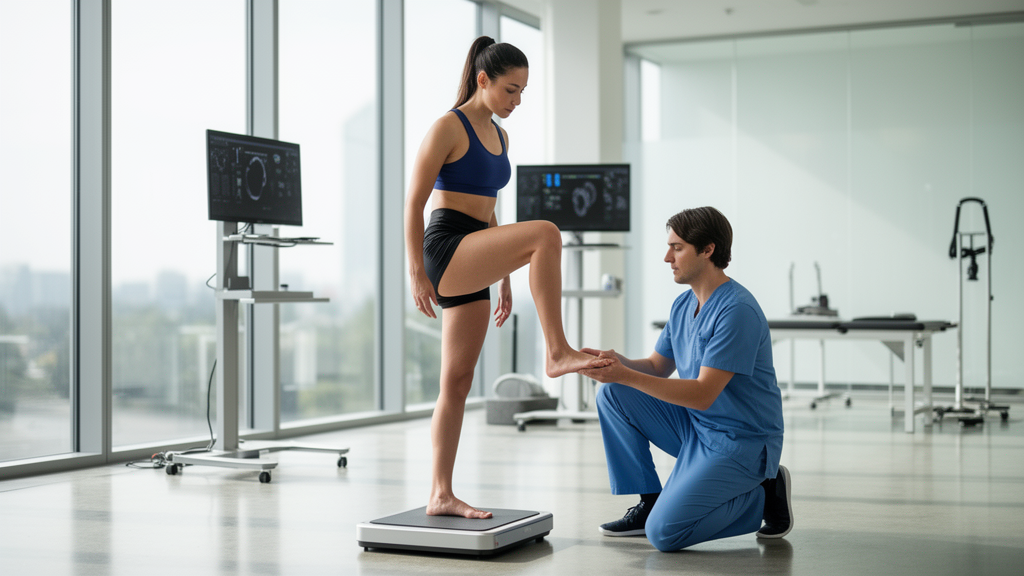
At baseline, a single trained assessor blinded to subsequent outcomes gathered fourteen candidate prognostic variables spanning seven distinct demographic, clinical, anthropometric, and functional domains. These comprehensive evaluations captured age, biological sex, habitual weekly physical activity hours, body mass index, and arch height index, alongside injury history metrics including lifetime previous sprain count, self-reported giving-way frequencies, and subjective joint instability severity scored from the modified Ankle Instability Index. Patient-reported functioning was documented via both subscales of the Foot and Ankle Ability Measure. Objective functional assessments integrated standardized laboratory protocols: weight-bearing lunge measurements of dorsiflexion range of motion; dynamic balance evaluations capturing the composite reach distance of the Star Excursion Balance Test normalized to leg length; dynamic postural stability quantified via the Biodex Balance System Overall Stability Index across unstable platform perturbations; and unilateral explosive functional performance evaluated through the normalized triple-hop distance. To ensure maximum measurement stability, performance-based variables represented the mean of the two best performances across three standardized trials conducted in dedicated familiarization and randomized testing sessions separated by two to three days of physiological rest.
Model training and statistical validation were conducted within a rigorous nested cross-validation framework designed to protect against optimistic performance inflation and data leakage. The analytical pipeline compared an unpenalized logistic regression baseline against five versatile machine learning algorithms: Elastic Net penalized regression, support vector machines equipped with a radial-basis kernel, random forests, extreme gradient boosting, and light gradient boosting machines. Within this nested structure, the outer loop performed five-fold cross-validation repeated five independent times, generating twenty-five distinct outer training-and-testing partitions, while an inner five-fold loop tuned algorithm hyperparameters through random search across twenty candidate configurations optimizing inner-fold discriminative area under the receiver operating characteristic curve. Crucially, all preprocessing transformations—including median imputation of sparse missing values affecting fewer than five percent of entries and continuous feature standardization—were refitted strictly inside the respective training partitions. Because forty-one events across fourteen candidate predictors yielded an events-per-variable ratio of approximately 2.9, stratified sampling was preserved across folds to handle class distribution without introducing synthetic oversampling techniques that could distort empirical probability calibration.
Across all evaluated computational architectures, the primary models developed without external feature selection demonstrated strong discriminative capacity, with all five machine learning models surpassing an area under the curve benchmark of 0.70. Under a pre-specified selection rule prioritizing models that balanced discriminative power with optimal probability calibration, Elastic Net was designated as the primary predictive tool, achieving an area under the curve of 0.807 with a ninety-five percent bootstrap confidence interval spanning 0.714 to 0.893, accompanied by a near-ideal calibration slope of 1.015 and an intercept of 0.007. Extreme gradient boosting and light gradient boosting machines produced closely matching discriminative values of 0.805 and 0.799, while support vector machines and random forests reached 0.795 and 0.747, respectively. Although the unpenalized logistic regression baseline recorded an apparent area under the curve of 0.812, it exhibited substantial miscalibration, characterized by an attenuated calibration slope of 0.482 and an intercept of negative 0.166. This marked contrast underscored that the primary mathematical advantage delivered by regularized machine learning in this clinical cohort lay not in raw discrimination, but in outputting well-calibrated probabilities that directly mirror genuine empirical risk.
To evaluate whether model performance depended heavily on entering all candidate markers or whether a sparse subset could suffice, the investigators executed a pre-planned sensitivity analysis incorporating stability selection inside every outer cross-validation fold. By fitting lasso logistic regression across one hundred random subsamples of each training partition and retaining features surpassing a selection frequency threshold of sixty percent, the researchers filtered the predictor space down to the most stable variables before retraining models. When models were refitted solely on this selected subset, discrimination dropped uniformly across all algorithms, with the Elastic Net area under the curve falling to 0.735. However, when evaluating per-fold performance discrepancies using the Nadeau and Bengio corrected resampled t-test—an inferential correction that properly accounts for non-independence and participant overlap across repeated cross-validation folds—none of the predictive differences between the full and reduced models maintained statistical significance, all yielding corrected p-values at or above 0.087. This sensitivity check proved instrumental in confirming that the apparent superiority of the comprehensive model reflected natural information loss rather than algorithmic instability, while simultaneously verifying that the underlying prognostic signal was anchored to a reproducible set of core physiological characteristics.
Interpreting the mathematical drivers governing risk predictions via Shapley additive explanations and partial dependence plots identified five baseline features that dominated predictive importance across the top-performing algorithms. In the stability-selection analysis, these identical variables were the only candidates selected in more than sixty percent of fold iterations: biological sex appeared in ninety-two percent, arch height index in eighty-eight percent, previous sprains in eighty-four percent, dorsiflexion range of motion in seventy-six percent, and stability index in sixty-eight percent. In contrast, dynamic functional tests like the normalized triple-hop ranked near the bottom and achieved zero percent stability retention. Visualizing partial dependence relationships delineated clear, predominantly non-linear risk inflections where marginal reinjury probabilities crossed fifty percent: arch height index values around 0.37 to 0.38, previous sprain counts exceeding approximately five injuries, restricted dorsiflexion mobility falling below thirty-six to forty degrees, and stability index scores exceeding 1.0 to 1.1 points.
Because clinical algorithms must perform equitably across diverse patient populations, the researchers conducted an out-of-fold fairness audit focused on biological sex as a protected demographic attribute. Within-sex evaluation demonstrated that model discrimination was inherently comparable between sexes, with female area under the curve values reaching 0.775 for Elastic Net, 0.770 for extreme gradient boosting, and 0.800 for light gradient boosting, compared against male values of 0.767, 0.764, and 0.735, with widely overlapping confidence intervals. However, when the authors implemented a conventional single global Youden decision threshold derived out-of-fold, severe operational inequities emerged: for the primary Elastic Net model, male sensitivity reached 0.929 while female sensitivity plummeted to 0.615, generating a sizable equalized-odds gap of 0.384 and a disproportionate-impact ratio of 0.428, well beneath the recognized 0.80 four-fifths regulatory threshold. To remediate this imbalance without rebuilding the model architecture, the investigators applied sex-specific classification thresholds derived independently out-of-fold. This post-processing adjustment reduced the equalized-odds gap by fifty-seven percent down to 0.164 and elevated the disproportionate-impact ratio to 0.683, proving that substantial fairness improvements can be realized purely through calibrated operational threshold tuning at the clinical deployment interface.
From a translational standpoint, these findings offer a pragmatic pathway toward individualized clinical risk stratification, directing therapeutic focus toward modifiable physical impairments while establishing that decision thresholds can be adjusted to balance sensitivity across demographic groups. Nevertheless, the authors emphasized critical limitations that preclude immediate, uncritical deployment in clinical settings. The analytical sample of ninety-six participants and forty-one reinjury events, including only thirteen female reinjury events, represents an exploratory sample size characterized by broad bootstrap confidence intervals where individual outcome misclassifications exert notable percentage shifts on sensitivity metrics. Furthermore, reinjury events were ascertained through systematic participant surveys rather than blinded clinical examinations, candidate variables omitted specific measures of hip or peroneal muscle strength and psychological fear of movement, the exploratory partial dependence cutoffs have not undergone validation against recognized clinical benchmarks, and the residual disproportionate-impact ratio of 0.683 indicates that sex-specific thresholding narrows but does not completely eliminate disparate positive-prediction rates. Because observational prognostic models illuminate multivariable associations rather than causal mechanics, subsequent randomized controlled trials and large-scale external validation cohorts will be indispensable to confirm whether rehabilitating these identified markers directly mitigates recurrent ankle injury across broader athletic populations.
Subject of Research: Machine learning prediction and fairness audit for two-year ankle reinjury in chronic ankle instability
Article Title: Sex-Equitable Machine Learning Prediction of Ankle Reinjury in Individuals with Chronic Ankle Instability: A 2-Year Prospective Cohort Study with Fairness Audit
Article References: Hwang, U.-J., Son, S. J., Fu, S.-N., Wong, A. Y. L., Bruening, D., Feland, B., Seeley, M., & Hopkins, J. T. (2026). Sex-Equitable Machine Learning Prediction of Ankle Reinjury in Individuals with Chronic Ankle Instability: A 2-Year Prospective Cohort Study with Fairness Audit. Sports Medicine – Open, 12(1), Article 169. https://doi.org/10.1186/s40798-026-01137-3
Image Credits: AI Generated
DOI: 10.1186/s40798-026-01137-3
Keywords: Chronic Ankle Instability, Machine Learning, Ankle Reinjury, Prospective Cohort Study, Algorithmic Fairness, Elastic Net, Dorsiflexion Range of Motion, Arch Height Index, Postural Control, Equalized Odds, Disproportionate Impact, Shapley Additive Explanations, Partial Dependence Plots, Sports Medicine, Predictive Modeling, Nested Cross-Validation, Biomechanics
News Source: Blake Davidson. (November 14, 2026). Machine Learning Accurately Predicts Chronic Ankle Reinjury Using Sex-Adjusted Thresholds. Scienmag.