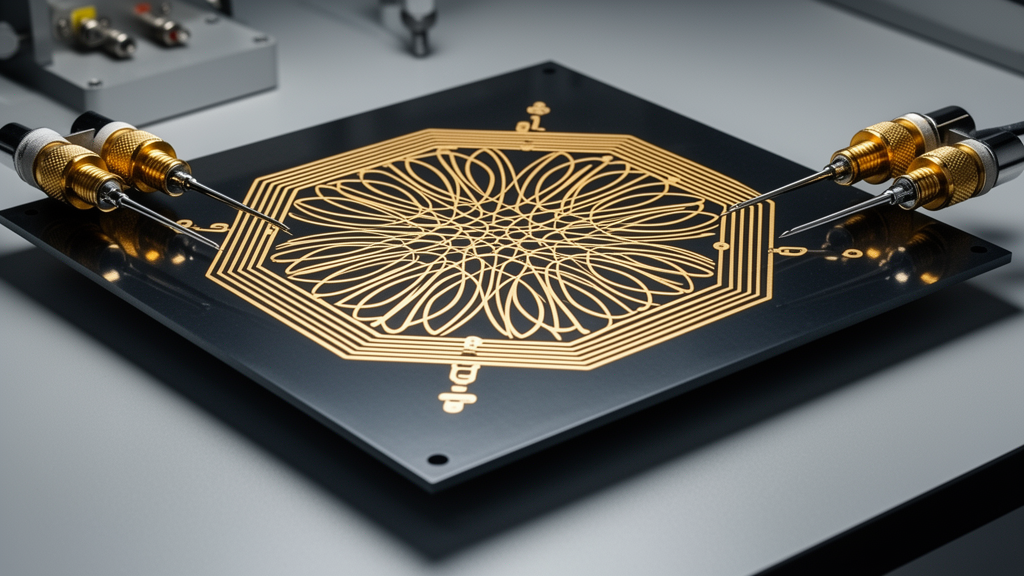
In planar high-frequency technology, the electromagnetic response of a printed microstrip circuit is dictated not only by the dielectric properties of the substrate, the metallization thickness, and the excitation feeding scheme, but also by the physical geometry of the conductive pattern. Slight modifications introduced to the contour profile, structural symmetry, slot arrangements, electric current paths, or surrounding dielectric conditions can shift resonant frequencies, change operational bandwidths, perturb impedance matching, and modify spatial electromagnetic field localization. While conventional engineering workflows often rely on standard computer-aided design shapes such as rectangles, circles, or simple polygon patches, exploring intricate, continuously parameterized boundaries presents significant opportunities for microwave devices, electromagnetic absorbers, metamaterial unit cells, and frequency-selective surfaces. To capture such complex planar shapes systematically, researchers frequently look to analytical formulations such as the Gielis superformula, an equation capable of generating a broad spectrum of regular, lobed, star-like, and multi-branch closed curves through six continuous parameters. However, evaluating these non-standard geometries inside commercial full-wave electromagnetic solvers typically imposes an extensive, repetitive manual burden that impedes systematic parametric exploration.
Addressing this computational and operational bottleneck, researchers Sebastián Montoya-Villada, Valentina Sierra-Gutierrez, and Erick Reyes-Vera developed GielisMeta-CST, an open-source MATLAB application created using App Designer to automate the end-to-end geometric reconstruction, physical assignment, and full-wave electromagnetic simulation of Gielis-inspired microstrip structures within Dassault Systèmes CST Studio Suite. In conventional modeling environments, exploring non-standard contours requires an engineer to manually plot parametric curves, transfer coordinates into a computer-aided design environment, repair non-manifold or self-intersecting boundaries, assign substrate and metal definitions, establish waveguide or Floquet boundary conditions, place excitation ports, define solver convergence parameters, and post-process scattered field data for every design iteration. This overhead becomes especially severe when rational symmetry parameters produce multi-branch curves that cannot be reproduced using standard geometric primitives. GielisMeta-CST resolves this friction by bridging MATLAB and CST Studio Suite through a Microsoft Windows Component Object Model interface, executing automated polygonal discretization, model building, solver initiation, and mode-dependent extraction directly from a unified graphical interface without requiring custom visual basic scripting from the user.
The underlying software architecture of GielisMeta-CST is organized into five decoupled layers: user interaction, Gielis geometry generation, computer-aided design compatible contour preparation, solver automation, and mode-dependent post-processing. By decoupling these structural layers, the software enforces a clean functional separation between the geometric flow and the electromagnetic flow. The geometric flow evaluates the parametric mathematical equations and yields clean, two-dimensional planar boundaries, whereas the electromagnetic flow assigns physical meaning by generating three-dimensional project models, allocating material properties, assigning boundary limits, creating ports, and configuring solver parameters. This strict decoupling ensures that identical mathematical contours can be seamlessly reused across diverse physical operational setups without altering the underlying geometric core. Furthermore, a synchronization validity flag monitors the state between the MATLAB graphical interface and the active CST Studio Suite project; whenever a user modifies any geometric, dielectric, or simulation input, the active project is flagged as outdated and solver execution is disabled until the structure is rebuilt, thereby preventing simulations on unsynchronized models.
At the mathematical foundation of the geometric core lies the polar form of the Gielis superformula, which calculates the radial coordinate as a function of the polar angle using six defining coefficients: scaling values along the coordinate axes, a rotational symmetry index defining feature repetitions around the origin, and three independent real exponents governing local curvature, concavity, and transitions between rounded and sharp segments. Because rational symmetry coefficients yield multi-branch curves across extended angular domains, the application evaluates the curve over an angular interval of up to four pi times the rational denominator when asymmetry or unequal scaling factors exist, or two pi times the denominator when rotational conditions permit. When evaluating raw mathematical curves, overlapping branches, self-intersections, and sharp local transitions often emerge that would otherwise cause standard three-dimensional computer-aided design Boolean and extrusion operations to fail. To overcome this limitation, GielisMeta-CST incorporates a radial-envelope reconstruction algorithm that converts sampled points into polar coordinates, divides the angular domain into seven hundred and twenty discrete sectors, and extracts the maximum radius within each sector to form a single continuous outer envelope.
To guarantee robust polygon handling within the computer-aided design kernel, empty angular sectors within the discretized radial envelope are reconstructed through periodic interpolation, followed by the application of a circular five-point moving average filter that smooths abrupt localized variations. This fixed angular discretization produces a constant angular resolution of half a degree, which the authors established internally in version 1.0.0. After obtaining the primary regularized outer boundary, concentric nested contours are generated through homothetic scaling about the coordinate origin, leaving designated gaps between adjacent boundaries that function as either metallic conducting traces or complementary capacitive slots. Before exporting these shapes to the electromagnetic solver, the software applies rigid two-dimensional transformations, including planar rotation and coordinate displacement, alongside a rigorous topology cleanup routine that strips duplicate consecutive coordinates, invalid vertices, and redundant closure points. The developers note that because concentric outlines are generated through homothetic scaling rather than true normal offsetting, the physical gap width varies locally along non-circular curves, and the smoothing window can introduce slight alterations in edge curvature that may modify capacitive coupling and current distribution.
The application orchestrates automated high-frequency electromagnetic analysis across three distinct operating modes: absorber mode, transmitter mode, and sensor mode. In absorber mode, the software models metallic Gielis resonators positioned over a grounded lossy dielectric substrate, automatically configuring unit-cell periodic boundary conditions along transverse coordinate axes, open boundaries along the normal axis, and Floquet port excitation at normal incidence to extract reflection coefficients and calculate overall power absorptance. In transmitter mode, the application generates either metallic resonator arrays or complementary slot screens on an ungrounded dielectric substrate, assigning periodic Floquet boundaries to extract co-polarized transmission coefficients across the spectrum. In sensor mode, GielisMeta-CST constructs a planar transmission line topology featuring a top microstrip feed line electromagnetically coupled to a complementary Gielis split-ring resonator etched directly into the bottom ground plane, employing open radiation boundary conditions and two waveguide ports to determine the transmission dip, resonant frequency, and spectral shifts caused by dielectric loading.
To demonstrate the functional capabilities and end-to-end execution of the automated pipeline, the investigators evaluated three illustrative benchmark examples spanning the operational modes across a frequency spectrum of one to eight gigahertz. In the absorber demonstration, two concentric Gielis resonators were modeled on a thirty by thirty millimeter lossy FR-4 substrate backed by a continuous copper ground plane. The automated simulation revealed a multiresonant absorption response with a primary absorption peak occurring at 2.435 gigahertz, where the co-polarized reflection coefficient dropped to approximately minus 16.87 decibels, corresponding to an absorptance of nearly 97.9 percent, which aligns closely with the industrial, scientific, and medical band utilized by short-range wireless communications. A secondary absorption resonance appeared at 3.849 gigahertz with a reflection coefficient of minus 10.26 decibels and an absorptance of 90.6 percent, alongside a weaker resonance above seven gigahertz. Simulated transmission through the grounded unit cell remained at the numerical floor of the solver at approximately minus 1300 decibels, confirming that power transmission through the twenty-six skin-depth ground plane was negligible.
The transmitter benchmark demonstrated the generation of dual electromagnetic topologies from identical Gielis superformula parameters using a rational symmetry parameter of 3.4 on a Rogers RO4003C substrate under Floquet excitation. Without altering the underlying geometric description, the application successfully synthesized both a conventional metallic patch layout and its inverted complementary slot screen through automated computer-aided design Boolean operations. The conventional metallic resonator produced two transmission rejection notches at 3.114 gigahertz with minus 37.42 decibels and 5.403 gigahertz with minus 51.01 decibels, separated by a transmission passband peak at 3.478 gigahertz with minus 0.07 decibels. Conversely, the complementary layout inverted this electromagnetic behavior, exhibiting its primary rejection notch at 3.513 gigahertz with minus 46.42 decibels and transmitting effectively at 4.745 gigahertz with minus 0.08 decibels. These numerical examples confirmed that GielisMeta-CST reliably automates complex topological inversions and Floquet port configurations while executing the full simulation workflow without manual post-generation intervention.
In the sensor evaluation, GielisMeta-CST generated a microstrip line coupled to a complementary Gielis split-ring resonator on lossy FR-4, after which a cylindrical dielectric analyte droplet with a radius of 1.5 millimeters was introduced over the resonator center in the solver environment to track resonant shifts as relative permittivity was swept from 1 to 70. In the reference state with a permittivity of 1, the transmission scattering parameter exhibited a sharp resonant minimum at 4.171 gigahertz. Increasing the relative permittivity to 10 shifted the resonance downward to 3.982 gigahertz, representing a frequency displacement of 189 megahertz and yielding a localized average sensitivity of 21.0 megahertz per permittivity unit. As dielectric permittivity increased further to 20, 30, 40, 50, 60, and 70, the resonant dips shifted progressively to 3.912, 3.877, 3.863, 3.835, 3.835, and 3.821 gigahertz, yielding an overall displacement of 350 megahertz and an average full-range sensitivity of 5.07 megahertz per permittivity unit, illustrating a pronounced nonlinear saturation behavior under increasing capacitive loading.
To validate the physical viability of the automated modeling framework, the researchers fabricated a physical prototype of the Gielis-CSRR sensor and performed experimental vector network analyzer transmission measurements. The fabricated unloaded physical sensor exhibited a principal resonance at 3.986 gigahertz, which deviated by 4.44 percent from the 4.171 gigahertz prediction calculated by the automated GielisMeta-CST model, while a manually assembled CST model predicted an unloaded resonance at 4.230 gigahertz. Experimental loading using air, deionized water, pure glycerin, and a fifty-fifty water-glycerin mixture confirmed consistent downward frequency shifts matching the numerical trend. Furthermore, an efficiency assessment conducted by an experienced CST operator demonstrated that manually configuring the sensor required between 65 and 120 minutes, whereas GielisMeta-CST completed the full setup in 2 to 5 minutes, excluding solver compute time. Although the initial release lacks automated continuous integration testing, programmatic parameter sweeps, and adaptive mesh convergence sensitivity analyses, the tool provides an accessible, reproducible, BSD 3-Clause licensed foundation for geometry-driven electromagnetic modeling.
Subject of Research: Automated design and full-wave simulation software for Gielis-inspired microstrip structures in CST Studio Suite
Article Title: GielisMeta-CST: A MATLAB application for automated design and full-wave simulation of Gielis-inspired microstrip structures in CST Studio Suite
Article References: Montoya-Villada, S., Sierra-Gutierrez, V., & Reyes-Vera, E. (2026). GielisMeta-CST: A MATLAB application for automated design and full-wave simulation of Gielis-inspired microstrip structures in CST Studio Suite. SoftwareX, 36, Article 103223. https://doi.org/10.1016/j.softx.2026.103223
Image Credits: AI Generated
DOI: 10.1016/j.softx.2026.103223
Keywords: GielisMeta-CST, MATLAB App Designer, CST Studio Suite, Gielis superformula, microstrip structures, electromagnetic simulation, full-wave solver, complementary split-ring resonators, electromagnetic absorbers, microwave sensors, Floquet excitation, Component Object Model, frequency-selective surfaces, metamaterials, computational electromagnetics, transmission coefficient, dielectric loading
News Source: Denise Maddox. (November 14, 2026). MATLAB Application Automates Gielis Microstrip Structure Modeling in CST Studio Suite. Scienmag.