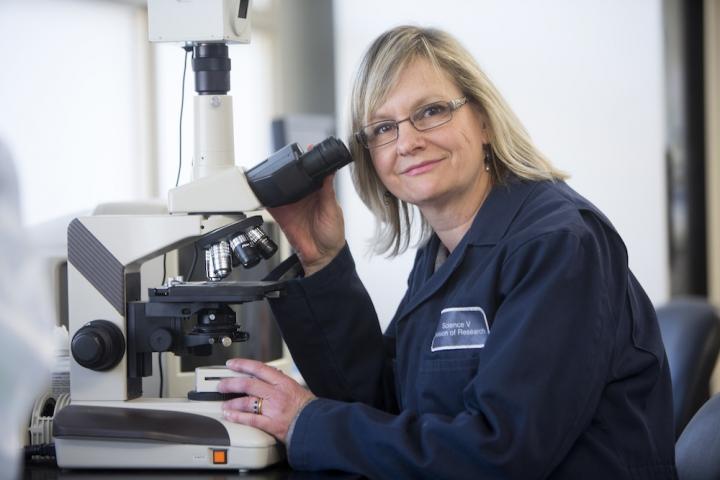
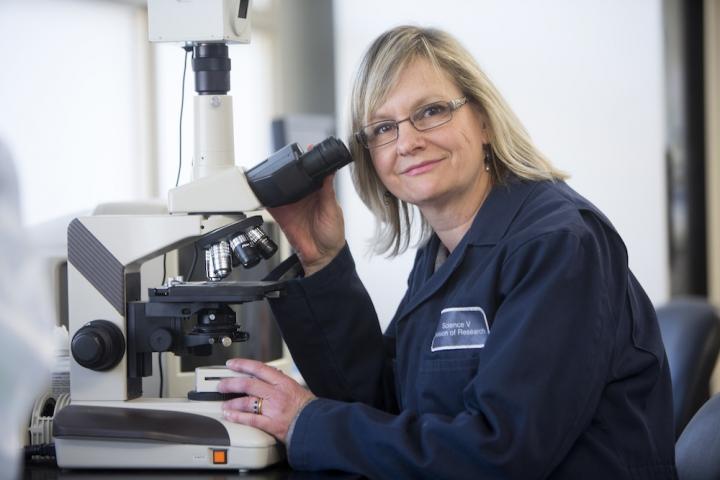
Credit: Jonathan Cohen/Binghamton University
BINGHAMTON, NY – Sexual preference is influenced by males' adolescent social stress history and social status, according to a research team including Nicole Cameron, assistant professor of psychology at Binghamton University, State University of New York.
Cameron, along with Cheryl McCormick from Brock University in Ontario, Canada, tested the hypotheses that social stress in adolescence decreases the "attractiveness" of male rats as sexual partners and that dominance status is a protective factor against the effects of social stress, when it comes to finding a sexual partner. The team's main prediction was that females would spend more time with control males than stressed males, and that this bias would be greater for submissive than for dominant rats.
The team subjected a group of male rats to social stress during adolescence, forcing the rats to change cage-partners regularly and establish their dominance in a group over and over. The team then placed a female into a mating chamber with one male who was stressed during adolescence and one who wasn't stressed, doing this with dominant and for subordinate rats separatly.
Among dominant pairs, female rats preferred the stressed males, spending more time with and visiting them more often. Among submissive pairs, females spent more time with control males than with social stress males. The results show that experience of stress in adolescence leads to long-lasting changes in males that are perceptible to females, are moderated by social status and influence sexual behavior.
"What we found was that of the dominant animals, the animals that were stressed during adolescence were more sexually favored by the female. But in the subordinate animals, the animals that were stressed during adolescence were not favored anymore. So, not only is the female capable of selecting partners as a function of social stressors that they have during adolescence, but she can tell which animal is subordinate and which animal is dominant when she gets tested, and she gets to choose between the two of them," said Cameron.
"Basically a female rat can identify who are dominant animals and who has been stressed during adolescence, and she will go toward the male that reacted the best to the stressor by being dominant in his cage. The male that was stressed during adolescence and is a submissive animal is really the loser, because the female will not go toward him as much. If a male received a social stressor during adolescence but survived this and became a dominant animal, the female is more likely to like this male compared to the control male that didn't suffer stress. But animals that suffer stress and became a submissive animal, that makes him a double loser, and the female will not spend time with him."
According to Cameron, this is the first time that researchers have studied the effects of social stress and the establishment of dominance, on female choice for a partner in rodents.
"Research has shown this in monkeys, but this is the first time that somebody has shown the impact of social stressors on dominance hierarchy in males and their impact on mating in rodents," said Cameron. "We showed that, yes, the dominance established after social stress really determines who will mate and who will not."
Cameron thinks that the results could lead to a better understanding of the effects of environmental stress on human reproduction.
"A lot of people are not capable of having children on their own, or it's difficult to do that. It's possible that environmental stressors are one of the variables that influence capacity for people to have children on their own," she said. "I think that this study is translational because it can lead us to a better understanding of the reproductive axis functions in mammals, including humans."
Cameron and her colleagues want to look at animals that have received low level of maternal care, and on top of that give them social stress, and find out what is going to happen to those animals later in life, not just at the level of reproduction but also in terms of learning and memory.
The paper, "The sexual preference of female rats is influenced by males' adolescent social stress history and social status," was published in Hormones and Behavior.
###
Media Contact
Nicole Cameron
[email protected]
607-777-4580
@binghamtonu
http://www.binghamton.edu