• HOME
  • NEWS
  • EXPLORE
    • CAREER
      • Companies
      • Jobs
    • EVENTS
    • iGEM
      • News
      • Team
    • PHOTOS
    • VIDEO
    • WIKI
  • BLOG
  • COMMUNITY
    • FACEBOOK
    • INSTAGRAM
    • TWITTER
Saturday, November 14, 2026
BIOENGINEER.ORG
No Result
View All Result
  • Login
  • HOME
  • NEWS
  • EXPLORE
    • CAREER
      • Companies
      • Jobs
        • Lecturer
        • PhD Studentship
        • Postdoc
        • Research Assistant
    • EVENTS
    • iGEM
      • News
      • Team
    • PHOTOS
    • VIDEO
    • WIKI
  • BLOG
  • COMMUNITY
    • FACEBOOK
    • INSTAGRAM
    • TWITTER
No Result
View All Result
Bioengineer.org
No Result
View All Result
Home NEWS Science News Technology

Robotic Microassembly System Automates Precision Coupling of Implantable Imaging Windows

by
November 11, 2026
in Technology
Reading Time: 2 mins read
0
Robotic Microassembly System Automates Precision Coupling of Implantable Imaging Windows

Robotic Microassembly System Automates Precision Coupling of Implantable Imaging Windows

Share on FacebookShare on TwitterShare on LinkedinShare on RedditShare on Telegram

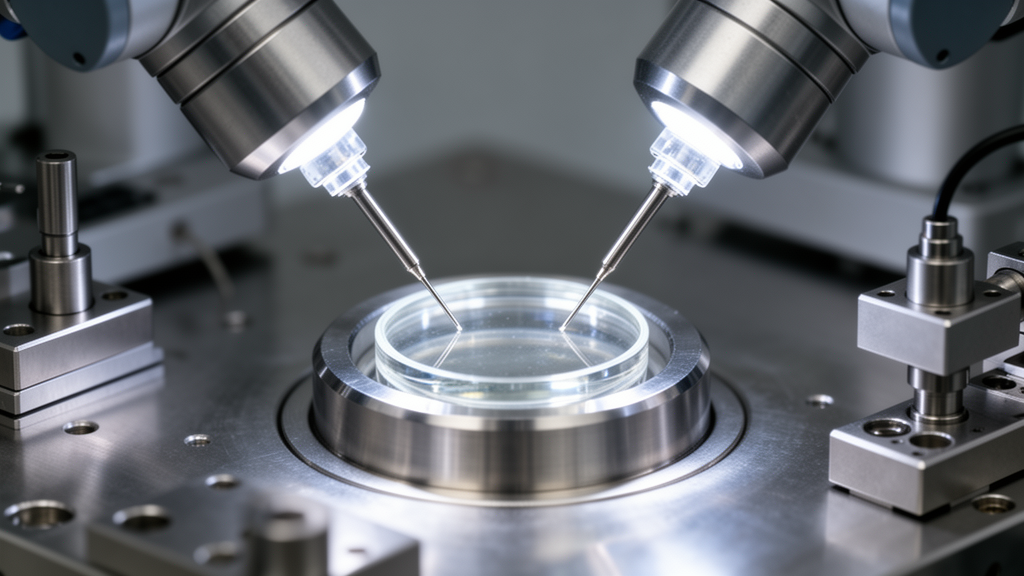
Researchers have developed a compact robotic microassembly system named LUCIA that automates the handling, alignment, and bonding of micrometer-scale components within a single integrated workflow. The system addresses a critical operational barrier in biomedical engineering, where the reliable fabrication of microengineered implantable devices has been impeded by the absence of standardized assembly procedures for microscopic parts.

Microengineered implantable technologies, including miniaturized optical imaging windows, microscale biosensors, and tissue-integrated scaffolds, are increasingly limited not by their underlying device design, but by the practical difficulty of assembling their micrometer-scale components. Conventional manual coupling methods for these delicate structures are slow, heavily dependent on the skill of individual operators, and poorly suited to safeguarding the strict structural integrity required by such microdevices. These manual constraints create a persistent bottleneck in research laboratories, restricting the transition of advanced prototypes into dependable devices suitable for experimental deployment.

The LUCIA platform consolidates precision positioning, controlled dispensing, and vacuum-based substrate handling into one system. These functionalities are typically distributed across multiple costly commercial platforms. By unifying micropositioning, dispensing, and vacuum manipulation into a single cost-effective apparatus, the automated platform enables reproducible microdevice assembly while maintaining low variability across repeated operations.

Experimental evaluations demonstrated that automated operation via LUCIA markedly reduces overall coupling time compared with conventional manual assembly. In addition to accelerating the process, the robotic system substantially lowers operator-dependent variability, ensuring consistent handling and alignment across assembly cycles.

The investigators detailed the design and technical implementation of the platform and validated its functionality through the automated coupling of a miniaturized implantable imaging window. This target biomedical device integrates microstructured scaffolds with microlenses engineered for intravital nonlinear imaging.

Device functionality was confirmed through in vivo implantation followed by post-implantation nonlinear microscopy.

LUCIA establishes a scalable platform for automated microassembly. The authors conclude that the system directly resolves a major manufacturing gap that research laboratories face when attempting to translate microengineered biomedical technologies into living systems.

Subject of Research: Automated robotic microassembly of implantable miniaturized optical imaging devices

Article Title: LUCIA: a cross-functional system for miniaturized imaging window assembly

Article References: Vigneri, M., Nardini, A., Cherubin, L., Raimondi, M. T., Cerullo, G., Osellame, R., Chirico, G., Martínez Vázquez, R., & Conci, C. (2026). LUCIA: a cross-functional system for miniaturized imaging window assembly. Frontiers in Photonics, 7, 1937918. https://doi.org/10.3389/fphot.2026.1937918

Image Credits: AI Generated

DOI: 10.3389/fphot.2026.1937918

Keywords: robotic microassembly, LUCIA platform, implantable imaging windows, microlenses, microstructured scaffolds, intravital nonlinear imaging, nonlinear microscopy, multiphoton polymerization, UV-curable adhesive bonding, precision positioning, controlled dispensing, vacuum substrate handling, in vivo implantation, biomaterials, 3D microstructures, coupling systems, biophotonics, microscale biosensors

News Source: Denise Maddox. (November 11, 2026). Robotic Microassembly System Automates Precision Coupling of Implantable Imaging Windows. Scienmag.

Tags: 3D microstructuresbiomaterialsbiophotonicscontrolled dispensingcoupling systemsimplantable imaging windowsin vivo implantationintravital nonlinear imagingLUCIA platformmicrolensesmicroscale biosensorsmicrostructured scaffoldsmultiphoton polymerizationnonlinear microscopyprecision positioningrobotic microassemblyUV-curable adhesive bondingvacuum substrate handling
Share12Tweet7Share2ShareShareShare1

Related Posts

Ensemble Feature Selection Achieves High Accuracy in Multiclass Thyroid Disease Classification

Ensemble Feature Selection Achieves High Accuracy in Multiclass Thyroid Disease Classification

November 14, 2026
Early Aortic Root Thrombus Resolves Conservatively in Two HeartMate 3 Cases

Early Aortic Root Thrombus Resolves Conservatively in Two HeartMate 3 Cases

November 14, 2026

German Clean Power Reaches Record Output While Sector Coupling Faces Systemic Hurdles

November 14, 2026

Data Modality Determines Machine Learning and Deep Learning Success in Breast Cancer Prediction

November 14, 2026

POPULAR NEWS

  • TRIM47 Impairs Cardiac Metabolism and Worsens Reperfusion Injury in Male Mice

    TRIM47 Impairs Cardiac Metabolism and Worsens Reperfusion Injury in Male Mice

    29 shares
    Share 12 Tweet 7
  • Egalitarian Gender Role Attitudes Predict Stronger Clinical Decision-Making in Surgical Nurses

    29 shares
    Share 12 Tweet 7
  • Knee Phenotype Alteration Links to Smaller Talar Inclination Changes After Arthroplasty

    29 shares
    Share 12 Tweet 7
  • Nearly One-Third of Home-Treated Pyelonephritis Patients Developed Bacteremia Without Mortality

    29 shares
    Share 12 Tweet 7

About

We bring you the latest biotechnology news from best research centers and universities around the world. Check our website.

Follow us

Recent News

Nigerian Nursing Students Show High Cancer Knowledge but Low Screening Uptake

Ensemble Feature Selection Achieves High Accuracy in Multiclass Thyroid Disease Classification

Central Adiposity Affects Children with Type 1 Diabetes Without Overweight or Obesity

Subscribe to Blog via Email

Enter your email address to subscribe to this blog and receive notifications of new posts by email.

Join 87 other subscribers
  • Contact Us

Bioengineer.org © Copyright 2023 All Rights Reserved.

Welcome Back!

Login to your account below

Forgotten Password?

Retrieve your password

Please enter your username or email address to reset your password.

Log In
No Result
View All Result
  • Homepages
    • Home Page 1
    • Home Page 2
  • News
  • National
  • Business
  • Health
  • Lifestyle
  • Science

Bioengineer.org © Copyright 2023 All Rights Reserved.