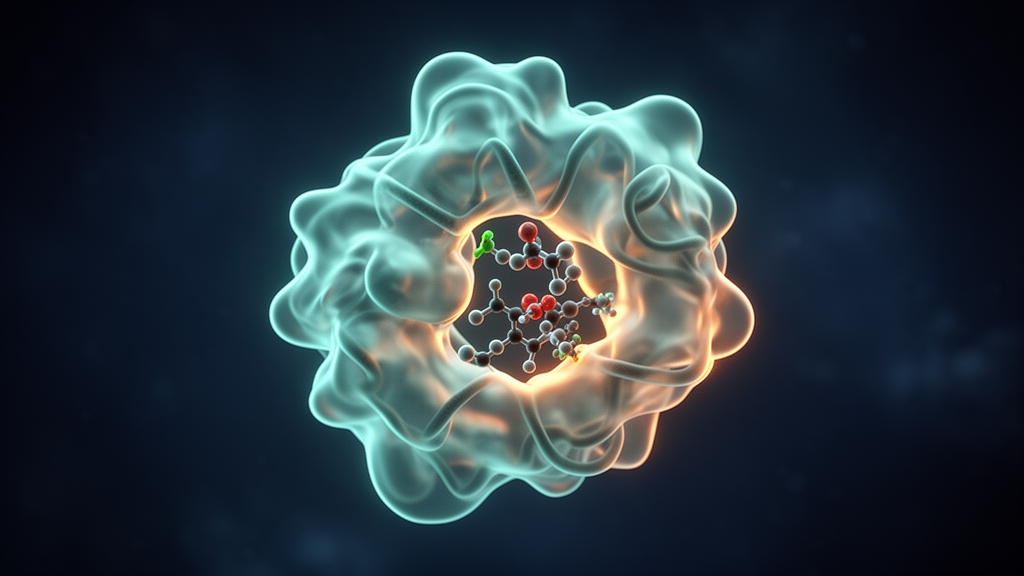
Computational researchers investigating plant-derived compounds have identified candidate phytochemicals from the shrub Sida acuta Burm f. capable of targeting NADH-ubiquinone oxidoreductase, an enzyme crucial for the survival of the human malaria parasite Plasmodium falciparum. In a multi-method in silico study combining density functional theory, molecular docking, molecular dynamics simulations, artificial neural networks, and network pharmacology, scientists evaluated sixteen specific phytochemicals against the crystal structure of the parasite enzyme. Docking calculations revealed that compound F13, chemically identified as (S)-2-hydroxy-1-((R)-4-hydroxy-5-oxo-3-(palmitoyloxy)-2,5-dihydrofuran-2-yl)ethyl palmitate, achieved the strongest calculated interaction energy of negative 8.32286453 kilocalories per mole. The studied compounds are predicted to interact with the oxidoreductase dimer, an enzyme located on the edge of membranes that propels electron transmission from NADH to quinone using a flavin adenine dinucleotide cofactor. Rather than demonstrating clinical efficacy, the study presents in silico models indicating that selected secondary metabolites from this Malvaceae shrub exhibit favorable binding affinities and structural stability against the designated drug target.
The investigation addresses the burden of malaria, a grave infection caused predominantly by Plasmodium falciparum and Plasmodium vivax that affects millions of people across the globe. Efforts to eradicate the disease have encountered severe obstacles due to rising parasite resistance against conventional synthetic drugs. In searching for alternative drug targets, researchers have focused on type II NADH-ubiquinone oxidoreductase, known as NDH2, in Plasmodium falciparum. The enzyme functions as a peripheral membrane dimer with 45-kilodalton subunits and a flavin adenine dinucleotide cofactor. Sida acuta Burm f., commonly known as wire-weed, is a vertical shrub growing to roughly 1.5 meters found along roadsides and waste areas in Nigeria, India, North America, and Nepal. While traditional extracts from various parts of this plant have been documented to treat conditions including malaria, gastrointestinal ailments, tuberculosis, asthma, gonorrhea, fever, and diarrhea, the present authors utilized molecular modeling to evaluate sixteen isolated phytochemicals against the enzyme structure cataloged under Protein Data Bank identifier 5jwa.
To evaluate electronic reactivity, the authors performed density functional theory calculations using Spartan 14 software with the 6-31+G* basis set in a vacuum. Molecular geometry optimization reached ground-state equilibrium with neutral charge and paired electrons for sixteen phytochemicals: 2-(3,4,5-trimethoxyphenyl)acetic acid (F1), methyl stearate (F2), ethyl palmitate (F3), 1,3-dihydroxypropan-2-yl palmitate (F4), (E)-5-(2-((Z)-1-(6-hydroxy-6-methylheptan-2-yl)-7a-methyloctahydro-4H-inden-4-ylidene)ethylidene)-4-methylenecyclohexane-1,3-diol (F5), (3S,8S,9S,10R,13R,14S,17R)-17-((2R,5R)-5,6-dimethylheptan-2-yl)-10,13-dimethyl-2,3,4,7,8,9,10,11,12,13,14,15,16,17-tetradecahydro-1H-cyclopenta[a]phenanthren-3-ol (F6), 2-methoxy-4-vinylphenol (F7), methyl (9Z,12Z,15Z)-octadeca-9,12,15-trienoate (F8), (9Z,12Z,15Z)-octadeca-9,12,15-trienoic acid (F9), (S)-N-(1-hydroxy-2,3,10-trimethoxy-9-oxo-5,6,7,9-tetrahydrobenzo[a]heptalen-7-yl)acetamide (F10), tetradec-13-en-1-yl acetate (F11), 2-methyl-11H-indeno[1,2-b]quinoxalin-11-one (F12), compound F13, 4-methylquinoline 1-oxide (F14), ethyl (9E,12E,15E)-octadeca-9,12,15-trienoate (F15), and 1-ethoxy-2-isopropylbenzene (F16). Quantum chemical analysis showed that compound F10 achieved the highest energy for the highest occupied molecular orbital at negative 3.90 electron volts and the narrowest frontier energy gap, indicating that closer energy gaps facilitate stronger interactions with biological targets. Furthermore, compounds F11 and F12 exhibited the lowest unoccupied molecular orbital energy values, reflecting a high receptivity for electron acceptance.
Molecular docking was carried out with Molecular Operating Environment software, version 2022, using the crystal structure of NADH-ubiquinone oxidoreductase from the RCSB Protein Data Bank under identifier 5jwa. The receptor was prepared using the QuickPrep tool, and binding sites were identified with the SiteFinder tool before executing induced fit docking. The calculated binding affinities spanned from negative 4.34622145 kilocalories per mole to negative 8.32286453 kilocalories per mole. Compound F13 registered the most negative binding score of negative 8.32286453 kilocalories per mole, representing the highest predicted interaction energy. The remaining compounds yielded binding scores of negative 5.4224453 kilocalories per mole for F1, negative 6.74320555 kilocalories per mole for F2, negative 6.58777571 kilocalories per mole for F3, negative 6.11738253 kilocalories per mole for F4, negative 7.62878323 kilocalories per mole for F5, negative 6.11796808 kilocalories per mole for F6, negative 4.34622145 kilocalories per mole for F7, negative 7.70895576 kilocalories per mole for F8, negative 6.23089933 kilocalories per mole for F9, negative 5.95226192 kilocalories per mole for F10, negative 6.5141921 kilocalories per mole for F11, negative 4.94583368 kilocalories per mole for F12, negative 4.44395447 kilocalories per mole for F14, negative 7.33192158 kilocalories per mole for F15, and negative 4.80517578 kilocalories per mole for F16.
Analysis of ligand-receptor interactions identified the specific amino acid residues engaged during docking against NADH-ubiquinone oxidoreductase. The complex between compound F2 and the target enzyme revealed residue Lys175 linked to an oxygen atom via hydrogen-acceptor bonding at a measured distance of 3.19 angstroms. Compound F4 formed a hydrogen-acceptor bond connecting its hydroxyl group to residue Lys334 across an interatomic distance of 3.22 angstroms. For compound F9, docking calculations detected an interaction involving residue Ser472 and a ligand hydroxyl group. When compared with the reference antimalarial drug chloroquine, sixty percent of the evaluated phytochemicals demonstrated stronger calculated binding affinities than the reference drug, whereas compounds F7, F12, F14, and F16 exhibited weaker inhibiting potential. The authors observed that these computational affinities correlate with previous literature demonstrating antimalarial properties in Sida acuta extracts, although they caution that docking scores model mathematical interaction potential rather than clinical cure rates.
To evaluate conformational stability over time, the researchers conducted 100-nanosecond molecular dynamics simulations on the compound F13-oxidoreductase complex alongside the chloroquine reference complex. Ligands were parameterized using SwissParam software and simulated with the target using GROMACS under the CHARMM36m force field. The simulation systems were solvated with water molecules and neutralized with ions to maintain constant temperature and pressure. Over the 100-nanosecond run, root mean square deviation analysis demonstrated that compound F13 maintained a more stable configuration and lower deviation than the reference drug, reflecting sustained binding within the active site. Root mean square fluctuation measurements showed similar overall residue oscillation trends, but compound F13 exhibited a smaller degree of deviation, indicating higher affinity and constrained target flexibility. Furthermore, predicted hydrogen bonding patterns and radius of gyration values confirmed that the complex formed by compound F13 and NADH-ubiquinone oxidoreductase achieved greater structural stability and compactness than the chloroquine reference complex.
In parallel with docking and dynamics, the researchers developed a quantitative structure-activity relationship model using an artificial neural network to predict binding affinities from computed phytochemical characteristics. Using Materials Studio software, version 2023, for multiple linear regression and neural network analysis, the model incorporated sixteen data rows within an 8-3-1 network architecture featuring eight input nodes, one hidden layer containing three hidden nodes, and one output node. Model validation was evaluated taking into account the squared correlation coefficient, adjusted correlation coefficient, and cross-validation metrics. The resulting artificial neural network achieved a squared correlation coefficient of 0.99067200, well exceeding the 0.5 threshold established in literature for a valid and dependable predictive model. Furthermore, the correlation between calculated actual binding affinities and neural-network-predicted values yielded a correlation determination coefficient of 0.9841. This statistical performance indicates that the neural network architecture accurately mapped the relationship between molecular descriptors and binding scores across the examined phytochemical set.
Pharmacokinetic evaluations were performed on compound F13 and the reference compound using ADMETLab and ADMETsar 1 software to evaluate drug-likeness. The screening encompassed Lipinski rule of five properties alongside ten specific pharmacological dimensions: physicochemical properties, medicinal chemistry characteristics, absorption, distribution, metabolism, excretion, general toxicity, environmental toxicity, Tox21 pathways, and toxicophore rules. The predicted features for compound F13 showed fair correlation when compared against the benchmark profile of chloroquine, indicating that the lead candidate possesses suitable drug-like characteristics under computational criteria across supplementary comparison tables. However, because these pharmacokinetic profiles are derived entirely from computational software models rather than clinical pharmacology trials or animal metabolism assays, they represent theoretical approximations. In vivo absorption rates, systemic biodistribution, metabolic stability in human liver microsomes, and potential adverse reactions remain unmeasured empirically, requiring experimental pharmacological validation before therapeutic claims can be substantiated.
Beyond individual enzyme targeting, network pharmacology analysis identified 240 common malaria-linked genes associated with Sida acuta constituents. Protein-protein interaction mapping identified prominent controllers including CXCR4, MMP7, NOS2, PRKCB, C5AR1, GRK5, CD38, CCNE1, MAOA, CDK1, PIK3CB, F7, and HDAC3, as well as components of the MAPK1 and PI3K gene families. These genes participate in immune regulation, inflammatory signaling pathways, and cell survival. Specifically, the chemokine receptor CXCR4 regulates immune cell recruitment, which can trigger inflammatory responses in severe malaria, suggesting that targeting CXCR4 with plant compounds could reduce inflammation. The analysis also highlighted inducible nitric oxide synthase, NOS2, which exhibits a dual role: its nitric oxide product suppresses parasite proliferation through oxidative stress, yet excessive nitric oxide causes endothelial injury and cerebral malaria. Modulating NOS2 could therefore mitigate vascular damage. Furthermore, targeting matrix metalloproteinase-7, protein kinase C beta, histone deacetylases such as HDAC3 and HDAC11, and metabolic enzymes including ALPL, ACACA, and LDHA suggests a multi-target mode of action that could disrupt parasite dissemination and metabolism.
Gene Ontology annotation and KEGG pathway enrichment elucidated the cellular locations, processes, and pathways associated with these target genes. Cellular component terms showed enrichment in membrane rafts, receptor complexes, synapses, and secretory vesicles, which are essential for parasite ingress into red blood cells, immune signaling, and protein trafficking. Biological process analysis revealed involvement in responses to organonitrogen and nitrogen compounds, oxygen-containing compounds and reactive oxygen species, endogenous stimuli, and protein phosphorylation. Molecular function enrichment highlighted protein serine/threonine/tyrosine kinase activity, phosphotransferase activity, ATP binding, and nucleotide binding. KEGG pathway analysis identified the PI3K-Akt signaling pathway, HIF-1 signaling, sphingolipid signaling, and the PD-L1/PD-1 checkpoint pathway. Disrupting these pathways could impair parasite development and host adaptation. The authors concluded that computational modeling of Sida acuta phytochemicals identifies candidate molecules with high predicted affinity for NADH-ubiquinone oxidoreductase, but they emphasize that these computational predictions require subsequent biological and clinical validation to establish antimalarial efficacy.
Subject of Research: Computational screening of Sida acuta phytochemicals targeting malarial NADH-ubiquinone oxidoreductase
Article Title: Insilico, network pharmacology and neural network studies on Sida acuta Burm f.- based phytochemicals targeting NADH-ubiquinone oxidoreductase
Article References: Oyebamiji, A. K., Akintelu, S. A., Ebenezer, O., Akintayo, E. T., Akintayo, C. O., Adeoye, M. D., Peter, A. A., & Elbasyouni, A. (2025). Insilico, network pharmacology and neural network studies on Sida acuta Burm f.- based phytochemicals targeting NADH-ubiquinone oxidoreductase. Discover Pharmaceutical Sciences, 1(1), Article 3. https://doi.org/10.1007/s44395-025-00002-8
Image Credits: AI Generated
DOI: 10.1007/s44395-025-00002-8
Keywords: Sida acuta, NADH-Ubiquinone Oxidoreductase, Plasmodium falciparum, Molecular Docking, Neural Networks, Network Pharmacology, Pharmacokinetics, Antimalarial Agents, Insilico, network, pharmacology, neural
News Source: Ophelia Keating. (November 10, 2026). Computational Study Identifies Plant Compounds Targeting Crucial Malaria Parasite Enzyme. Scienmag.