• HOME
  • NEWS
  • EXPLORE
    • CAREER
      • Companies
      • Jobs
    • EVENTS
    • iGEM
      • News
      • Team
    • PHOTOS
    • VIDEO
    • WIKI
  • BLOG
  • COMMUNITY
    • FACEBOOK
    • INSTAGRAM
    • TWITTER
Monday, March 30, 2026
BIOENGINEER.ORG
No Result
View All Result
  • Login
  • HOME
  • NEWS
  • EXPLORE
    • CAREER
      • Companies
      • Jobs
        • Lecturer
        • PhD Studentship
        • Postdoc
        • Research Assistant
    • EVENTS
    • iGEM
      • News
      • Team
    • PHOTOS
    • VIDEO
    • WIKI
  • BLOG
  • COMMUNITY
    • FACEBOOK
    • INSTAGRAM
    • TWITTER
  • HOME
  • NEWS
  • EXPLORE
    • CAREER
      • Companies
      • Jobs
        • Lecturer
        • PhD Studentship
        • Postdoc
        • Research Assistant
    • EVENTS
    • iGEM
      • News
      • Team
    • PHOTOS
    • VIDEO
    • WIKI
  • BLOG
  • COMMUNITY
    • FACEBOOK
    • INSTAGRAM
    • TWITTER
No Result
View All Result
Bioengineer.org
No Result
View All Result
Home NEWS Bioengineering

Bioengineered Bacteria Ripen Fruit By Belching Ethylene

Bioengineer by Bioengineer
November 30, 2014
in Bioengineering
Reading Time: 2 mins read
0
Share on FacebookShare on TwitterShare on LinkedinShare on RedditShare on Telegram

The ruby red rows of tomatoes at the local grocery store don’t come off the vine in such a pretty state. Food producers pick fruits while unripe and later douse them with ethylene, a gas that plants naturally produce to trigger ripening. The ethylene used by food producers comes from cracking fossil fuels. As a green alternative, Cristina Del Bianco of the University of Trento, in Italy, and her team bioengineered Escherichia coli to produce ethylene to accelerate fruit ripening (ACS Synth. Biol. 2014, DOI: 10.1021/sb5000077).
fruit

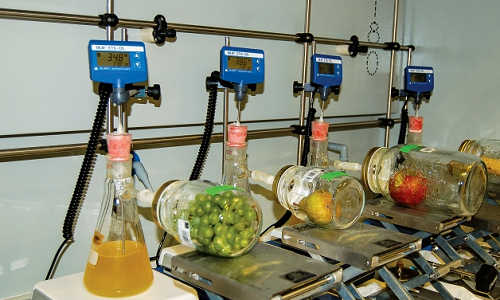
Researchers grew cultures of ethylene-producing bacteria in flasks connected to jars containing unripe fruits such as cherry tomatoes, pears, apples, and bananas. The ethylene helped ripen the fruit. Photo Credit: Laboratory of Cristina Del Bianco

To program E. coli to make the gas, the scientists turned to another microbe called Pseudomonas syringae. This plant pathogen has an enzyme that converts 2-oxoglutarate, a citric acid cycle intermediate, to ethylene in a single step. The researchers inserted the gene into E. coli so that they could turn it on in the presence of the sugar arabinose. When they added arabinose to liquid cultures of the bacteria, ethylene levels in the flasks reached 100 ppm.

Next, the researchers grew the bacteria in flasks connected to jars filled with unripe cherry tomatoes, kiwis, or apples. After eight days, the fruits connected to flasks that received a dose of arabinose were significantly riper than those connected to bacterial cultures that didn’t get the sugar. The tomatoes were redder, the kiwis were softer, and the apples had less starch—a signature of ripening.

To make ethylene production easier for commercial applications, the team reengineered the bacteria so that they expressed the ethylene gene when exposed to blue light. The researchers detected 92 ppm of ethylene in a culture of these bacteria grown in blue light, whereas no ethylene was detected from bacteria grown in the dark.

Story Source:

The above story is based on materials provided by American Chemical Society, Erika Gebel Berg.

Share14Tweet9Share3ShareShareShare2

Related Posts

Why is the first Turkish bioengineering promotion website, Biyomuhendislik.com, so important?

February 4, 2023

Robo-fish

September 19, 2016

Mice born from ‘tricked’ eggs

September 17, 2016

UCLA researchers use stem cells to grow 3-D lung-in-a-dish

September 16, 2016
Please login to join discussion

POPULAR NEWS

  • blank

    Revolutionary AI Model Enhances Precision in Detecting Food Contamination

    96 shares
    Share 38 Tweet 24
  • Imagine a Social Media Feed That Challenges Your Views Instead of Reinforcing Them

    1005 shares
    Share 397 Tweet 248
  • Promising Outcomes from First Clinical Trials of Gene Regulation in Epilepsy

    51 shares
    Share 20 Tweet 13
  • Advancements in EV Battery Technology to Surpass Climate Change-Induced Degradation

    45 shares
    Share 18 Tweet 11

About

We bring you the latest biotechnology news from best research centers and universities around the world. Check our website.

Follow us

Recent News

Modeling African Swine Fever Spread and Control in Romania

New Study Finds Autism Risk Genes Common Across Different Ancestries

OHSU Study Reveals Cellular ‘Trade Winds’ Guiding Movement and Repair

Subscribe to Blog via Email

Enter your email address to subscribe to this blog and receive notifications of new posts by email.

Join 78 other subscribers
  • Contact Us

Bioengineer.org © Copyright 2023 All Rights Reserved.

Welcome Back!

Login to your account below

Forgotten Password?

Retrieve your password

Please enter your username or email address to reset your password.

Log In
No Result
View All Result
  • Homepages
    • Home Page 1
    • Home Page 2
  • News
  • National
  • Business
  • Health
  • Lifestyle
  • Science

Bioengineer.org © Copyright 2023 All Rights Reserved.