By deleting the mpkA gene, which encodes the final kinase in the cell wall integrity (CWI) signaling pathway, the team produced fungal biomass that exhibits greater ultimate tensile strength and strain at failure compared to its isogenic control. This study, published in Fungal Biology and Biotechnology, offers a novel genetic approach to tuning the physical characteristics of fungal-based materials, moving beyond traditional methods that rely on altering growth media or processing techniques.
Mycelial materials, derived from the vegetative growth of filamentous fungi, are increasingly viewed as sustainable alternatives to petroleum-based products in packaging, textiles, and construction. These materials are valued for their renewability and biodegradability, yet their mechanical performance often lags behind industrial standards. Previous efforts to improve these properties have focused on external factors, such as the composition of the growth substrate or the application of plasticizers. However, the current study posits that the internal genetic architecture of the fungus, specifically its cellular phenotypes, is a primary driver of the resulting material’s mechanical behavior.
The CWI pathway is a highly conserved signaling cascade in fungi responsible for monitoring and repairing the cell wall. The mpkA gene encodes MpkA, the terminal kinase in this pathway. Deletion of mpkA renders the pathway inoperative, leading to significant morphological and growth defects in the fungus. The research team hypothesized that this inoperative pathway would result in weaker hyphal walls and, consequently, a weaker mycelial material. Contrary to this initial expectation, the mutant strain produced a material with superior mechanical resilience.
To test this hypothesis, the team generated mycelial material disks from two strains: the ΔmpkA deletion mutant (strain A1404) and its isogenic parent control (strain A1405). Both strains were cultivated in identical conditions on the surface of a static liquid growth medium for 120 hours at 28 degrees Celsius. The resulting materials were harvested and subjected to a comprehensive suite of mechanical and phenotypic assessments, including tensile testing, fragmentation assays, and advanced microscopy.
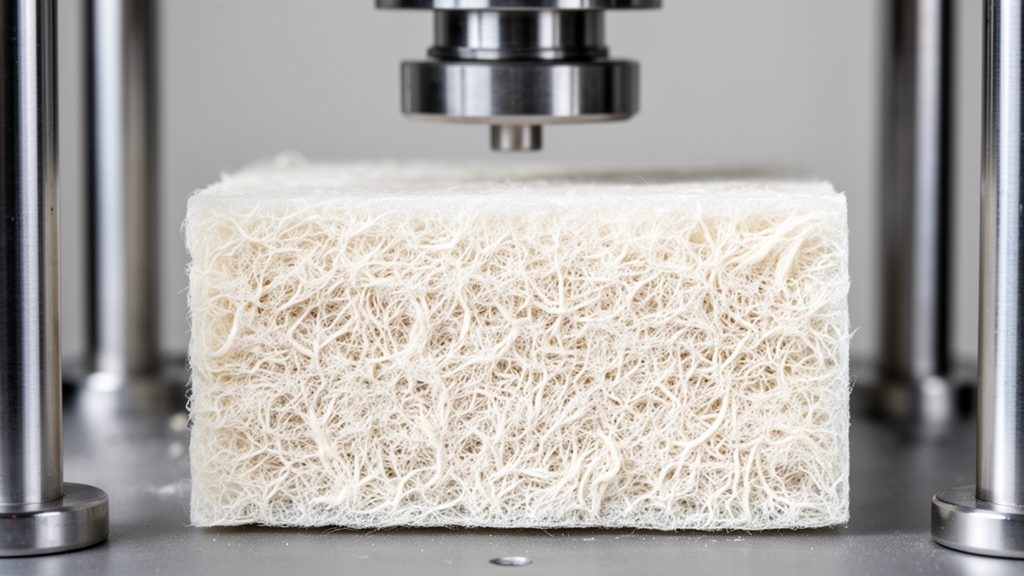
Tensile testing revealed that while the elastic modulus, or stiffness, of the two materials was statistically similar, the ΔmpkA material demonstrated significantly higher ultimate tensile strength and strain at failure. The mutant material withstood a stress of 339 ± 18 kPa before breaking, compared to 213 ± 33 kPa for the control. Furthermore, the mutant material stretched to a strain of 0.30 ± 0.02 at failure, whereas the control failed at 0.22 ± 0.01. These results indicate that the genetically modified material is not only stronger but also more flexible, capable of absorbing more energy before fracture.
Further analysis using a high-shear fragmentation assay confirmed the enhanced resistance of the mutant material to mechanical stress. When subjected to high-shear mixing, the ΔmpkA material retained a larger average particle size after the initial five-second cutting phase compared to the control. This suggests that the hyphae in the mutant material are more resistant to shear-induced fragmentation, a trait that correlates with the higher ultimate tensile strength observed in the tensile tests. The specific fragmentation rate, which reflects the rate of hyphal breakdown during the cavitation phase, showed no significant difference between the two genotypes.
To understand the biological basis for these mechanical improvements, the researchers conducted a detailed phenotypic characterization. Transmission electron microscopy (TEM) revealed that the hyphae in the ΔmpkA mutant were significantly wider, with an average diameter of 2,124 ± 86 nm, compared to 1,405 ± 70 nm in the control. This 50% increase in hyphal diameter suggests that the mutant hyphae are more robust structures. However, the thickness of the cell wall itself did not differ significantly between the two strains, indicating that the increased diameter is due to a larger cytoplasmic volume rather than a thicker wall.
Scanning electron microscopy (SEM) of the material’s surface and fracture points highlighted a key structural difference: the ΔmpkA material was more densely packed with fewer visible voids. The control material contained an abundance of developmental structures, such as conidia and Hülle cells, which appear to disrupt the packing of the hyphae. In contrast, the mutant material had significantly fewer of these structures, allowing the hyphae to pack more tightly. This denser architecture likely contributes to the material’s higher strength by reducing the number of unsupported positions that could serve as points of failure.
Chemical analysis of the cell wall composition using solid-state NMR spectroscopy identified significant alterations in the polysaccharide profile of the mutant. The ΔmpkA material showed a significant decrease in α-1,3-glucan and a corresponding increase in β-1,3-glucan. Additionally, the mutant exhibited the presence of N-acetyl galactosamine (GalNAc), a monomer associated with galactosaminogalactan linkages, which was absent in the control. The team also found that the mutant material contained nearly twice the amount of melanin per dry cell weight compared to the control, a pigment known for hardening and preserving the fungal cell wall.
The reduction in developmental structures was quantified through conidiation assays, which showed that the ΔmpkA mutant produced 40% fewer conidia than the control. This suggests that the energy and resources that would have been diverted into asexual reproduction in the control strain were instead directed toward vegetative growth and biomass accumulation. Indeed, growth curves indicated that while both strains grew at similar exponential rates initially, the mutant continued to increase in mass throughout the 120-hour period, resulting in 50% more total biomass than the control, which reached a plateau earlier.
Fourier transform infrared (FTIR) spectroscopy further supported the link between cellular composition and mechanical performance. The FTIR traces indicated a higher water content in the ΔmpkA material compared to the control. Previous studies have established a correlation between increased water capacity and enhanced ultimate tensile strength in mycelial materials, suggesting that the mutant’s ability to retain more water contributes to its superior mechanical properties. The combination of larger hyphae, denser packing, altered cell wall chemistry, and higher water content creates a material that is structurally and chemically distinct from the control.
The study concludes that the deletion of mpkA leads to a cascade of phenotypic changes that collectively enhance the mechanical properties of the resulting mycelial material. While the specific contribution of each phenotype—such as hyphal diameter, wall composition, and packing density—to the overall strength requires further experimentation, the findings provide a strong foundation for using genetic engineering to design fungal materials with tailored properties. This approach offers a precise tool for optimizing mycelial materials for specific industrial applications, potentially overcoming the mechanical limitations that have hindered their widespread adoption.
To determine whether altered hyphal growth dynamics contributed to the observed material properties, the researchers examined early developmental kinetics on Concanavalin A-coated coverslips in liquid medium. By tracking fixed cells stained with calcofluor white between hours 9 and 16 under fluorescence microscopy, the team measured individual germination and branching events. Both the control and the ΔmpkA mutant exhibited identical germination rates of 0.10 ± 0.02 germinated hyphae per hour (P = 0.46) and matching total branching rates of 0.11 ± 0.02 total branches per hour (P = 0.52). These findings demonstrated that the physical divergence between the two mycelial materials was not driven by differences in early germination speed or branching frequency, but rather by downstream alterations in biomass accumulation and cellular morphology.
Beyond the rigid core shifts, two-dimensional solid-state NMR experiments provided deeper insights into the mobile carbohydrate domain of the fungal cell wall. Using an 800 MHz spectrometer, the investigators observed an altered galactomannan architecture in the mutant, highlighted by a selective increase in α-1,2-mannose alongside a statistically significant loss of galactose (P < 0.05). Concurrently, the rigid polysaccharide core retained stable proportions of chitin and chitosan between strains, indicating that structural strengthening did not depend on elevating chitin content. Because both α-1,3-glucan and galactosaminogalactan contribute to hyphal aggregation, the selective emergence of N-acetyl galactosamine in the mutant likely represents a compensatory mechanism that maintains structural cohesion despite the reduction of α-1,3-glucan.
Precise growth measurements also revealed how biomass dynamics unfolded over time. Over the first 75 hours of cultivation, both strains grew at comparable exponential rates of 0.041 h⁻¹ for the control and 0.043 h⁻¹ for the deletion mutant, showing no statistically significant difference (P = 0.84). While the control stopped gaining weight after approximately 100 hours, reaching 0.20 g of dry biomass per disk, the mutant continued growing through 120 hours to reach 0.30 g (P = 0.001). During coupon preparation for mechanical evaluation, laser-cut strips were hydrated in a glycerol-water solution, coated in petroleum jelly, and secured within paper frames for testing on an Instron load frame equipped with a laser extensometer. Coupons cut from different positions across the disks showed only random variation, confirming that the synthesized sheets were structurally homogeneous.
Unlike composite mycelial materials that incorporate agricultural residues like sawdust, pure mycelial materials produced solely from fungal hyphae in liquid culture offer greater processing versatility for acoustic insulation, thermal barriers, and biobased leather alternatives. Nevertheless, the authors cautioned that while the deletion of mpkA produced larger hyphae, a denser matrix, increased melanin, and altered wall polymers, isolating the relative contribution of each individual cellular trait will require further experimental investigation.
Subject of Research: Aspergillus nidulans cell wall integrity kinase, MpkA, impacts cellular phenotypes that alter mycelial-material mechanical properties
Article Title: Aspergillus nidulans cell wall integrity kinase, MpkA, impacts cellular phenotypes that alter mycelial-material mechanical properties
Article References: Gray, K., Edwards, H., Doan, A. G., Huso, W., Lee, J., Pan, W., Bolima, N., Morse, M. E., Yoda, S., Gautam, I., Harris, S. D., Zupan, M., Wang, T., deCarvalho, T., & Marten, M. R. (2024). Aspergillus nidulans cell wall integrity kinase, MpkA, impacts cellular phenotypes that alter mycelial-material mechanical properties. Fungal Biology and Biotechnology, 11(1), Article 22. https://doi.org/10.1186/s40694-024-00191-4
Image Credits: AI Generated
DOI: 10.1186/s40694-024-00191-4
Keywords: Aspergillus, nidulans, cell, wall, integrity, kinase, MpkA, impacts, cellular, phenotypes, alter, mycelial-material
News Source: Juliet Wilcox. (November 10, 2026). Fungal Gene Deletion Enhances Mycelial Material Strength. Scienmag.