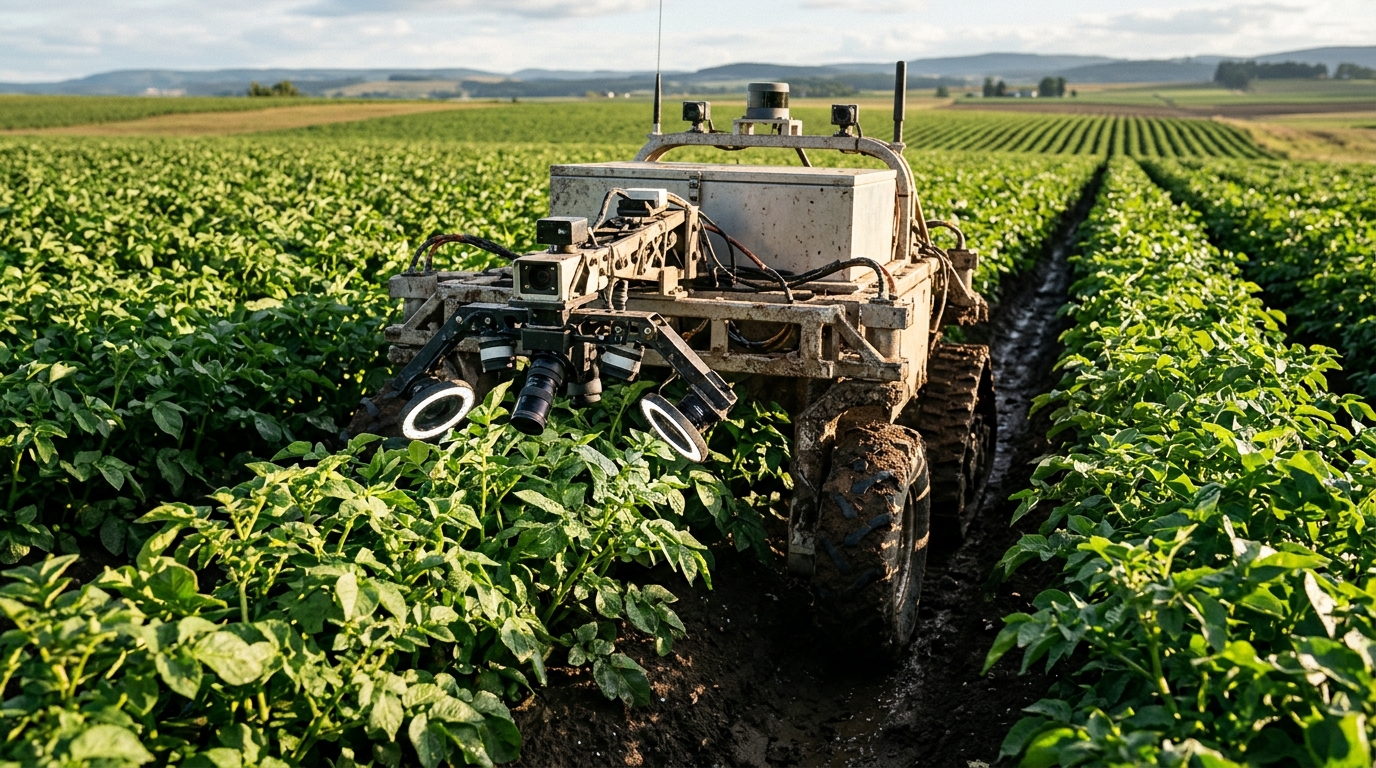
Agricultural engineers and plant pathologists in the Netherlands have evaluated an autonomous field robotics framework that pairs visible to short-wave infrared hyperspectral imaging with machine learning to identify diseased seed potato canopies. The investigation, carried out by researchers including Daniel Argüello, Manya Afonso, Arturo Aquino, Miguel Noguera, Corné Lugtenburg, and Gerrit Polder, targeted the simultaneous in-field detection of three major potato pathogens: Potato virus Y, Potato leafroll virus, and bacterial blackleg caused by Pectobacterium and Dickeya species. By mounting high-resolution line-scan hyperspectral sensors under an actively illuminated enclosure aboard a ground platform named the TraitSeeker, the team demonstrated that infected plants could be discriminated from healthy controls with a balanced accuracy of 0.8192 under visual field inspection labels, and 0.8449 when using a temporally updated ground truth designed to capture latent infections.
Viral and bacterial infections represent the primary source of economic losses within temperate seed potato production, driving substantial crop downgrades during statutory seed certification assessments. In the Netherlands, which supplies approximately 60 percent of the certified seed potato exports across the European Union, post-harvest laboratory audits conducted by the Dutch General Inspection Service recorded downgrading rates of nearly 31 percent in 2023 and 35.6 percent in 2019, with preliminary 2025 inspections registering 35 percent downgrades. The financial stakes remain steep, with annual viral losses in the European Union estimated at 187 million euros and bacterial blackleg adding tens of millions more, exposing Dutch producers to losses reaching 60 to 90 million euros during high-pressure seasons. Because chemical insecticidal treatments offer negligible containment against the rapid non-persistent transmission of Potato virus Y and cannot address systemic tuber-borne bacteria, growers rely heavily on roguing, the manual extraction of diseased plants from fields before official inspections take place.
Manual roguing demands substantial operational resources, requiring an estimated 6.2 hours of manual labor per hectare while becoming progressively harder as crop canopies close. Visual scouting is also fundamentally limited by human perception, as cultivars such as Russet Norkotah and Shepody often remain visually asymptomatic or show minimal external cues despite harboring high pathogen titers that act as reservoirs for aphid transmission. Furthermore, while official field scouting exhibits an approximate 93 percent congruence with laboratory polymerase chain reaction or enzyme-linked immunosorbent assays on plants exhibiting overt macroscopic symptoms, asymptomatic or early-stage infections escape human detection entirely. Aerial imaging systems deployed on unmanned aerial vehicles have attempted to fill this scouting gap, but coarse spatial resolution and shifting outdoor solar illumination make individual plant diagnosis difficult in commercial seed crops.
To overcome these environmental and observational hurdles, the research team deployed the TraitSeeker, a specialized mobile field robot engineered for non-destructive proximal sensing. The robotic platform operates beneath a dedicated shadow hood containing an actively cooled halogen illumination system, isolating the optical sensors from ambient solar fluctuations, shadows, and varying sky conditions. The sensor payload comprises two complementary pushbroom hyperspectral line scanners: a Specim FX10 visible and near-infrared camera capturing 224 spectral bands between 400 and 1000 nanometers at a spectral resolution of 5.5 nanometers, and a thermoelectrically cooled Specim FX17 short-wave infrared camera recording 224 bands spanning 900 to 1700 nanometers at 8.0 nanometer resolution. Combined with real-time kinematic satellite navigation and an inertial navigation system, the robotic rig scanned experimental plots at an ultra-fine spatial resolution of 0.003 meters per pixel across a swath width of roughly 1.5 meters.
The experimental trials were conducted during the 2024 growing season across two field plots at the Stichting Wageningen Research facility in Lelystad, Netherlands, using the commercial potato cultivars Rudolph and Jacky. Rather than applying artificial inoculations that produce uniform disease development uncharacteristic of agricultural fields, the researchers sourced naturally infected commercial seed tubers from Dutch breeding enterprises including Agrico, HZPC, and Meijer Potato. Imaging campaigns were executed across three distinct phenological stages spanning June and July 2024 at weekly intervals: an early vegetative phase two to three weeks after crop emergence, an intermediate canopy development phase, and a mid-season canopy closure phase roughly six weeks post-emergence. Healthy controls were established at least 1.5 meters away from known symptomatic plants and tracked across the season using precision coordinate logging.
The data processing pipeline began by segmenting green plant foliage from bare soil using vegetation indices and mathematical morphology. For the visible and near-infrared data, the Renormalised Difference Vegetation Index was calculated using reflectance at 800 and 670 nanometers, while the Global Vegetation Moisture Index was computed from short-wave infrared reflectance at 950 and 1600 nanometers. Automated Otsu thresholding was refined through iterative morphological opening by reconstruction using a unitary disc structuring element, stripping away detached debris and isolated soil pixels without distorting leaf margins. Because systemic symptoms of Potato virus Y and Potato leafroll virus predominantly manifest in newly developing apical foliage, the team identified the primary canopy centroid during the first acquisition week and applied a distance-dependent decay weighting mask, prioritizing the central apical meristem while attenuating peripheral leaf pixels susceptible to background mixing and senescence.
Extracted canopy spectra underwent rigorous chemometric conditioning before classification. Atmospheric water-vapor absorption bands spanning 960 to 990 nanometers and 1350 to 1450 nanometers were excised to prevent artifact propagation. The filtered spectral vectors were smoothed, and their first and second derivatives were calculated using a nine-point Savitzky–Golay filter with a second-order polynomial, effectively removing baseline offsets and linear spectral drifts. Light-scattering variations across measurement sessions were neutralized by applying Multiplicative Scatter Correction to the first-derivative spectra and Standard Normal Variate scaling to the second-derivative spectra, followed by band-wise z-score standardization across all samples. Classifiers were trained across five comparative feature batteries comprising various combinations of smoothed reflectance, first derivatives, and second derivatives.
The researchers evaluated four diverse machine learning architectures: Support Vector Machines utilizing a radial basis function kernel, ensemble Random Forests, Partial Least Squares Discriminant Analysis, and Multi-Layer Perceptrons featuring varied hidden-layer topologies. For models requiring dimensionality reduction, principal component analysis was calibrated exclusively on training data, with component selection governed by three-fold cross-validation and the one-standard-error rule to prevent overfitting on the 457-patch training split. The models were evaluated on an independent hold-out test set of 115 patches drawn from a total cohort of 572 image patches representing 198 individual plants. The classification task was framed as a binary problem distinguishing healthy plants from a pooled diseased class comprising Potato virus Y, Potato leafroll virus, and blackleg, reflecting the commercial reality where any single infection triggers seed lot downgrade.
Under the standard ground-truth evaluation, where plant health labels were determined solely by visual assessment from certified Dutch General Inspection Service inspectors at the time of scanning, symptomatic plants were successfully identified across all model families. A Support Vector Machine trained on second-derivative features (Battery E) using 50 principal components achieved the top performance, recording a balanced accuracy of 0.8192, an overall accuracy of 0.8435, an F1-score of 0.8424, a diseased-class true positive rate of 0.7436, and a positive predictive value of 0.7838. A 5000-iteration percentile bootstrap analysis indicated a 95 percent confidence interval for balanced accuracy spanning from 0.738 to 0.892. Other architectures achieved comparable balanced accuracies ranging between 0.7488 and 0.7932, confirming that the spectral signature of visible disease expression is robustly captured across different algorithmic formulations rather than depending on a single specialized classifier.
To investigate whether proximal hyperspectral sensing could detect infections before visible symptoms manifested, the researchers developed a temporally re-labelled ground-truth framework. In this setup, 46 image patches that had been labeled healthy by inspectors were reclassified as diseased because the corresponding plants developed overt symptoms during subsequent weekly visits. When re-trained on this noise-reduced dataset, a streamlined Multi-Layer Perceptron containing a single hidden layer of 50 neurons and processing 60 principal components from smoothed reflectance (Battery C) attained a balanced accuracy of 0.8449, with a 95 percent confidence interval between 0.773 and 0.911, an overall accuracy of 0.8522, a true positive rate of 0.7959, and a positive predictive value of 0.8478. The numeric improvement under temporal re-labeling is consistent with the hypothesis that spectral sensors register physiological perturbations prior to human visual perception, although the overlapping confidence intervals prevent statistical separation between the two regimes on this single test partition.
The investigators emphasized several crucial biological and methodological boundaries when interpreting the findings. Most notably, plant health classifications were anchored to expert visual inspections in the field rather than individual molecular verifications such as reverse-transcription polymerase chain reaction or enzyme-linked immunosorbent assays. Consequently, the study demonstrates a clear statistical association between canopy spectral signatures and subsequent symptom expression rather than definitive, molecularly verified pre-symptomatic diagnosis. Furthermore, because commercial infections co-occurred naturally, the single-headed classification scheme aggregated all three pathogens into one general disease class, precluding pathogen-specific or strain-level discrimination. While literature points to reduced photosynthetic rates, chlorophyll degradation, and vascular water stress as plausible physiological drivers of the observed red-edge and infrared shifts, the authors did not isolate specific diagnostic wavelength bands.
The study also noted structural constraints regarding dataset scale and geographic diversity, having collected data from 198 physical plants across two cultivars during a single growing season at one experimental site. While patch-level train-test splits showed negligible data leakage, with nearest calibration neighbors always belonging to separate physical plants, broader multi-season evaluations encompassing diverse soil backgrounds, varying weather patterns, and symptom-tolerant potato cultivars remain necessary prior to operational deployment. Nevertheless, the integration of controlled illumination, plant-level line-scan spatial resolution, and automated apical canopy extraction demonstrates that autonomous ground robots can consistently resolve disease signatures in field environments. Linking such proximal sensing pipelines to real-time kinematic satellite coordinates offers a viable pathway toward automated, precision-guided roguing machinery capable of mitigating reliance on scarce agricultural labor.
Subject of Research: Robotic hyperspectral imaging for seed potato disease detection
Article Title: In-field hyperspectral detection of Potato virus Y, Potato leafroll virus and blackleg in seed potato canopies using an autonomous ground robot
Article References: Argüello, D., Afonso, M., Aquino, A., Noguera, M., Lugtenburg, C., & Polder, G. (2026). In-field hyperspectral detection of Potato virus Y, Potato leafroll virus and blackleg in seed potato canopies using an autonomous ground robot. Smart Agricultural Technology, 15, Article 102689. https://doi.org/10.1016/j.atech.2026.102689
Image Credits: AI Generated
DOI: 10.1016/j.atech.2026.102689
Keywords: hyperspectral imaging, seed potatoes, agricultural robotics, Potato virus Y, Potato leafroll virus, blackleg, crop protection, machine learning, In-field, hyperspectral, detection, Potato
News Source: Alan Morgan. (November 9, 2026). Ground Robot Uses Hyperspectral Imaging to Spot Multiple Seed Potato Diseases. Scienmag.