Published in Advanced Modeling and Simulation in Engineering Sciences, the study investigates the production of Ag925 sterling silver powders through experiments and computational fluid dynamics. The primary objective was to compare the advantages and limitations of experimental results with numerical simulations under two distinct frameworks: a conventional Discrete Phase Model (DPM) and a hybrid Volume-of-Fluid–Discrete Phase Model (VOF–DPM) with adaptive mesh refinement. The findings indicate that while both simulations deviate significantly from experimental data in statistical tests, the VOF–DPM approach consistently achieves closer agreement in predicting particle size distribution and morphology.
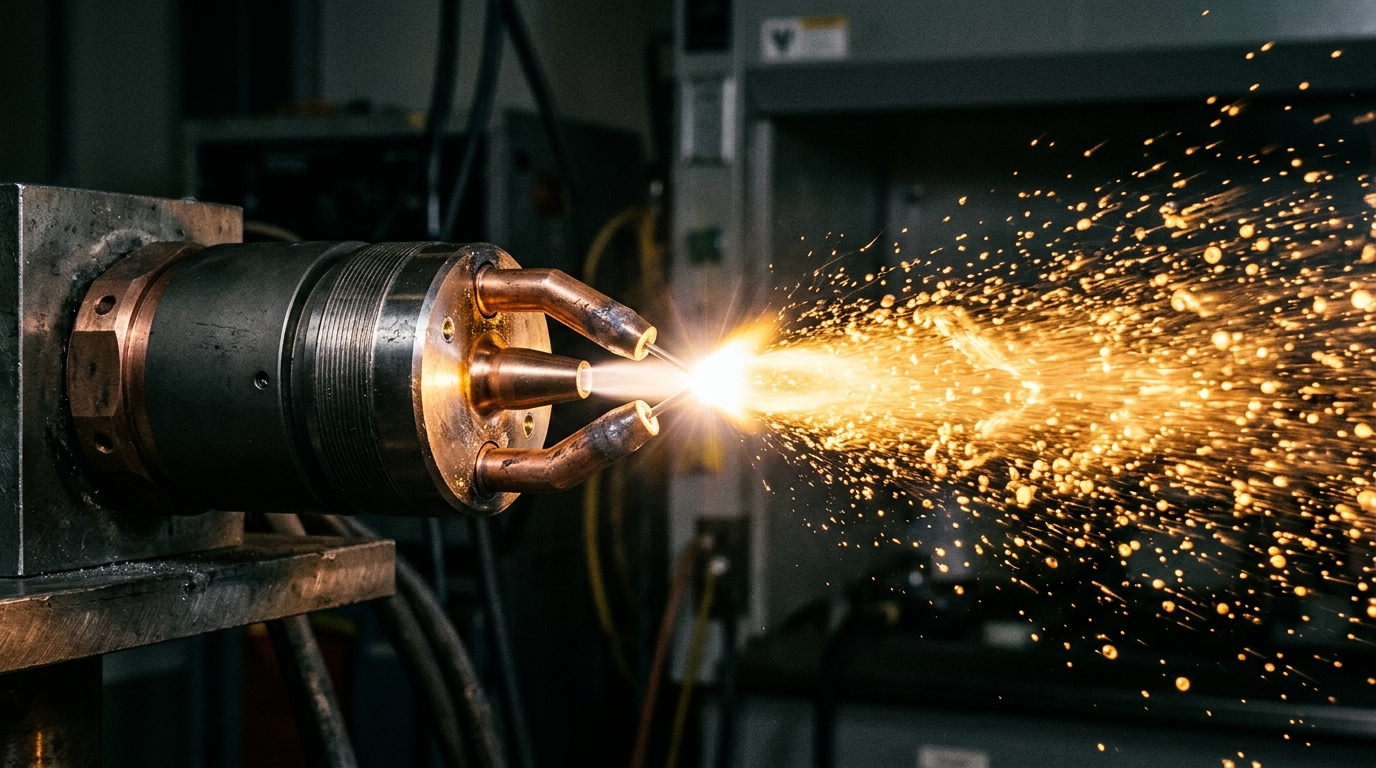
The wire arc spraying atomization process involves feeding two Ag925 silver wires continuously into an arc zone, where they are melted to form a molten pool at the wire tips. This molten metal is then accelerated and fragmented by a high-velocity nitrogen gas jet, inducing both primary and secondary breakup of the molten jet within the spray chamber. The resulting powders are collected downstream using a cyclone separator and characterized for morphology and particle size distribution. The experimental setup utilized a TATF-400 nozzle, a standard convergent-type nozzle with an outlet convergence angle of 30 degrees and a gas inlet diameter of 10 millimeters. The spray chamber was designed with a width of 0.90 meters and an overall height of 5.5 meters to regulate the flow environment and stabilize atomization.
Experimental analysis of the produced powders revealed a predominantly spherical morphology. Scanning electron microscopy images confirmed that most particles exhibited smooth surfaces and relatively narrow size distributions, reflecting the efficiency of atomization and symmetric cooling of molten droplets. However, a fraction of particles displayed irregular or elongated shapes, which may arise from incomplete solidification or coalescence of molten droplets during secondary breakup. Quantitative analysis using ImageJ-Fiji software yielded an average circularity shape factor of 0.82 for the experimental powders, with values closer to one indicating highly spherical particles. The particle size distribution was analyzed using a laser scattering particle size distribution analyzer, showing a unimodal distribution with a mean particle size in the range of 45 to 50 micrometers.
To model these dynamics, the researchers employed two numerical frameworks. The conventional DPM uses an Euler–Lagrange approach where the continuous phase is solved in an Eulerian reference frame and the dispersed phase is tracked in a Lagrangian manner. This method assumes particles are spherical, which simplifies the calculation of aerodynamic forces but neglects the physics of primary breakup and ligament formation. In contrast, the VOF–DPM framework integrates the Volume of Fluid method with the DPM to describe the breakup mechanisms of molten metal. The VOF method simulates primary breakup, involving the formation of the molten jet and the development of liquid films, while the DPM captures secondary breakup, including droplet trajectories, energy exchange, and solidification dynamics.
The VOF–DPM simulations were configured with adaptive mesh refinement to capture microscale interfacial phenomena. A base cell size of 50 micrometers was used, with refinement levels up to three, producing a finest resolution of 0.6875 micrometers in critical regions. This approach allows the simulation to faithfully reproduce microscale breakup dynamics while maintaining computational efficiency. The turbulence was modeled using the k–omega Shear Stress Transport model, which is suitable for capturing shear-dominated and highly turbulent flows. The breakup process was initiated by Kelvin–Helmholtz instabilities on the liquid jet surface, followed by Rayleigh–Taylor instabilities as droplets detached and entered regions where inertial momentum diminished.
When comparing the simulation results with experimental data, the VOF–DPM framework demonstrated superior performance in predicting the surface-area–weighted mean diameter, or D32. The experimental D32 was approximately 58.96 micrometers, while the VOF–DPM simulation predicted 54.05 micrometers, and the DPM simulation predicted 49.27 micrometers. The VOF–DPM results also more closely matched the experimental standard deviation of 16.99 micrometers, with a simulated standard deviation of 16.46 micrometers, compared to 10.97 micrometers for the DPM. This closer alignment suggests that the hybrid framework better captures the coexistence of fine and coarse particles observed in real atomization processes.
Statistical goodness-of-fit tests were applied to quantify the similarity between simulated and experimental particle size distributions. The Chi-square test showed a substantially lower statistic for VOF–DPM than for DPM, indicating a better fit. Similarly, the Kolmogorov–Smirnov test indicated a smaller maximum cumulative distribution function gap for VOF–DPM. The Anderson–Darling k-sample test rejected overall similarity for both models, but the pairwise tests favored the VOF–DPM approach. These statistical results confirm that while neither simulation perfectly replicates the experimental data, the VOF–DPM approach provides a more faithful representation of the particle size distribution.
Morphology comparison further highlighted the advantages of the hybrid framework. The experimental circularity was 0.82, while the VOF–DPM simulation yielded a circularity of 0.84, closely matching the experimental outcome. In contrast, the DPM simulation produced a circularity index of 1.00, reflecting its assumption of perfect spheres. This idealized assumption in the DPM neglects deformation, secondary breakup, and the formation of satellite particles observed experimentally. The VOF–DPM approach, by capturing detailed interfacial dynamics including droplet deformation under aerodynamic shear, provides a more realistic representation of particle morphology.
The study also examined the computational resources required for each simulation approach. The DPM-only simulation completed within a relatively short period, whereas the coupled VOF–DPM simulation required substantially longer wall-clock time due to the need to resolve primary breakup prior to parcel generation. All simulations were performed on a high-performance workstation equipped with dual Intel Xeon processors and 128 GB of memory. Despite the higher computational cost, the VOF–DPM framework offered mechanistic insights inaccessible through experiments alone, including localized interfacial instability growth and microscale turbulence–interface coupling.
Limitations of the study include the use of constant material properties, reduced computational domains, and simplified particle assumptions. The thermophysical properties of Ag925 were prescribed at its melt temperature, and a sensitivity analysis confirmed negligible effects on the predicted particle-size distribution. However, incorporating temperature-dependent properties and radiative heat transfer would improve predictive accuracy in future work. The reduced computational domain with symmetry planes may suppress certain three-dimensional instabilities, and the simulations did not explicitly model oxide formation or surface chemistry. Additionally, no high-speed imaging or in-situ flow visualization was performed to validate breakup mechanisms directly.
Despite these limitations, the study provides a robust framework for understanding the multiscale breakup dynamics in wire arc spray atomization. The VOF–DPM approach connects interfacial instabilities with particle formation, aided by adaptive mesh refinement to capture multiscale behavior. This framework enables nozzle and gas-condition tuning that suppresses coarse-end tails without broadening the overall particle size distribution, providing direct industrial relevance for stable high-quality powder production. The findings highlight the importance of resolving primary and secondary breakup mechanisms to capture both particle size distribution and morphology accurately.
The research contributes to the broader field of additive manufacturing and thermal spray coating techniques, where the demand for materials with superior mechanical and microstructural properties has driven the development of atomization technologies. By integrating experimental calibration with numerical simulations, the study expands the understanding of breakup dynamics from interfacial instabilities to particle formation. Future work should focus on incorporating temperature-dependent properties, extending to fully three-dimensional domains, and including oxidation kinetics to provide a more complete picture of powder morphology.
Subject of Research: Experiment–simulation synergy on multiscale breakup dynamics in wire arc spray atomization
Article Title: Experiment–simulation synergy on multiscale breakup dynamics in wire arc spray atomization
Article References: Sukkee, M., & Kongphan, P. (2025). Experiment–simulation synergy on multiscale breakup dynamics in wire arc spray atomization. Advanced Modeling and Simulation in Engineering Sciences, 12(1), Article 34. https://doi.org/10.1186/s40323-025-00317-2
Image Credits: AI Generated
DOI: 10.1186/s40323-025-00317-2
Keywords: Experiment, simulation, synergy, multiscale, breakup, dynamics, wire, spray, atomization, scientific research
News Source: Denise Maddox. (November 9, 2026). Hybrid Simulation Improves Accuracy of Wire Arc Spray Atomization. Scienmag.