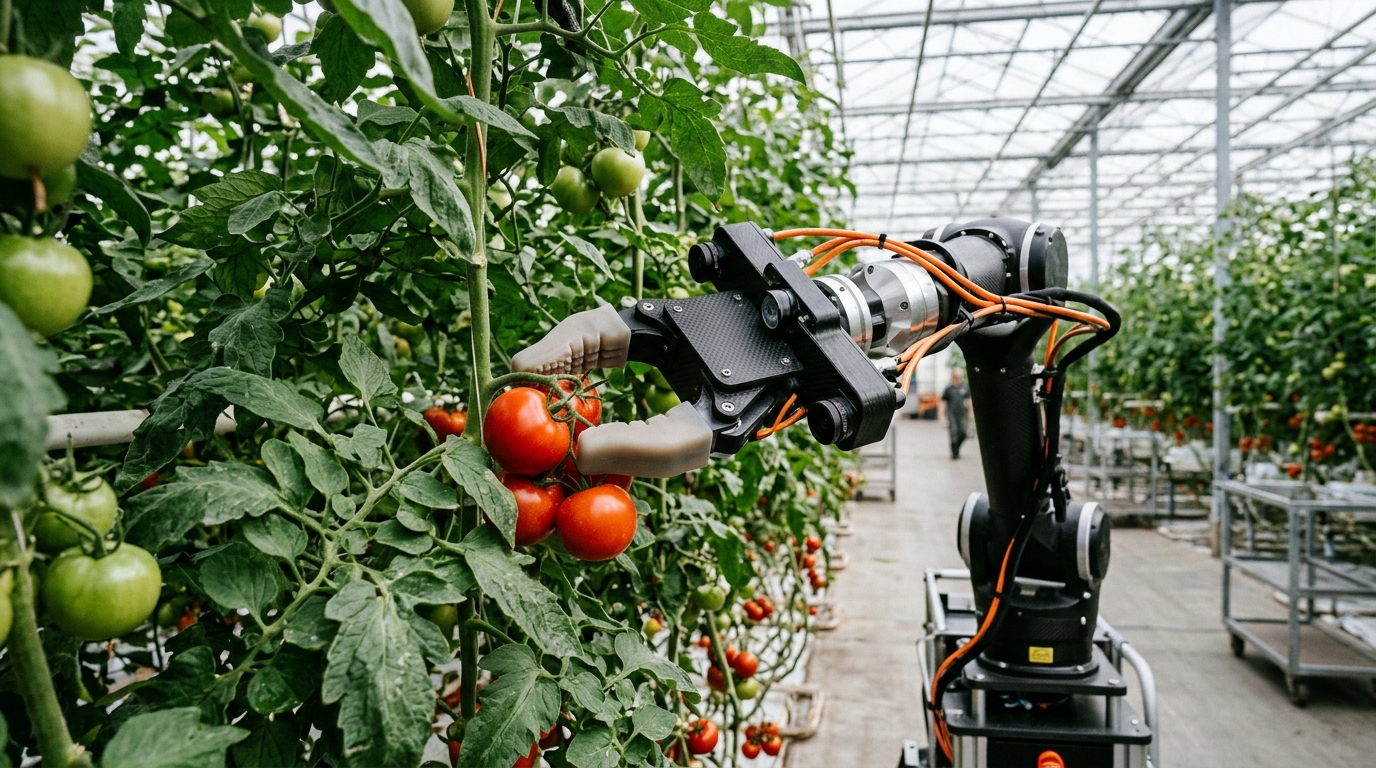
In a study published in the journal Frontiers in Robotics and AI, a research team from Yunnan Agricultural University and Kunming University of Science and Technology introduced an improved algorithm combining Rapidly-exploring Random Trees with an Artificial Potential Field mechanism to navigate Cartesian obstacle spaces. Operating in the three-dimensional task space of a harvesting end-effector, the novel method resolves long-standing inefficiencies associated with traditional random sampling algorithms, specifically their slow rate of convergence, high path redundancy, and erratic node dispersion. Across controlled simulation benchmarks and physical greenhouse trials, the proposed computational framework cut path planning durations by up to ninety-nine percent compared to standard baseline planners while generating smooth, collision-free trajectories. When transferred to a physical multi-jointed manipulator working inside an active cherry tomato greenhouse, the system achieved a one hundred percent obstacle-avoidance planning success rate under severe foliage and cluster occlusions that completely thwarted conventional exploratory algorithms.
The push toward autonomous picking systems has become increasingly urgent across global agriculture as commercial producers confront mounting labor shortages, an aging rural workforce, and rising operational costs. While modern computer vision and deep learning systems have made significant strides in detecting and spatially localizing small target fruits such as cherry tomatoes, translating spatial coordinates into reliable arm trajectories remains an acute technical hurdle.
Existing approaches to robotic manipulator trajectory generation are broadly bifurcated into global map-dependent algorithms and local obstacle avoidance techniques, each presenting distinct liabilities when applied to commercial greenhouse operations. Nature-inspired swarm algorithms, including ant colony optimization, carry severe computational complexity and readily stall in local mathematical extrema. Standalone Artificial Potential Field methods, while computationally lean and inherently goal-directed, frequently become trapped in local potential minima or suffer from repulsive force saturation when obstacles cluster near the target destination. Conversely, Rapidly-exploring Random Trees, known widely as RRT, excel at exploring continuous spaces without complete prior environmental models because they rely on incremental stochastic sampling. However, standard RRT and asymptotically optimal variants like RRT-star exhibit blind exploration patterns, meandering search trees, excessive redundant nodes, and irregular, jagged paths requiring heavy computational rewiring that strains embedded microprocessors.
To overcome these systemic bottlenecks, the research team structured an ultra-lightweight, single-tree directed exploration architecture that systematically curbs algorithmic randomness through coordinated mathematical interventions. The first layer introduces a goal-biased sampling heuristic directly into the primary random tree framework. Rather than distributing sample points uniformly across the entire configuration volume, the planner evaluates each iteration against a defined probability threshold of 0.50. When a randomly generated floating-point value exceeds this parameter, the algorithm automatically designates the exact coordinate of the target fruit as the next directional sample, focusing tree expansion directly toward the destination while retaining sufficient stochastic dispersion to circumnavigate intervening obstacles. This directed guidance significantly compresses the peripheral search volume, suppressing the generation of aimless exploratory branches that typically inflate memory consumption and planning latency in standard sampling-based planning frameworks.
The second core enhancement integrates an Artificial Potential Field directly into the tree expansion step to actively steer newly generated nodes around detected obstacles. When an initial candidate node is projected along an extension step size of 1.0 centimeter from the nearest existing tree node, the algorithm calculates synthetic gradient forces acting upon that spatial point. An attractive potential field pulls the candidate position toward the target tomato coordinate, while repulsive potential fields generated by surrounding obstacles push the point away from physical boundaries within a defined five-centimeter influence radius. By applying a potential force scaling factor of 0.03, the algorithm computes a corrected spatial position that balances directional pursuit with safe spatial clearance. If a corrected node encounters an obstacle boundary, the current expansion is safely discarded, and the tree samples anew. This blended mechanism prevents the search tree from colliding blindly into canopy structures while circumventing the terminal local minima traps that commonly cripple pure potential field systems.
To accelerate path closure and refine physical trajectory execution, the framework incorporates a greedy connection heuristic alongside an improved quadratic B-spline curve post-processing routine. Immediately following the successful registration of each corrected node, the greedy strategy executes a straight-line collision check between that node and the final goal point using a discrete sampling interval of 0.5 centimeters. If the intervening line segment remains entirely free of obstacles, the algorithm establishes an immediate direct link to the goal and terminates the search, eliminating hundreds of superfluous exploratory iterations. Because the resulting polygonal path inevitably contains sharp corners and abrupt directional shifts that would induce extreme mechanical jerk in physical robotic joints, the team implemented a specialized quadratic B-spline smoothing filter. By removing acute corner vertices and inserting replacement control points at exactly one-third of the step size along adjacent path segments, the smoothing algorithm guarantees continuous velocity and acceleration profiles within the local control polygon while rigorously observing a pre-established three-millimeter obstacle safety inflation margin.
The computational performance of the improved RRT-APF algorithm was initially evaluated through extensive numerical simulations executed in both two-dimensional and three-dimensional digital environments on an Intel Core i7-14700HX workstation running Python 3.10.9. Across fifty repeated trials in a two-dimensional simple obstacle environment, the improved algorithm generated valid paths in an average time of 0.012 seconds using an average of 47 sampling nodes, outperforming standard RRT, RRT-star, and pure APF by reducing planning times by 75.51 percent, 79.31 percent, and 52.00 percent, respectively. When the complexity was escalated to a challenging two-dimensional environment packed with 26 distinct obstacles, standalone APF failed completely due to repulsive force traps near the goal. In contrast, the hybrid RRT-APF algorithm converged reliably in 0.036 seconds with an average of 84 nodes, cutting average planning time by 29.41 percent compared to RRT and by 70.73 percent compared to RRT-star, while yielding an average path length of 28.883 centimeters.
Simulations conducted within three-dimensional task spaces revealed even more pronounced operational advantages, mirroring the complex spatial depth encountered by physical manipulators operating inside dense greenhouse rows. In three-dimensional simple obstacle configurations, the improved algorithm recorded an average planning duration of only 0.002 seconds and required just 18 sampling nodes. This marked a planning time reduction of 99.57 percent against RRT, 99.87 percent against RRT-star, and 85.71 percent against pure APF, alongside a node reduction exceeding 97 percent across all comparisons. In three-dimensional complex obstacle arrays, standard RRT required an average of 12.280 seconds and 6,839 nodes, while RRT-star consumed 17.663 seconds and 5,682 nodes. The proposed algorithm solved the identical complex environments in an average of 0.024 seconds using only 35 nodes, achieving a 99.80 percent and 99.86 percent reduction in computational duration while simultaneously decreasing planned path lengths by over twenty-six percent.
To validate the practical feasibility of the architecture in actual agricultural production, the researchers deployed the complete software pipeline onto a physical robotic harvesting platform operating inside an intelligent greenhouse at Yunnan Agricultural University. Operating among cherry tomato vines cultivated with a row spacing of 1.60 meters and canopy heights reaching 2.00 meters, the vision system captured localized spatial point clouds around target fruit clusters. The computational pipeline cropped a spherical region of interest with a 0.5-meter radius centered on the selected fruit, downsampled the point cloud using a voxel grid filter with a 0.04-meter leaf size, and modeled surviving skeleton points as four-millimeter bounding spheres with a three-millimeter safety margin to serve as repulsive obstacles for the real-time planner.
Physical trials conducted across thirty repeated iterations under two challenging harvest conditions—leaf occlusion and direct fruit cluster occlusion—definitively demonstrated the superiority of the hybrid algorithm under real-world operational constraints. In both occlusion regimes, baseline RRT and RRT-star algorithms failed entirely to synthesize a collision-free path before exhausting their 10,000-iteration cutoff threshold, recording a zero percent success rate across all thirty trials. The improved RRT-APF framework achieved an unblemished one hundred percent success rate, successfully transmitting valid, kinematically smooth waypoints to the internal motion controller of the AUBO-i5 manipulator in every run. Under fruit occlusion, the algorithm computed paths in an average of 0.069 seconds with 55 sampling nodes, resulting in an average physical manipulator movement duration of 3.45 seconds over a 0.323-meter trajectory. In more sprawling, irregularly shaped leaf occlusion scenarios, planning averaged 0.358 seconds with 149 nodes, producing an average arm travel time of 5.67 seconds over a 0.383-meter path.
Subject of Research: Robotic path planning algorithms for agricultural manipulators harvesting tomatoes in occluded environments
Article Title: Research on an improved RRT-APF path planning algorithm for tomato harvesting manipulators
Article References: Zhao, Y., Li, J., Hu, H., Wang, B., Xiang, K., Jiang, R., & Zhang, Y. (2026). Research on an improved RRT-APF path planning algorithm for tomato harvesting manipulators. Frontiers in Robotics and AI, 13, 1929636. https://doi.org/10.3389/frobt.2026.1929636
Image Credits: AI Generated
DOI: 10.3389/frobt.2026.1929636
Keywords: path planning, tomato harvesting, agricultural robotics, robotic manipulator, Rapidly-exploring Random Tree, Artificial Potential Field, goal-biased strategy, quadratic B-spline, obstacle avoidance, AUBO-i5 manipulator, point cloud processing, leaf occlusion, fruit occlusion, Cartesian task space, greedy connection heuristic, trajectory smoothing, greenhouse automation
News Source: Denise Maddox. (November 11, 2026). Hybrid Path Planning Algorithm Accelerates Robotic Tomato Harvesting in Complex Canopies. Scienmag.