Civil engineers evaluating concrete durability in extreme saline environments have demonstrated that mixing and curing concrete with hypersaline water drastically impairs its mechanical integrity and durability performance. In an experimental investigation testing sodium chloride concentrations ranging from 100 to 300 grams per liter, concrete cubes suffered compressive strength losses between 39 and 64 percent after 28 days of curing. The severe deterioration highlights the structural vulnerability of infrastructure exposed to inland salt lakes, coastal lagoons, and brines where salinity far exceeds that of typical seawater. Across all evaluated saline mixing and curing regimes, the resulting 28-day strengths fell considerably below standard structural design thresholds, showing that unmitigated Portland limestone cement concrete cannot maintain structural adequacy under such extreme brine exposure.
Coastal urbanization and industrial activity increasingly place infrastructure in environments subject to severe chemical aggression, including salterns, marshes, and hypersaline lakes such as the Dead Sea or the shallow acid-brine lakes of Western Australia where salt concentrations regularly reach between 50 and 400 grams per liter. While marine concrete research traditionally focuses on natural seawater containing approximately 35 grams per liter of dissolved salt, structural assets such as pipelines, roadways, and coastal tourism facilities in hypersaline regions face far more aggressive degradation mechanisms. Chemical interactions involving chloride ions trigger expansion, internal cracking, and loss of binding matrix cohesion. In the United States alone, the American Society of Civil Engineers reports that approximately 76 billion dollars is expended annually on retrofitting and rehabilitating concrete structures, underscoring the urgent necessity of understanding how elevated salt concentrations influence long-term structural viability.
To explore these degradation phenomena systematically, researchers prepared concrete mixtures using Portland Limestone Cement of grade 42.5 N conforming to BS EN 197-1:2011, combined with river sand passing a 2.36 millimeter sieve and crushed granite coarse aggregate with a nominal size of 12 millimeters sourced from Benin City, Nigeria. The fine aggregate exhibited a fineness modulus of 2.45, a coefficient of uniformity of 1.03, and a coefficient of curvature of 4.46, falling within standard specifications for well-graded natural sand. Coarse aggregate evaluation yielded an aggregate crushing value of 27.79 percent, satisfying the standard threshold of 30 percent for structural concrete. The concrete mix was designed using the DOE method targeting a 30 megapascal compressive strength, maintaining a fixed water-to-cement ratio of 0.50 with constituent proportions of 320 kilograms per cubic meter of cement, 160 kilograms per cubic meter of water, 518 kilograms per cubic meter of fine aggregate, and 1,400 kilograms per cubic meter of coarse aggregate.
The experimental matrix examined analytical-grade sodium chloride dissolved in mixing water at concentrations of 0, 10, 15, 20, and 30 percent by weight, corresponding to dissolved salt levels of 0, 100, 150, 200, and 300 grams per liter. Salt was added directly in addition to the batch water to preserve a constant effective water-to-cement ratio. Researchers evaluated three separate exposure configurations across 7, 14, and 28 days of curing at an ambient temperature of 26 degrees Celsius: saline mixing paired with freshwater curing, freshwater mixing followed by saline curing, and concurrent saline mixing and saline curing. Control specimens were mixed and cured in clean potable water. The testing regime captured fresh properties, including setting times via the Vicat apparatus, workability via the slump cone test, and bleeding behavior using ASTM C232 Method B consolidation on a vibrating table, alongside hardened property evaluations of compressive strength and water absorption.
Fresh paste consistency and setting tests revealed that salinity exerts a biphasic influence on cement hydration kinetics. In the control paste, initial and final setting times were 95 minutes and 182 minutes, respectively. Incorporating 10 percent and 15 percent sodium chloride accelerated early stiffening, reducing initial setting times to 70 and 76 minutes due to early hydration acceleration induced by chloride ions. However, increasing salinity to 20 percent and 30 percent reversed this behavior, causing initial setting times to prolong to 92 and 121 minutes and extending final setting times up to 300 minutes. Concrete slump measurements showed a progressive increase in workability with salinity, rising from 10 millimeters in the control mix to 13, 18, 22, and 38 millimeters at 10, 15, 20, and 30 percent salt. Although all mixes remained within the stiff S1 workability class of 10 to 40 millimeters, the enhanced flowability was attributed to salt dissolution expanding the liquid phase and improving interparticle lubrication.
Fresh concrete bleeding characteristics were similarly altered by salt content, reflecting significant changes in mix cohesion and rheology. Relative to the freshwater control bleeding value of 4.76 percent, mixes containing 10 percent and 15 percent salt demonstrated reduced bleeding rates of 3.08 percent and 3.36 percent, indicating that moderate ionic strength favored particle flocculation, early hydrate precipitation, and temporary water retention within the cement network. Conversely, bleeding increased back to 4.76 percent at 20 percent salt and surged to 6.44 percent at 30 percent salt. This excessive bleeding indicates that extreme ionic concentrations disrupt cement particle cohesion, elevating free water migration toward the specimen surface and increasing the likelihood of early settlement defects, plastic shrinkage, and weakened surface zones.
Compressive strength evaluations on hardened cubes demonstrated substantial, statistically significant strength losses across all saline exposure regimes. Control concrete cured in freshwater achieved a 28-day mean strength of 28.265 megapascals, increasing from 21.615 megapascals at 7 days. Specimens batched with saline water and cured in freshwater reached compressive strengths of only 17.258 megapascals at 100 grams per liter and 14.007 megapascals at 300 grams per liter, representing a 39 to 50 percent strength reduction relative to the control. Simultaneous saline mixing and saline curing caused even steeper declines, with 28-day strengths falling from 15.88 megapascals at 100 grams per liter to 10.325 megapascals at 300 grams per liter, marking an overall loss of nearly 64 percent. In all saline exposure cases, the resulting compressive strengths fell far short of the specified 30 megapascal target for structural concrete classification under BS EN 206 standards.
An anomalous behavior was identified at the 150 gram per liter salinity concentration across all exposure routes. In freshwater-cured concrete mixed with salt, the 150 gram per liter batch achieved the highest 28-day strength in its series at 17.802 megapascals. Similarly, freshwater-batched specimens cured in a 150 gram per liter brine recorded continuous strength progression up to 17.291 megapascals at 28 days, an outcome absent in all other saline-cured groups. Researchers attributed this localized peak to the formation of Friedel’s salt through the reaction of chloride ions with tricalcium aluminate phases in the cement matrix, which precipitates solid crystalline products that temporarily fill pore spaces and densify the microstructure. Beyond 150 grams per liter, the binding capacity of the aluminate phases is exceeded, allowing free chlorides to accumulate in pore fluids, disrupt calcium silicate hydrate stability, and suppress normal long-term strength gain.
Water absorption assessments conducted up to 96 hours illustrated how hypersaline exposure modifies concrete pore continuity and permeability. In freshwater-cured concrete, water absorption rose consistently with initial mix salinity, expanding from 1.974 percent in the freshwater control to 3.535 percent in the 300 gram per liter mix, signaling increased capillary connectivity. Saltwater-cured specimens exhibited a divergent response: absorption increased at 10 and 15 percent salinity but declined at 20 and 30 percent, with the 30 percent saltwater-cured specimens registering an absorption of 1.91 percent. Regression modeling in MATLAB confirmed distinct environmental mechanisms, showing a negative correlation between compressive strength and water absorption under freshwater curing with a determination coefficient of 0.706, contrasted with a positive correlation under saltwater curing with a determination coefficient of 0.885. This reduction in measurable absorption under severe brine curing reflects physical pore blocking from extensive internal salt crystallization rather than genuine microstructural refinement.
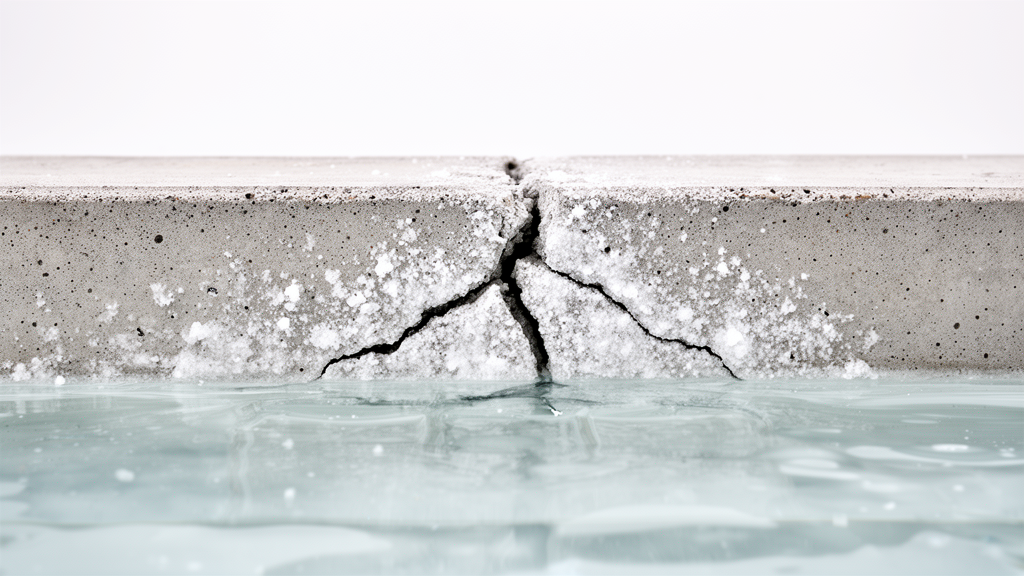
Visual examination of concrete specimens following exposure confirmed severe physical deterioration, displaying extensive surface scaling, darker coloration, persistent dampness, and uniform whitish powdery efflorescence across outer faces. The researchers emphasized key investigation boundaries, noting that internal degradation mechanisms such as Friedel’s salt precipitation, pore restructuring, and gel disruption were deduced from macroscopic physical and mechanical measurements rather than direct microstructural techniques such as scanning electron microscopy or X-ray diffraction. Furthermore, because testing was restricted to early ages up to 28 days, the findings do not capture multi-year field behavior. Consequently, the study concludes that mixing water salinity should remain strictly below 100 grams per liter and that unavoidable hypersaline exposure requires protective interventions, including waterproof surface barriers, supplementary cementitious materials, and blended freshwater sources.
Subject of Research: Mechanical and durability properties of concrete in hypersaline environments
Article Title: Mechanical and durability properties of concrete mixed and cured in hypersaline water
Article References: Falade, A. A., Nwankwo, E., Agboola, S. A., Mohammed, A. J., & Ujah, J. A. (2026). Mechanical and durability properties of concrete mixed and cured in hypersaline water. Discover Concrete and Cement, 2(1), Article 64. https://doi.org/10.1007/s44416-026-00099-9
Image Credits: AI Generated
DOI: 10.1007/s44416-026-00099-9
Keywords: concrete durability, hypersaline water, compressive strength, cement hydration, materials science, structural engineering, bleeding test, water absorption, Mechanical, durability, properties, concrete
News Source: Denise Maddox. (November 8, 2026). Hypersaline Water Severely Compromises Concrete Strength and Durability Properties. Scienmag.