Researchers have developed and validated an integrated piezoelectric sensor that monitors the stiffness of weak granular pavement subgrades under laboratory testbed conditions, offering a potential pathway toward continuous structural health tracking for transportation infrastructure. The system, termed the Subgrade Stiffness Monitoring sensor, pairs shear wave and compressional wave transducers to measure elastic wave velocities directly within sandy subgrade materials. Pavement foundations depend on the base, subbase, and subgrade layers to distribute vehicular wheel loads and ensure uniform structural support across roadway networks. When the underlying subgrade is weak or unevenly compacted, distresses such as permanent rutting and fatigue cracking frequently originate deep within the lower layers. Conventional pavement engineering uses the resilient modulus to evaluate the load-bearing capacity and construction quality of these foundational layers. However, existing field testing techniques cannot provide continuous, real-time measurements of foundation stiffness during service, presenting a major engineering challenge for modern roadway asset management.
Standard non-destructive field evaluation tools, including the Falling Weight Deflectometer and Heavy Weight Deflectometer, infer structural layer moduli indirectly by measuring surface deflections caused by an applied impulse load. These surface measurements rely on empirical back-calculation or statistical regression algorithms using non-standardized software tools, capturing only isolated temporal snapshots rather than tracking continuous environmental or structural changes over time. Other diagnostic devices, such as the GeoGauge, evaluate soil stiffness only within a shallow depth of influence, while techniques based on the Spectral Analysis of Surface Waves require complex computational inversion models based on numerous idealized subsurface assumptions. Moreover, conventional surface testing induces stress and strain conditions that differ fundamentally from the repeated, cyclic stresses applied by moving commercial vehicular traffic. To address these limitations, earlier research introduced the Bender Element field sensor to monitor unbound base and subbase aggregate layers continuously through elastic wave velocity measurements. While that device proved successful in dense-graded aggregate materials, its physical geometry and operational wave frequencies were unsuitable for the much finer particle sizes and markedly lower stiffness characteristic of subgrade soils.
To overcome this performance mismatch, the newly designed Subgrade Stiffness Monitoring sensor integrates two distinct piezoelectric transducer types into a dedicated modular housing configuration tailored specifically for granular subgrades. Piezoelectric ceramics deform when excited by an electric current and conversely produce an electric voltage when subjected to physical deformation. In the new monitoring unit, Bender Elements act as shear wave transducers, physically oscillating in a lateral cantilever motion when excited by an electrical voltage to transmit directional S-waves through the particulate matrix. Complementing these elements, Piezo Disc Elements consisting of a metal diaphragm bonded to a piezoceramic plate oscillate perpendicularly across their planar faces, generating compressional P-waves. While Bender Elements embed directly into the surrounding soil to achieve robust bilateral mechanical coupling, Piezo Disc Elements couple through flat-surface contact, which delivers lower overall acoustic energy into the medium. By miniaturizing the transducer dimensions to match the physical scale of sandy subgrade particles, the researchers established an integrated assembly capable of recording both shear and compressional wave propagation velocities simultaneously.
The physical scale of wave propagation through particulate materials governed the geometric optimization of the sensor assembly. When elastic wave propagation is evaluated in granular media, the relative spatial scale—defined as the ratio of acoustic wavelength to soil particle diameter—dictates whether the medium behaves as a continuous solid or scatters energy internally. Internal low-pass filtering, which causes significant attenuation and velocity decay, occurs when the internal scale of the soil medium approaches half the acoustic wavelength. To ensure that the soil mass acts as a continuum without wave disruption, the transmitted wavelength must remain substantially larger than the internal grain diameter, with theoretical guidelines recommending a wavelength at least twenty-five times the average particle size. In unbound base courses containing aggregate particles up to 20 millimeters in diameter, wavelengths exceeding 50 centimeters are required to avoid filtering, mandating large physical sensor spacings to prevent near-field signal interference. In sandy subgrades where particle sizes are orders of magnitude smaller, the required wavelengths decrease correspondingly, enabling a much more compact sensor frame that avoids near-field waveform distortion without compromising elastic continuum mechanics.
The research team conducted extensive large-scale validation experiments within a controlled laboratory soil testbed measuring 122 centimeters wide to optimize transducer dimensions and operating spacing under realistic placement conditions. The testbed was filled with a uniform dry sand classified as poorly graded sand under the Unified Soil Classification System and A-1-b under the AASHTO soil classification system. The test soil exhibited a median particle diameter of 0.74 millimeters, a coefficient of uniformity of 3.12, a coefficient of curvature of 0.9, an optimum moisture content of 9.4 percent, a maximum dry density of 1.92 grams per cubic centimeter, and an average California Bearing Ratio of 3.2 percent. The material was placed in three successive lifts to establish an 11-inch thick layer, achieving an in-place dry density of 1.78 grams per cubic centimeter, corresponding to 93 percent of maximum dry density, and an initial moisture content of 0.3 percent. Sensors were positioned centrally at a depth of 23 centimeters to eliminate wave reflections from the testbed boundaries, and six experimental geometric configurations were evaluated across transducer spacings spanning from 30 to 91 centimeters.
To assess signal transmission across different confinement conditions, five static loading increments ranging from 0 to 133 kilograms were applied uniformly across the testbed surface using a loaded wooden distribution plate. The excitation system delivered a 10-volt, 20-hertz square wave amplified by a linear amplifier by a factor of six to drive the source transducers, while receiving transducers fed signals through an analog band-pass filter and amplifier. To minimize random electrical noise, 1,024 individual signal cycles were stacked and averaged across each measurement sequence. The arrival times of propagating waveforms were determined using the first-break method, which identifies initial signal departure and demonstrates lower sensitivity to input frequency fluctuations than peak-to-peak matching techniques. At the shortest tested distance of 30 centimeters, the transmitted signal amplitude reached 239.8 millivolts for the embedded Bender Elements, compared to 15.1 millivolts for the surface-coupled Piezo Disc Elements, clearly demonstrating the contrasting mechanical energy transfer efficiencies between lateral cantilever oscillation and planar face vibration.
Signal quality analysis revealed that sensor spacing significantly influenced waveform interpretability. For the Bender Element shear wave measurements, maintaining a signal-to-noise ratio above 10 was essential for unambiguous identification of the first arrival break. Transducer separations of 61 centimeters and 91 centimeters produced signal-to-noise ratios below 10, rendering wave arrival detection unreliable in the loose granular sand due to rapid acoustic energy dissipation. In contrast, a 30-centimeter transducer spacing consistently generated shear wave signal-to-noise ratios well above 10 across all loading stages. For the Piezo Disc Elements, lower mechanical coupling efficiency restricted signal-to-noise ratios to values below 10 across all test geometries. However, because compressional P-waves propagate faster than all other wave modes in the soil mass, their initial arrivals are not obscured by precursor waveforms, allowing reliable identification at lower signal thresholds. Large 31-millimeter diameter Piezo Disc Elements positioned at a 30-centimeter spacing produced signal-to-noise ratios between 3 and 5, aligning with established seismological processing thresholds where a ratio of 5 decibels provides sufficient fidelity for first-arrival interpretation.
The simultaneous acquisition of shear and compressional wave velocities enabled the direct mathematical calculation of Poisson’s ratio and small-strain elastic modulus without relying on empirical approximations. In conventional Bender Element field assessments, Poisson’s ratio for unbound pavement foundation layers is routinely assumed to be a fixed constant of 0.35, introducing potential errors into subsequent modulus calculations. By calculating Poisson’s ratio directly from the measured ratio of compressional wave velocity to shear wave velocity, the integrated sensor yielded dynamically responsive values ranging from 0.30 to 0.45 across the static loading stages. Shear wave velocities combined with specimen density provided the small-strain shear modulus, which subsequently yielded the small-strain elastic modulus. As the static surface load increased from 0 to 133 kilograms, corresponding to the single-wheel contact load of a lightweight vehicle such as a motorcycle, small-strain modulus estimates increased moderately from 40 to 55 megapascals, accurately reflecting the stress-hardening behavior characteristic of granular soils under increasing confining pressure.
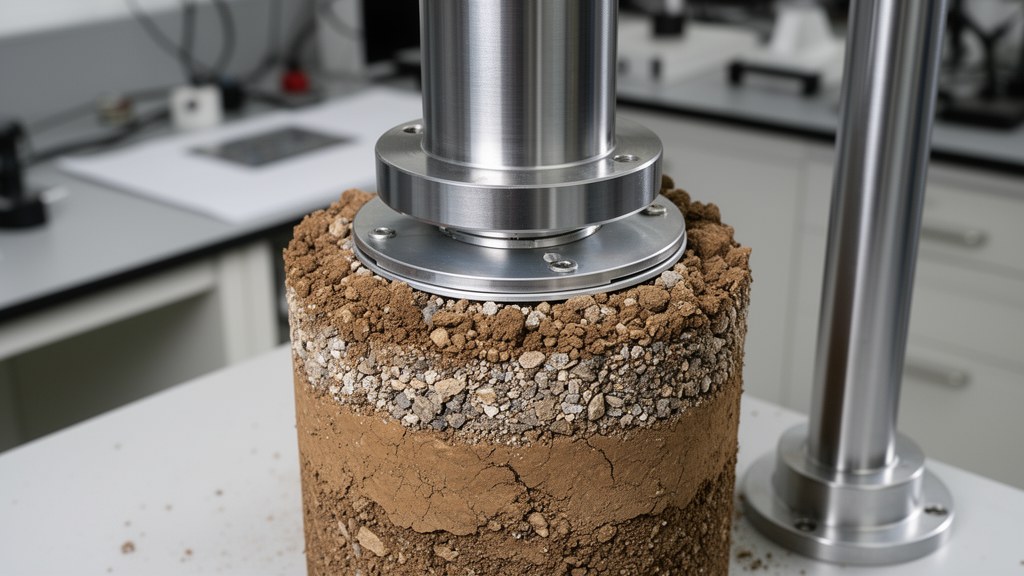
To bridge the operational gap between sensor-measured small-strain stiffness and the large-strain resilient modulus required for mechanistic-empirical pavement design, the authors conducted repeated load triaxial tests following the standard AASHTO T 307 protocol. Cylindrical sand specimens measuring 15.2 centimeters in diameter and 30.5 centimeters in height were compacted to 93.6 percent of maximum dry density and instrumented with two internal Linear Variable Differential Transformers to measure axial recoverable and permanent deformations. Two pairs of Bender Elements and one perpendicular pair of Piezo Disc Elements were embedded at the specimen mid-height. Following an initial conditioning sequence of 1,000 cycles, specimens underwent fifteen sequential loading stages comprising 100 repetitions each across bulk stresses spanning 83 to 690 kilopascals. S-wave and P-wave velocities measured at the conclusion of each stress stage confirmed high measurement repeatability, exhibiting an average velocity difference of 3.1 percent between parallel sensor pairs. Throughout 2,500 total load repetitions, the Bender Element signal amplitude decayed by only 11.4 percent, dropping from 1.600 volts to 1.417 volts, proving structural survivability under cyclic laboratory stress.
The repeated load triaxial test data established a precise power-law regression linking the high-strain resilient modulus directly to the sensor-derived small-strain elastic modulus. Because geotechnical materials experience non-linear modulus degradation as shear strain amplitudes increase, small-strain modulus values consistently exceeded the resilient modulus across all stress states. The experimental data exhibited an exceptional correlation fit, achieving a coefficient of determination of 0.9555 and a root-mean-square error of 14.18 megapascals. Testbed construction quality was verified using Dynamic Cone Penetrometer and GeoGauge tests, which indicated consistent surface moduli between 64 and 73 megapascals. The slightly higher moduli recorded by the surface GeoGauge reflected differences in measurement depth, static surface contact stress, and non-linear strain ranges compared to the embedded sensor at 23 centimeters depth. The authors noted that the current investigation evaluated only uniform dry sand under controlled static and triaxial conditions, excluding cohesive clays, silts, and variable moisture states. Consequently, recalibrating the empirical power-law relationship and conducting long-term field pavement trials across diverse soil types remain necessary steps before deploying the sensor technology in operational highway networks.
Subject of Research: Development and laboratory optimization of a piezoelectric subgrade stiffness monitoring sensor
Article Title: Development and optimization of a subgrade stiffness monitoring sensor using piezoelectric transducers in a laboratory testbed
Article References: Kang, M., Acharya, H., Wang, H., & Cahoon, H. R. (2026). Development and optimization of a subgrade stiffness monitoring sensor using piezoelectric transducers in a laboratory testbed. International Journal of Geo-Engineering, 17(1), Article 24. https://doi.org/10.1186/s40703-026-00285-5
Image Credits: AI Generated
DOI: 10.1186/s40703-026-00285-5
Keywords: pavement foundations, subgrade stiffness, piezoelectric transducers, bender elements, piezo disc elements, shear wave velocity, compressional wave velocity, Poisson's ratio, resilient modulus, small-strain modulus, repeated load triaxial test, granular subgrade, soil dynamics, non-destructive testing, signal-to-noise ratio, stress-hardening behavior
News Source: Denise Maddox. (November 20, 2026). Piezoelectric Sensor Measures Subgrade Soil Stiffness Directly in Laboratory Pavement Tests. Scienmag.