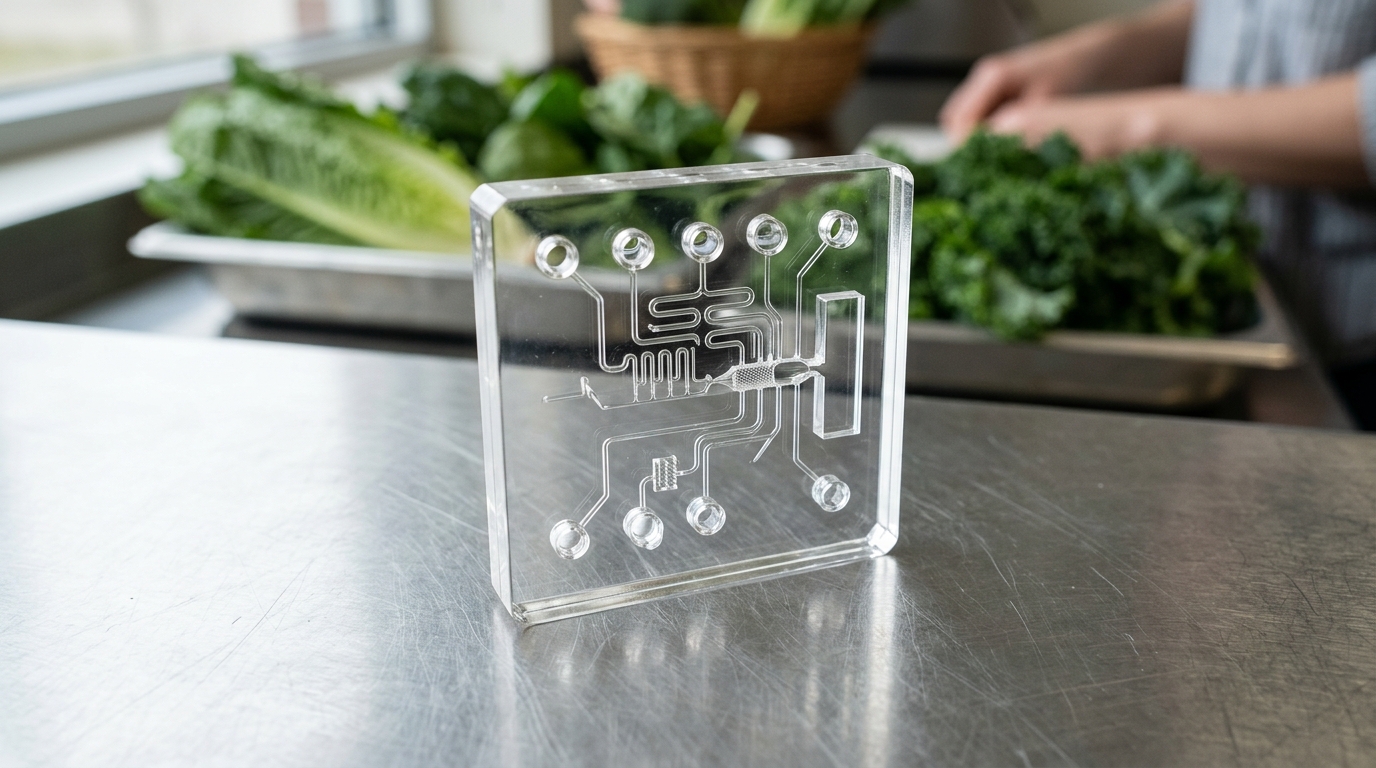
A comprehensive review published in Biotechnology for Sustainable Materials evaluates how integrating nucleic acid aptamers into microfluidic platforms addresses long-standing challenges in food contamination detection. Traditional food safety monitoring depends heavily on centralized laboratory methods such as microbiological culturing, high-performance liquid chromatography, gas chromatography, enzyme-linked immunosorbent assays, and polymerase chain reaction. Although these conventional analytical approaches deliver high analytical sensitivity, they remain time-consuming, expensive, and require transport of samples to central facilities where processing can span several hours to days. In response to the need for field-deployable tools that can prevent foodborne illness, researchers have increasingly developed microfluidic systems that miniaturize target-specific separation, rapid detection, and bioanalysis while maintaining minimal sample and reagent consumption.
Microfluidic devices achieve analytical efficiency through small physical dimensions, high surface-to-volume ratios, high-throughput capability, disposability, and cost-effectiveness. In food safety testing, these platforms allow for rapid analysis, reduced reagent usage, and multi-analyte processing suitable for on-site monitoring. The structural construction of microfluidic devices utilizes various fabrication materials depending on targeted analytical requirements. Traditional platforms commonly rely on glass and silicon, while polydimethylsiloxane has emerged for rapid prototyping and cost-effective chip assembly. Although polydimethylsiloxane offers manufacturing accessibility, its practical implementation faces hurdles including the absorption of small molecules, cumbersome user interfaces, and fabrication constraints. Additional materials explored for specialized food testing devices include acrylonitrile butadiene styrene, polylactic acid, polymethyl methacrylate, Lay-Felt, graphene-doped polylactic acid, microdiamond-doped acrylonitrile butadiene styrene, and polylactic acid combined with copper oxide nanoparticles.
To guarantee selectivity in complex food matrices, microfluidic systems require functional bioreceptors capable of distinguishing specific analytes. Commercial biosensors have historically relied on antibodies and enzymes, which carry several operational vulnerabilities. Antibodies are sensitive to fluctuations in pH, temperature, and redox conditions, exhibit notable batch-to-batch variation, and require costly, labor-intensive in vivo production pipelines. Furthermore, antibody test strips often exhibit shelf lives limited to 6 to 24 months and demand strict temperature control during storage and transport, complicating deployment in high-temperature or resource-limited environments. In conventional sandwich assay formats, identifying antibody pairs that bind distinct non-competing epitopes is particularly challenging for low molecular weight compounds with single epitopes. Furthermore, immunizing animals with toxic substances or non-immunogenic haptens cannot directly yield functional antibodies without complex chemical carrier conjugation.
In contrast to protein antibodies, nucleic acid aptamers offer chemical, structural, and logistical advantages that resolve key sensor design limitations. Aptamers consist of short single-stranded DNA or RNA oligonucleotides that fold into defined three-dimensional architectures to bind target molecules with high affinity and specificity. Synthesized chemically through in vitro Systematic Evolution of Ligands by Exponential Enrichment from libraries containing more than 10^14 distinct sequences, aptamers eliminate biological batch variation and remove the need to re-evaluate freshly prepared lots. Their synthetic nature permits high thermal stability, enabling automated refolding upon hydration after thermal denaturation and facilitating deployment under adverse field conditions. Aptamers also withstand wider ranges of pH and ionic strength, can bind targets within non-physiological environments such as urine or saliva, and can be split into complementary fragments to execute sandwich-format assays for single-epitope molecules without multi-antibody screening.
Surface immobilization represents another critical operational factor where aptamers outmatch conventional immunoglobulins on microfluidic substrates. Because aptamers are significantly smaller than antibodies, they achieve higher packing densities when functionalized onto gold nanoparticles or nitrocellulose membrane surfaces. Aptamer sequences can also be synthesized with site-specific chemical tags, such as terminal thiol groups for gold attachment or biotin moieties for streptavidin interactions, ensuring oriented immobilization without the structural heterogeneity caused by random lysine modifications in antibodies. Additionally, aptamer selection readily accommodates targets spanning low molecular weight chemicals, environmental pollutants, and heavy metals that fail to elicit animal immune responses. This synthetic versatility underpins multi-modal optical, fluorescent, and electrochemical detection methods that interface with microfluidic fluid manipulation.
The review details numerous implementations of aptamer-integrated microfluidic devices across major classes of foodborne microbial pathogens. For instance, researchers developed a microfluidic chip utilizing dumbbell-shaped aptamers selected through Cell-SELEX to detect Bacillus cereus vegetative cells and spores across diverse milk phases and rice samples, achieving a limit of detection of 9.27 CFU/mL within one hour. Another multiplexed colorimetric paper microfluidic platform incorporating gold nanoparticles and polystyrene microparticles quantified DNA hybridization for Escherichia coli O157:H7 and Salmonella Typhimurium across a 0.001 to 10 nM linear range, yielding detection limits of 10^3 CFU/mL and 10^2 CFU/mL, respectively. In seafood testing, an electrochemical aptasensor built from thread channels, nylon electrodes, and molybdenum disulfide nanosheets detected Vibrio parahaemolyticus down to 5.74 CFU/mL within 30 minutes across a span of 10 to 10^6 CFU/mL.
Microfluidic aptamer sensors have likewise demonstrated high diagnostic sensitivity when targeting dangerous food allergens in complex matrices. In one fluorometric paper-and-PDMS analytical device, aptamer-functionalized quantum dots paired with graphene oxide quenchers completed target detection within five minutes for seafood toxins and egg white lysozyme. For peanut allergen monitoring, a microfluidic system identified Ara h 1 using quantum dot-aptamer conjugates and graphene oxide-based fluorescence resonance energy transfer, recording a detection limit of 56 ng/mL within 10 minutes. An alternative paper-based electrochemical nano-aptasensor employing black phosphorus nanosheets detected Ara h 1 in spiked cookie dough down to 21.6 ng/mL over a 50 to 1000 ng/mL linear range in 20 minutes. Similarly, luminescent paper analytical devices designed for milk allergen beta-lactoglobulin utilized carbon quantum dot-labeled complementary DNA to achieve a 0.6 ng/mL detection limit in bakery and dairy items.
The detection of hazardous toxins in food commodities represents another critical domain advanced by microfluidic aptasensors. For mycotoxin analysis, a colorimetric paper device functionalized with gold nanoparticles detected aflatoxin B1 across a concentration window of 1 pM to 1 mM with a limit of detection reaching 10 nM. A dual-readout electrochemical and colorimetric paper device employing chitosan-functionalized MoS2-Au@Pt nanostructures detected ochratoxin A across linear ranges of 0.1 to 200 ng/mL by colorimetry and 0.0001 to 200 ng/mL electrochemically. Applying AC electrothermal enrichment combined with capacitive sensing on a printed circuit board array lowered the detection limit for aflatoxin B1 to 620 aM within 20 seconds, achieving a 2262-to-1 selectivity ratio over non-target interferences across a 1 fM to 10 pM testing range.
Aptamer microfluidics have also demonstrated utility in monitoring chemical residues, environmental contaminants, and veterinary drug residues in livestock products. A multi-target aptasensor integrated with microfluidics simultaneously tracked aflatoxin M1, 17beta-estradiol, and kanamycin in milk using magnetic beads, obtaining limits of detection of 0.95 pg/mL, 6.8 pg/mL, and 0.32 pg/mL, respectively, in under three minutes. For environmental monomers, an upconversion nanoparticle and gold nanoparticle FRET microfluidic platform quantified bisphenol A between 0.02 and 100 ng/mL, reaching a 0.014 ng/mL detection boundary. Additionally, paper microfluidic strips functionalized with Cy5-labeled aptamers and graphene oxide identified silver ions, mercury ions, and neomycin residues in food samples with detection limits of 47 nM, 121 nM, and 153 nM, confirming the broad applicability of synthetic bioreceptors for low molecular weight chemical contaminants.
Despite substantial analytical advantages, the review highlights technical bottlenecks that currently restrict widespread commercial translation of microfluidic aptasensors. A major constraint remains the difficulty in executing simultaneous multi-analyte identification through distinct, non-overlapping signal peaks on single chips. Furthermore, many current microfluidic configurations function primarily as single-use disposable devices, requiring expanded device architectures to accommodate multiplexed screening. The authors emphasize that bridging these gaps requires discovering new high-affinity aptamer sequences, developing multifunctional sorbents for selective multicomponent extraction, refining 3D printing for innovative device supports, and integrating alternative nanomaterials such as cobalt, nickel, and silica nanoparticles to advance sustainable, on-site food safety control.
Subject of Research: Aptamer-based microfluidic devices for food safety analysis and contamination detection
Article Title: Application of microfluidic device based on aptamer for the determination of food contamination; recent progress and challenges
Article References: Adampourezare, M., Nikzad, B., & Roshangar, L. (2025). Application of microfluidic device based on aptamer for the determination of food contamination; recent progress and challenges. Biotechnology for Sustainable Materials, 2(1), Article 7. https://doi.org/10.1186/s44316-025-00030-5
Image Credits: AI Generated
DOI: 10.1186/s44316-025-00030-5
Keywords: food safety, microfluidics, aptamers, biosensors, food contamination, pathogen detection, mycotoxins, lab-on-a-chip, Application, microfluidic, device, based
News Source: Gregory Coleman. (November 8, 2026). Aptamer Microfluidic Devices Advance Portable and Rapid Food Contamination Testing. Scienmag.