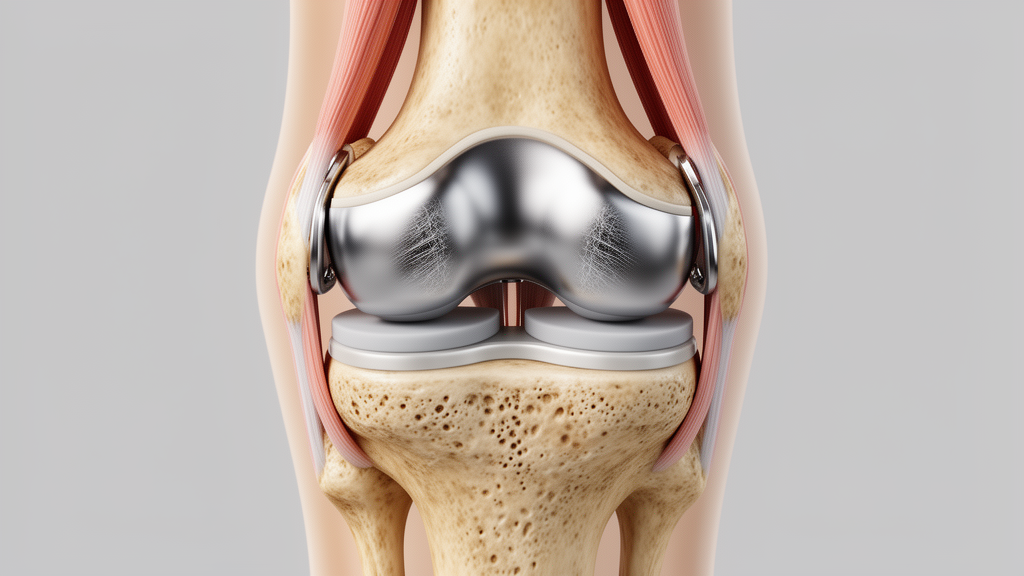
Researchers conducted an in vitro wear simulation study to investigate how coronal alignment-related mediolateral load distribution affects polyethylene wear in a specific medial-pivot total knee arthroplasty design. The study, published in the Archives of Orthopaedic and Trauma Surgery, utilized a standardized knee wear simulator to test three distinct loading conditions representing neutral, varus, and valgus overall lower-limb alignment. The primary objective was to determine whether these alignment-related changes in load distribution would alter the magnitude and pattern of polyethylene wear, a critical factor in the long-term survival of knee implants.
Total knee arthroplasty aims to restore function to damaged knee joints, with mechanical alignment traditionally targeting a neutral hip-knee-ankle angle. More recent approaches, such as kinematic alignment, preserve the native joint line and may allow for residual varus or valgus alignment. While these individualized strategies are increasingly common, their specific impact on the wear of the polyethylene insert, which acts as the cushion between the metal components, has not been fully characterized. Understanding this relationship is essential for optimizing implant design and surgical technique to ensure durable outcomes.
The study employed the MS 5C® medial pivot total knee implant system, featuring a single-radius femoral component and a fixed-bearing insert with medial congruency and a flat lateral compartment. Twelve implants were tested in a servo-hydraulic knee wear simulator, with three dynamically loaded inserts and one load-soak control for each of the three alignment conditions. The testing protocol followed ISO 14243-1:2009, simulating level walking over five million cycles to replicate the cumulative loading experienced in daily life.
To replicate the mediolateral load distributions associated with different alignments, custom 3D-printed positioning guides were used during the embedding process. These guides positioned the tibial tray at specific mediolateral offsets relative to the loading axis, without altering the coronal rotation of the components. The neutral condition represented a 60% medial and 40% lateral load share, the varus condition a 70% medial and 30% lateral share, and the valgus condition a 50% medial and 50% lateral share. These distributions were based on established biomechanical models of lower-limb alignment.
The results indicated a numerical trend in wear rates among the groups, although the differences did not reach statistical significance. The varus-related load distribution demonstrated the lowest overall wear rate at 4.83 ± 1.06 mg per million cycles, while the valgus group produced the highest wear rate at 9.43 ± 1.47 mg per million cycles. The neutral group showed an intermediate wear rate of 6.81 ± 3.07 mg per million cycles. Statistical analysis using the Kruskal-Wallis test confirmed that these differences were not statistically significant, with a p-value of 0.113.
Visual inspection of the inserts revealed distinct wear patterns corresponding to the loading conditions. All groups exhibited medial-dominant wear, consistent with the physiological predominance of medial loading during gait. However, the valgus group showed increased lateral wear compared to the other groups. The varus group had the smallest overall visible wear areas on both the topside and backside of the inserts. No delamination or pitting was detected in any of the specimens, and only small, narrow scratches were observed on the metallic components.
The observed wear rates fall within the range reported for force-controlled knee wear simulator studies using highly cross-linked polyethylene. The specific geometry of the medial-pivot design may explain the wear patterns observed. The highly congruent medial compartment distributes load over a large contact area with low contact stress, while the flat lateral compartment allows for greater sliding motion. Under valgus loading, the increased lateral load acts on this less congruent surface, potentially leading to higher wear due to cross-shear motion.
Under varus loading, the load is concentrated on the more congruent medial compartment, which may result in lower overall wear despite the higher local medial load. The neutral and valgus conditions distribute load more evenly, allowing wear to accumulate on both compartments. This suggests that the interaction between alignment-related load distribution and implant geometry plays a significant role in determining wear outcomes. The findings highlight the importance of considering both alignment and implant design when evaluating long-term implant performance.
The study has several limitations that should be considered when interpreting the results. The small sample size of three dynamically loaded specimens per condition limits the statistical power, and the absence of statistical significance should not be interpreted as evidence of equivalence between the groups. The in vitro conditions do not replicate the full complexity of the in vivo environment, including the influence of soft tissues and ligaments on joint kinematics. Additionally, the findings are specific to the tested implant design and may not directly translate to other geometries.
Despite these limitations, the study provides valuable insights into the biomechanical effects of coronal alignment on polyethylene wear in medial-pivot total knee arthroplasty. The numerical trend toward higher wear under valgus-related loading warrants further investigation, particularly in implant designs with flat lateral tibial surfaces. Future studies with larger sample sizes, different implant designs, and more comprehensive models of clinical alignment strategies are needed to determine the clinical relevance of these observations. This research contributes to the growing body of evidence supporting the need for individualized alignment strategies in total knee arthroplasty.
The study was explicitly designed to isolate the effect of mediolateral load distribution by testing three predefined, controlled loading conditions. The experimental setup did not reproduce the full complexity of clinical kinematic or functional alignment strategies, where component positioning, joint-line orientation, soft-tissue balance, and gap balancing may vary simultaneously. Consequently, the findings reflect the isolated effect of load distribution rather than the overall impact of a specific clinical alignment strategy. The accuracy and reproducibility of the custom 3D-printed positioning guides were not quantitatively validated by measuring the deviation between the predefined and achieved mediolateral position, which represents an additional methodological limitation. Other combinations of tibial and femoral component positioning, such as femoral component rotation, were deliberately kept constant to avoid confounding factors. In a clinical setting, such additional variations in component positioning could further influence load distribution and potentially exacerbate polyethylene wear beyond what was modeled in this in vitro study.
The original hypothesis that both varus- and valgus-related load distributions would result in higher wear than the neutral condition was not supported by the data. The observed wear rates fall within the range reported for force-controlled knee wear simulator studies using conventional and highly cross-linked ultra-high molecular weight polyethylene. This range spans approximately 3 to 40 mg per million cycles for cruciate-retaining total knee arthroplasty designs and about 2 to 33 mg per million cycles for posterior stabilized designs. Wear rates toward the lower end of this range are typically reported for highly cross-linked polyethylene, while conventional, non-cross-linked inserts tend to produce wear rates at the upper end. The values in this study are consistent with the expected performance of vitamin E-stabilized, cross-linked ultra-high molecular weight polyethylene, which was used in the tested inserts.
Comparable studies using similar experimental designs have reported different outcomes. In one study involving a medial fixed-bearing unicompartmental design, five degrees of varus or valgus tibial component positioning significantly reduced wear compared with neutral alignment. That study attributed the reduction to a decreased articulation contact area under the altered alignment condition. Earlier cadaveric and simulator work has demonstrated that pressure distribution and total load across the medial and lateral tibial surfaces change significantly with as little as three degrees of coronal component angulation. In a mobile-bearing simulator study testing one to three degrees of alteration in tibial component alignment, researchers concluded that deviations up to three degrees remained within an acceptable range of in vitro tolerability, whereas larger deviations produced unacceptable loading conditions. These findings support three degrees as an approximate threshold beyond which coronal deviations begin to meaningfully alter tibiofemoral load transmission, consistent with the magnitude of overall lower-limb alignment represented by the loading conditions in the present study.
Another study reported comparable wear rates between kinematically and mechanically aligned components using a cruciate-retaining design. In that setup, the femoral component was tilted by four degrees relative to the tibial resection plane to simulate the joint-line obliquity typical of kinematic alignment, while the overall mechanical loading axis of the simulator was kept unchanged. Consequently, the knee adduction moment itself was not directly altered, and the model isolated the effect of component-level joint-line tilt rather than a shifted mediolateral load distribution. Despite this methodological difference, that study also observed a trend toward reduced wear under the tilted, non-neutral alignment condition relative to neutral alignment. These varied results highlight the complexity of interpreting alignment effects in total knee arthroplasty, where different biomechanical variables may interact in ways that are difficult to isolate in a single experimental setup.
The qualitative visual assessment indicated greater medial than lateral wear across all groups, reflecting the physiological predominance of medial loading during gait. In vivo instrumented-implant data confirm that the medial compartment typically transmits a greater share of the tibiofemoral contact force than the lateral compartment across the majority of the gait cycle, largely independent of overall limb alignment. This is consistent with the medial-dominant loading pattern assumed even in the neutral condition, where 60 percent of the load is borne medially and 40 percent laterally. The specific geometry of the tested medial-pivot design may contribute to this observation. The highly congruent, ball-in-socket medial compartment distributes load over a large contact area with correspondingly low contact stress, while the comparatively flat lateral tibial surface permits greater anteroposterior and rotational sliding of the femoral condyle.
This distinction matters because polyethylene wear is driven disproportionately by cross-shear motion, defined as sliding transverse to the predominant direction of motion, rather than by contact pressure alone. Under the valgus-related load distribution, the increased lateral load acts on the compartment that is both less congruent and potentially subject to greater cross-shear motion, which may explain the more extensive visually observed wear in this group. Under the varus-related load distribution, by contrast, load is concentrated on the more congruent, lower-shear medial compartment, while the lateral compartment is relatively offloaded. This is consistent with the qualitatively smaller visible wear areas observed in this group despite the higher local medial load. The neutral and valgus-related load distributions distribute load more evenly across both compartments, allowing wear to accumulate on both the high-shear lateral and the high-congruence medial surface, which may contribute to the numerically higher total material loss observed in these conditions.
These patterns are consistent with other research indicating that altered alignment conditions did not necessarily increase total wear but rather redistributed it between compartments. However, other studies have shown that residual varus alignment can still lead to progressive polyethylene damage over time in vivo, likely reflecting the persistence of an elevated knee adduction moment even after surgical correction. The current study simulated level walking according to the ISO 14243-1:2009 protocol, which has been shown to account for the majority of the cumulative loading cycles experienced by the knee joint in daily life. Higher load activities such as stair climbing or sports could reveal additional wear patterns and risks that are not captured by the walking simulation alone. The findings are specific to the implant design tested and may not directly translate to other geometries, although medial pivot geometries are the design most commonly paired with kinematic and functional alignment concepts in current clinical practice.
Subject of Research: Coronal alignment-related mediolateral load distribution and polyethylene wear in a medial-pivot total knee arthroplasty design
Article Title: Coronal alignment-related mediolateral load distribution and polyethylene wear in a medial-pivot total knee arthroplasty design
Article References: Lesnicar, C., Kistler, M., Thorwächter, C., Tural, I., Simon, J.-M., Niethammer, T. R., Holzapfel, B. M., & Woiczinski, M. (2026). Coronal alignment-related mediolateral load distribution and polyethylene wear in a medial-pivot total knee arthroplasty design. Archives of Orthopaedic and Trauma Surgery, 146(1), Article 388. https://doi.org/10.1007/s00402-026-06558-z
Image Credits: AI Generated
DOI: 10.1007/s00402-026-06558-z
Keywords: Coronal, alignment-related, mediolateral, load, distribution, polyethylene, wear, medial-pivot, total, knee, arthroplasty, design
News Source: Ophelia Keating. (November 7, 2026). Knee Alignment Shifts Wear Patterns in Medial Pivot Implants. Scienmag.